CM Yogi Pushes Temple Corridor Drive in Ghaziabad, Baghpat
Synopsis
The Chief Minister's Office of Uttar Pradesh confirmed on 17 July 2026 that grand corridor projects are in progress at the Doodheshwarnath Temple in Ghaziabad and the Pura Mahadev Temple in Baghpat, with the Baghpat site also receiving a grand Adiyogi statue, extending CM Yogi's state-wide temple infrastructure drive.
Key Takeaways
Grand corridor construction is in progress at the Doodheshwarnath Temple in Ghaziabad , confirmed by the CM's Office on 17 July 2026 .
The Pura Mahadev Temple in Baghpat will receive both a grand corridor and a grand Adiyogi statue .
Both projects extend CM Yogi Adityanath 's temple corridor programme, which began with the Kashi Vishwanath Corridor in Varanasi in 2018 .
The initiative targets western Uttar Pradesh and the NCR hinterland, regions with large urban pilgrim populations.
Local traders, pilgrims, and the broader religious tourism ecosystem in Ghaziabad and Baghpat are the primary stakeholders.
Completion timelines and budgets for both corridors remain officially undisclosed.
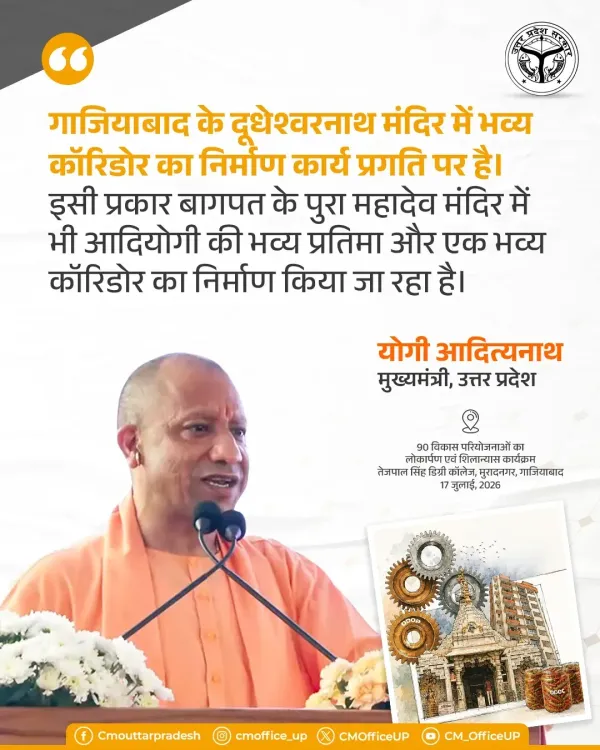
The Chief Minister's Office of Uttar Pradesh announced on Friday, 17 July 2026 that grand corridor construction is underway at two historic Shiva temples — Doodheshwarnath Temple in Ghaziabad and Pura Mahadev Temple in Baghpat — with the Baghpat site also set to receive a grand Adiyogi statue.
Context
The official post, attributed to Chief Minister Yogi Adityanath, states: 'Ghaziabad ke Doodheshwarnath Mandir mein bhavy corridor ka nirman karya pragati par hai' ['Grand corridor construction work is in progress at Ghaziabad's Doodheshwarnath Temple']. It further notes that at Baghpat's Pura Mahadev Temple, both a grand Adiyogi statue and a corridor are being built.
The Doodheshwarnath Temple is one of Ghaziabad's most revered Shiva shrines, drawing large numbers of devotees particularly during Sawan and Mahashivratri. The Pura Mahadev Temple in Baghpat holds similar regional significance as an ancient Shiva pilgrimage site in western Uttar Pradesh.
Policy Backdrop
The announcements fit squarely within a sustained religious infrastructure programme that the Uttar Pradesh government has pursued since 2017. The flagship Kashi Vishwanath Corridor, launched in 2018 in Varanasi, set the template: widen temple precincts, improve pilgrim amenities, and integrate the site into a broader tourism circuit.
Subsequent corridor projects were announced in Ayodhya and Mathura, extending the model beyond Varanasi. The Ghaziabad and Baghpat projects represent the next layer of that expansion — pushing the corridor drive into the National Capital Region hinterland and western Uttar Pradesh, regions with large urban and semi-urban pilgrim populations.
The addition of an Adiyogi statue at Pura Mahadev echoes a pattern seen at other Shiva-centric sites across India, where large iconographic installations have been used to anchor new pilgrimage destinations and generate media visibility for the site.
Stakeholders and Impact
Pilgrims visiting both temples stand to benefit from improved access, better facilities, and expanded precincts once construction is complete. Local traders and hospitality businesses in Ghaziabad and Baghpat are the other primary beneficiaries, as corridor projects have historically driven footfall and commercial activity around temple zones.
The projects also carry cultural significance for communities in western Uttar Pradesh, where both temples serve as focal points for festivals and daily worship. Heritage conservation is an implicit objective, as corridor construction typically involves clearing encroachments and restoring the immediate environs of historic shrines.
What's Next
Completion timelines and project budgets for both corridors have not been officially disclosed. The Uttar Pradesh state tourism department's tracking of pilgrim footfall at completed corridor sites — particularly Varanasi — will be a key benchmark for assessing whether the Ghaziabad and Baghpat investments yield comparable returns. Any formal inauguration by CM Yogi Adityanath would likely be accompanied by state-level religious tourism data, offering a clearer picture of the programme's cumulative impact.
Point of View
Upwardly mobile Hindu population — suggests the government is calibrating religious tourism investment to also serve electoral geography. The addition of an Adiyogi statue at Pura Mahadev follows a proven formula: large iconographic installations amplify media coverage and draw first-time visitors, effectively marketing lesser-known pilgrimage sites to a national audience. Whether the Ghaziabad and Baghpat corridors replicate the footfall gains seen at Kashi will be the real test of the programme's scalability.
NationPress
16 Oct 2026
Frequently Asked Questions
What is being built at Doodheshwarnath Temple in Ghaziabad?
A grand corridor is currently under construction at the Doodheshwarnath Temple in Ghaziabad , as confirmed by the Chief Minister's Office of Uttar Pradesh on 17 July 2026 .
What is the Pura Mahadev Temple Baghpat corridor project?
The Uttar Pradesh government is constructing a grand corridor and a grand Adiyogi statue at Pura Mahadev Temple in Baghpat , as part of CM Yogi Adityanath 's state-wide religious infrastructure programme.
What is the Adiyogi statue being built in Baghpat?
An Adiyogi statue — a large iconographic representation of Lord Shiva as the first yogi — is being installed at Pura Mahadev Temple in Baghpat , alongside a grand corridor, as part of the site's redevelopment.
What other temple corridors has CM Yogi built in Uttar Pradesh?
CM Yogi Adityanath launched the Kashi Vishwanath Corridor in Varanasi in 2018 and subsequently announced corridor projects in Ayodhya and Mathura , forming a state-wide religious tourism infrastructure programme.
When will the Ghaziabad and Baghpat temple corridors be completed?
Official completion timelines for the Doodheshwarnath Temple corridor in Ghaziabad and the Pura Mahadev Temple corridor in Baghpat have not yet been disclosed by the Uttar Pradesh government .