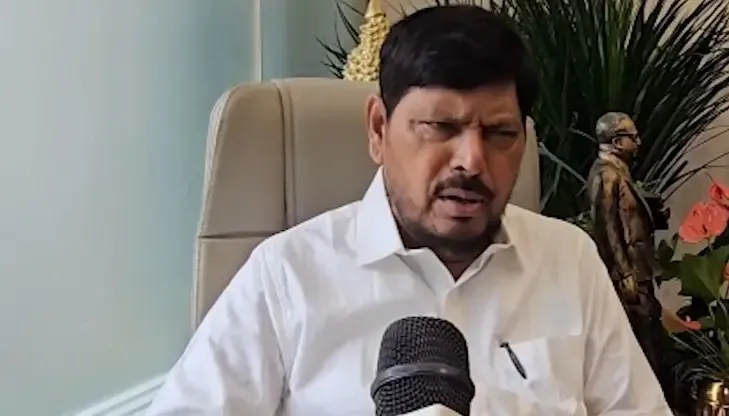
Athawale questions Opposition's 'vote theft' claims over electoral roll SIR row
Synopsis
Union Minister Ramdas Athawale turned the Opposition's 'vote theft' argument on its head with a pointed question: if electoral irregularities explain unfavourable results, should the NDA have cried foul when it missed Modi's '400 paar' target? The remark reframes the SIR protest row as political opportunism — and signals the ruling alliance will go on offence, not retreat.
Key Takeaways
Union Minister Ramdas Athawale on 22 October said the Opposition has the right to protest over the Special Intensive Revision (SIR) of electoral rolls but cannot use protests to change a government.
Athawale questioned the Opposition's 'vote theft' narrative, asking why the NDA did not make the same allegation after falling short of Prime Minister Narendra Modi 's 400-plus seat target.
The NDA secured 237 seats in the 2024 Lok Sabha elections against a declared target of over 400 .
Athawale named Sanjay Raut specifically, dismissing past predictions of the government's fall as unfulfilled.
Ambedkar 's Constitution to argue that government change in India is possible only through elections, contrasting India explicitly with Bangladesh .
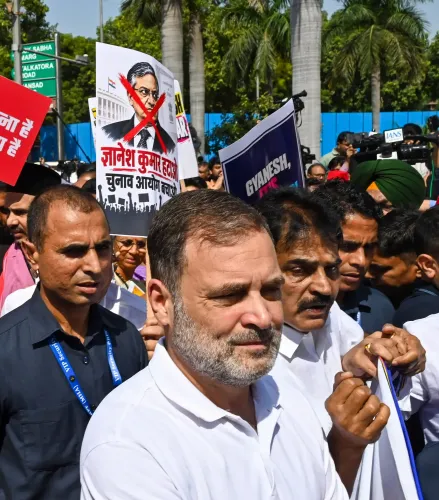
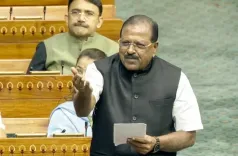
Union Minister Ramdas Athawale on Thursday, 22 October defended the Opposition's right to hold peaceful protests over alleged irregularities in the Special Intensive Revision (SIR) of electoral rolls, but sharply questioned the logic behind their 'vote theft' narrative — asking whether the BJP-led National Democratic Alliance (NDA) should make the same allegation after falling short of its 400-seat target in the 2024 Lok Sabha elections.
The SIR Controversy and Opposition Protests
The Opposition has raised concerns about the accuracy of electoral rolls under the SIR process, alleging bogus voting and the wrongful deletion of legitimate voters' names. Athawale acknowledged these concerns as legitimate areas of scrutiny. 'If their demand is legitimate, that vote theft occurred or that SIR is not right, their stance is that the electoral roll must be correct, and bogus voting or wrongful deletion of voters should not happen,' he said.
However, he drew a sharp distinction between raising procedural concerns and using those concerns as a political instrument to challenge the government's legitimacy. Demonstrations, he argued, cannot substitute for the democratic process.
Athawale's '400 Paar' Counter-Question
Athawale turned the Opposition's logic back on the ruling alliance, pointing to Prime Minister Narendra Modi's ambitious pre-election target of winning more than 400 seats. The NDA ultimately secured 237 seats — well short of that goal. 'When PM Modi announced the '400 paar' goal and we didn't achieve that many seats, should we accuse them of stealing votes to get more seats?' he asked. He alleged that the Opposition 'simply has no other issue' and invents excuses to sustain its protest momentum.
Criticism of Opposition Leaders
Athawale also took aim at specific Opposition figures, dismissing what he described as repeated, unfulfilled predictions about the government's collapse. He specifically named Sanjay Raut, saying, 'Even earlier, Sanjay Raut used to say that the government would fall in 2024, but there was no possibility or indication of the government falling.' He characterised the Opposition as 'completely restless, unstable and agitated' over the electoral outcome, alleging that 'immense arrogance has built up in their minds.'
Constitutional Framework and the Bangladesh Contrast
Invoking the Constitution drafted under the leadership of Dr B.R. Ambedkar, Athawale reiterated that governments in India change only through elections held every five years — not through street protests. He drew an explicit contrast with Bangladesh, where mass demonstrations led to a government change, stating that India's constitutional framework makes such an outcome impossible here. 'It is not Bangladesh, it is India. And there is the Constitution of India. But regime change is not possible through protests,' he said.
What This Signals
The remarks come as the Opposition's anti-SIR campaign gains traction ahead of upcoming state assembly elections, making the electoral roll row a politically charged flashpoint. Athawale's counter-narrative — reframing the protest as political desperation rather than democratic accountability — signals that the ruling coalition intends to go on the offensive on the issue rather than engage it only defensively.
Point of View
Which the minister sidestepped, is whether the Election Commission's revision process has systemic safeguards against wrongful deletions — a concern that cuts across party lines. The Bangladesh comparison also deserves scrutiny: India's constitutional resilience is not in question; the Opposition's ask is for administrative accountability, not regime change by protest. Conflating the two may energise the base but does little to resolve the underlying electoral roll dispute.
NationPress
22 Oct 2026
Frequently Asked Questions
What is the Special Intensive Revision (SIR) of electoral rolls?
The Special Intensive Revision (SIR) is a periodic process by the Election Commission of India to update and clean electoral rolls, adding eligible new voters and removing those who are deceased or have migrated. The current controversy centres on Opposition allegations that the process has led to bogus voter additions and wrongful deletions of legitimate voters' names.
What did Ramdas Athawale say about Opposition protests over SIR?
Athawale said the Opposition has every right to hold peaceful meetings and protests over the SIR issue, but argued that demonstrations cannot be used to force a change of government. He questioned the 'vote theft' allegation by asking whether the NDA should have made the same claim after missing its 400-plus seat target in 2024.
How many seats did the NDA win in the 2024 Lok Sabha elections?
The NDA secured 237 seats in the 2024 Lok Sabha elections, falling short of Prime Minister Narendra Modi's pre-election target of winning more than 400 seats.
Why did Athawale mention Bangladesh in his remarks?
Athawale invoked Bangladesh to underline that India's constitutional framework prevents regime change through street protests. He was responding to Opposition-led agitations, arguing that India, unlike Bangladesh, has a written Constitution that mandates governments change only through elections held every five years.
Who is Sanjay Raut and why did Athawale name him?
Sanjay Raut is a senior leader of the Shiv Sena (UBT) and a prominent Opposition voice. Athawale cited him as an example of Opposition leaders who have repeatedly predicted the NDA government's collapse — predictions he said have consistently failed to materialise.