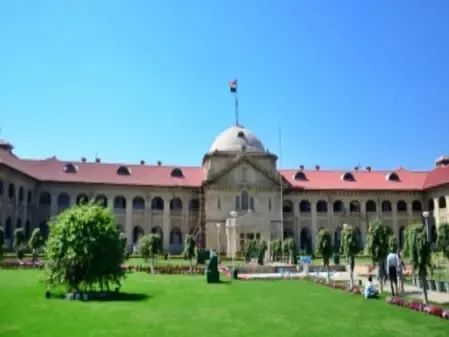
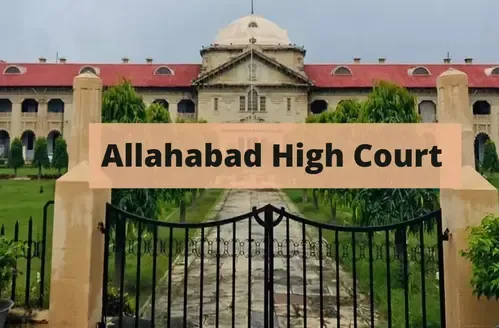
Allahabad High Court Grants Bail to Man for Controversial Instagram Post After Pahalgam Attack

Synopsis
In a pivotal ruling, the Allahabad High Court has allowed bail for an individual accused of sharing a controversial post related to the Pahalgam terrorist attack, raising questions about freedom of expression in sensitive times.
Key Takeaways
Bail granted to man accused of controversial post.
Post made after a deadly terrorist attack.
Court emphasized the importance of balancing freedom of speech and national security.
Conditions for bail include cooperating with the trial and avoiding objectionable social media content.
Release order to be processed for prompt execution.
New Delhi/Prayagraj, Feb 27 (NationPress) The Allahabad High Court has granted bail to an individual accused of posting on Instagram with the phrase “Pakistan Zindabad” right after the terrorist attack in Pahalgam, Kashmir, which resulted in the deaths of 26 people, including 25 tourists and a local resident.
A single-judge Bench led by Justice Arun Kumar Singh Deshwal made the decision to release Faizan, who was arrested in relation to an FIR filed under Sections 196(1), 152, and 318(4) of the Bharatiya Nyaya Sanhita (BNS) at the Jalesar Police Station in Etah district.
The prosecution alleged that the applicant uploaded the controversial post shortly after the tragic Pahalgam incident.
Representing the applicant, Senior Advocate N.I. Jafri argued that while the content of the post could be seen as objectionable, it did not meet the criteria of Section 152 BNS, claiming the applicant did not make any derogatory statements regarding India.
It was further asserted that simply expressing support for an enemy nation does not automatically fall under the jurisdiction of Section 152 BNS; at most, it could be categorized under Section 196 BNS, which is subject to a Magistrate's trial and carries a maximum penalty of three to five years.
The senior lawyer also pointed out that the chargesheet had already been filed and that the applicant, who has been incarcerated since May 3, 2025, was not needed for any further custodial questioning.
Conversely, the Uttar Pradesh Police strongly opposed the bail application but did not contest the factual details presented by the defense.
After reviewing the details and listening to both sides, Justice Deshwal stated: “In light of the complete facts and circumstances of the case, the arguments made by the legal representatives, and considering the nature of the offense, available evidence, involvement of the accused, along with the overpopulation in jails and backlog of cases in trial courts, as well as the Supreme Court's ruling in the Kapil Wadhawan vs Central Bureau of Investigation case, I believe the applicant is eligible for bail.”
The Allahabad High Court instructed that the applicant be released upon providing a personal bond and two sureties of the same amount, subject to conditions set forth by the court.
The court emphasized that the applicant should not “directly or indirectly make any inducements, threats, or promises to anyone familiar with the case's details,” must cooperate with the trial without seeking delays, and should refrain from engaging in any criminal activities after release.
Justice Deshwal also mandated that the applicant “must not post any content on social media that is objectionable or detrimental to the country's reputation or any community.”
The order clarified that any violation of these conditions could lead to the cancellation of bail and noted that its comments were limited to the bail adjudication and would not influence the trial's merits.
The Allahabad High Court directed that the release order be sent to the relevant jail through the Bail Order Management System (BOMS) to facilitate a prompt release, and that a copy of the order be emailed to the applicant by the Jail Superintendent via the e-prison portal.
Point of View
This ruling underscores the delicate balance between safeguarding national integrity and upholding individual freedoms. The court's decision reflects a commitment to ensuring justice while also acknowledging the complexities involved in cases of alleged sedition and freedom of expression.
NationPress
26 Sept 2026
Frequently Asked Questions
What was the basis for granting bail?
The Allahabad High Court granted bail based on the nature of the offense, the lack of derogatory content towards India, and the overcrowded conditions of jails.
What conditions were set for the bail?
The applicant must not make threats or inducements, cooperate in the trial, and avoid posting objectionable content on social media.
What are the implications of this ruling?
This ruling raises significant questions about the limits of free speech and the judicial system's response to expressions deemed objectionable.
What actions will follow this ruling?
The release order will be processed through the Bail Order Management System to ensure a swift release of the applicant.
What was the context of the original post?
The post was made shortly after a terrorist attack in Pahalgam, which resulted in significant loss of life, including 25 tourists.