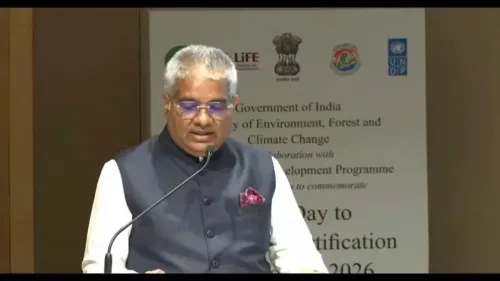
Bhupender Yadav: Growth and Green Goals Must Go Together
Synopsis
Union Environment Minister Bhupender Yadav on 4 July 2026 publicly reaffirmed India's 'development with conservation' doctrine, stating the country must scale new heights of progress while protecting its environment — a position central to India's climate diplomacy since COP26.
Key Takeaways
Union Environment Minister Bhupender Yadav posted on 4 July 2026 that India must pursue both economic progress and environmental conservation simultaneously.
The statement aligns with India's net-zero by 2070 pledge made at COP26 in Glasgow, which frames development and climate action as compatible goals.
India's National Action Plan on Climate Change (2008) established eight national missions linking growth with sustainability, forming the policy foundation for this dual mandate.
The Ministry of Environment, Forest and Climate Change oversees forest conservation, pollution control, wildlife protection, and India's NDC commitments under the Paris Agreement.
Key stakeholders — including India's industrial sector and state governments — face the practical challenge of meeting both growth and environmental benchmarks.
Upcoming COP sessions and India's revised Nationally Determined Contributions will be the primary tests of whether this dual commitment translates into measurable policy action.
Union Environment Minister Bhupender Yadav on Saturday, 4 July 2026, reaffirmed India's dual commitment to economic progress and environmental protection, stating that the country must reach new heights of development while simultaneously conserving its natural environment.
In a post on X, the minister wrote: 'हमें प्रगति की नई ऊंचाइयों को भी छूना है और हमें पर्यावरण का संरक्षण भी करना है.' ['We must touch new heights of progress, and we must also protect the environment.'] The statement encapsulates the governing philosophy that development and conservation are not opposing forces but parallel imperatives.
Context
Bhupender Yadav, who leads the Ministry of Environment, Forest and Climate Change, has been a central figure in India's climate diplomacy and domestic environmental governance. His remark distils a position the government has advanced at multiple international forums: that a developing nation's right to growth cannot be separated from its responsibility to the planet. The post, accompanied by a video, signals an effort to communicate this message directly to a domestic audience.
Policy Backdrop
India pledged net-zero emissions by 2070 at the COP26 summit in Glasgow, framing economic ambition and climate action as complementary rather than contradictory goals. The country's National Action Plan on Climate Change, established in 2008, laid out eight national missions that explicitly link economic growth with sustainability objectives including solar energy, energy efficiency, and afforestation. This 'development with conservation' doctrine has since become a cornerstone of India's positioning in global climate negotiations.
The minister's ministry oversees forest conservation, wildlife protection, pollution control, and India's Nationally Determined Contributions (NDCs) under the Paris Agreement. Domestically, the government has pursued large-scale renewable energy expansion alongside industrial growth, seeking to demonstrate that the two trajectories can advance in tandem.
Stakeholders and Impact
The statement carries weight for India's industrial sector and state governments, both of which must navigate environmental clearance processes and green transition mandates. Industry bodies have long sought clarity on how growth targets will be balanced against tightening environmental norms. For state governments, the dual mandate translates into pressure to pursue infrastructure development while meeting forest cover and pollution benchmarks set by the Centre.
Civil society and environmental advocates will watch whether the ministerial statement is followed by concrete policy measures — whether on green hydrogen capacity, expanded renewable targets, or updated NDC commitments — that give operational meaning to the twin-goal framework.
What's Next
Future COP meetings and the scheduled revision of India's Nationally Determined Contributions will be the most visible arenas where this dual commitment is tested. Domestically, progress on green hydrogen, solar and wind capacity additions, and afforestation drives will serve as measurable indicators of whether the 'progress with conservation' vision translates into policy outcomes. Minister Yadav's public communication effort suggests the government is keen to build popular and political consensus around this framework ahead of those milestones.
Point of View
The minister is clearly building a domestic political narrative around environmental stewardship ahead of what are likely to be demanding international climate commitments. The dual-goal framework has served India well as diplomatic positioning at forums like COP, but it increasingly faces scrutiny over whether domestic policy delivery — on air quality, forest cover, and industrial emissions — matches the rhetoric. The real test of this statement lies not in its articulation but in the specificity of the policy instruments that follow it.
NationPress
4 Jul 2026
Frequently Asked Questions
What did Bhupender Yadav say about environment and development?
Bhupender Yadav said India must reach new heights of progress while also protecting the environment, framing development and conservation as simultaneous national imperatives.
What is India's net-zero target?
India pledged to achieve net-zero carbon emissions by 2070, a commitment made at the COP26 climate summit in Glasgow in 2021.
What is the National Action Plan on Climate Change?
The National Action Plan on Climate Change, launched in 2008, is India's overarching framework comprising eight national missions that balance economic growth with environmental sustainability goals.
What does the Ministry of Environment, Forest and Climate Change do?
The Ministry of Environment, Forest and Climate Change oversees forest conservation, wildlife protection, pollution control, and manages India's international climate commitments including its Nationally Determined Contributions under the Paris Agreement.
What are India's Nationally Determined Contributions?
India's Nationally Determined Contributions are its formal climate pledges under the Paris Agreement, outlining targets for renewable energy capacity, emissions intensity reduction, and forest carbon sinks, subject to periodic revision.