Buddha Dhamma's Lessons for Iran-US-Israel Conflict Today

Synopsis
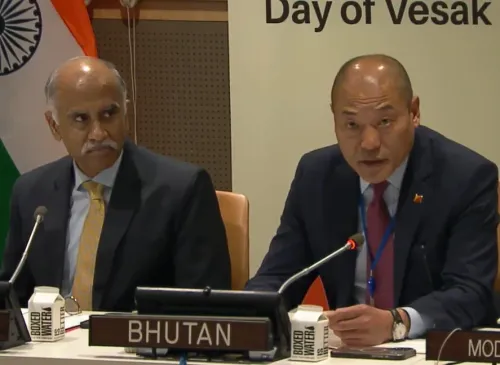
As Iran-US-Israel tensions threaten global energy and trade systems, ancient Buddhist teachings from the Nalanda tradition offer a surprisingly practical conflict-resolution framework rooted in dependent origination, restraint of greed, and the Buddha's own direct intervention to stop wars. A former Indian diplomat draws the parallel.
Key Takeaways
The Iran-US-Israel tensions are being analysed through the lens of Buddha Dhamma by a former Indian diplomat, who argues ancient Buddhist teachings offer a practical conflict-resolution framework.
The Buddha directly intervened in the Rohini River dispute between the Shakya and Koliya clans, resolving it without violence by appealing to rational proportionality.
Emperor Ashoka abandoned conquest after the Kalinga War (261 BCE) and adopted Dhamma governance , distinguishing defensive military use from expansionist aggression.
The Buddhist doctrine of dependent origination explains how disruptions in West Asia's energy routes cascade through global supply chains, affecting economies far removed from the conflict zone.
The Dhammapada teaching that hatred is never appeased by hatred is cited as an eternal law applicable to state conduct, not merely personal ethics.
The Nalanda tradition 's emphasis on reasoning, dialogue, and compassion is presented as a civilisational alternative to transactional diplomacy amid escalating global tensions.
New Delhi, April 26: As geopolitical tensions between Iran, the United States, and Israel intensify — threatening global energy corridors, disrupting trade networks, and pushing vulnerable populations to the brink — the ancient teachings of Buddha Dhamma, preserved through the Nalanda tradition, are drawing renewed attention as a credible and practical framework for conflict resolution. Far from being abstract philosophy, these teachings offer a structured, cause-driven approach to understanding and defusing modern crises rooted in greed, mistrust, and strategic overreach.
The Buddha as Conflict Mediator: Historical Precedents
A defining aspect of Buddha Dhamma that is often overlooked in geopolitical discourse is the Buddha's direct intervention in real-world conflicts. The most cited example is the dispute over the Rohini River between the Shakya and Koliya clans. Rather than invoking scripture, the Buddha appealed to rational proportionality — questioning whether human lives were worth less than water — and resolved the standoff without bloodshed.
Yet the same tradition also acknowledges limits. When his own Shakya clan faced destruction as a consequence of past actions, the Buddha chose not to intervene, recognising that the law of cause and effect — karma — cannot always be overridden. This dual model is instructive: peace efforts must be persistent and sincere, but also grounded in a clear-eyed understanding of deeper causation.
Modern conflict resolution, critics argue, fails precisely here — intervention without introspection, negotiation without accountability, and strategy without moral clarity.
Greed as a Systemic Force in West Asia's Conflicts
Buddha Dhamma identifies greed (lobha), hatred (dosa), and ignorance (moha) as the three root causes of human suffering. In contemporary geopolitics, greed has evolved from an individual failing into a systemic force — operating through resource control, strategic dominance, and economic leverage.
The conflicts in West Asia, including the current Iran-US-Israel tensions, cannot be cleanly separated from competition over energy routes, oil supply chains, and regional influence. These are routinely framed as matters of national security, but at their structural core lies an expansion of desire well beyond legitimate need.
The historical parallel is stark. Emperor Ashoka, following the devastating Kalinga War in approximately 261 BCE, recognised the moral bankruptcy of conquest driven by ambition. He adopted Dhamma as a governing principle — while still maintaining a defensive military. This distinction remains critical: defence for protection is fundamentally different from aggression for advantage.
Dependent Origination and the Fragility of Global Interdependence
One of Buddha Dhamma's most analytically powerful doctrines is Pratityasamutpada — dependent origination. Applied to geopolitics, this is not metaphysics but a causal map of conflict escalation. Today's global systems — energy supply chains, maritime shipping lanes, financial networks — are so deeply interconnected that disruption in one region cascades across continents.
A threat to the Strait of Hormuz, for instance, does not merely affect Iran or the United States; it reverberates through the import-dependent economies of South Asia, Southeast Asia, and Sub-Saharan Africa. Nations that pursue resource control as a demonstration of strength frequently overlook that this very control creates systemic vulnerability through the interdependence it seeks to exploit.
Climate, Natural Resources, and the Ethics of Shared Survival
Buddha Dhamma teaches that wealth and resources must be used for personal needs, for supporting others, and for safeguarding the future — not hoarded or monopolised. The tradition also emphasises harmony with nature, warning that what is extracted without balance returns as collective suffering.
Climate change is the most visible modern expression of this imbalance. Natural resources — water, energy, arable land — are shared by ecological design but divided by human ambition. When they are monetised and controlled beyond equitable limits, structural inequality and violent conflict follow. The deeper illegality, in a civilisational sense, lies in violating the natural order that sustains all life.
A Call for Collective Moral Leadership
The teaching from the Dhammapada is unambiguous: hatred is never appeased by hatred; by non-hatred alone is it stilled. This is an eternal law. Applied to statecraft, this principle does not counsel passivity. It demands active, disciplined engagement to prevent greater harm — what the tradition calls non-violence (ahimsa) as a form of moral courage, not weakness.
The Samyutta Nikaya's teaching on dependent origination reinforces this: suffering arises from identifiable causes and conditions. Unless those root causes are addressed — the mistrust, the resource competition, the historical grievances — no agreement will hold beyond the short term. Responsibility at this moment extends beyond governments to thinkers, religious leaders, philosophers, and senior political figures who must raise a universal voice for restraint.
The window for wisdom-driven intervention remains open, but history consistently demonstrates that wars, once initiated, develop their own momentum far beyond the intentions of those who begin them. The world stands at a civilisational inflection point: either humanity recognises its shared dependence and acts decisively for peace, or it allows conflict to expand until it becomes irreversibly self-destructive.
(Analysis based on the views of a former diplomat and strategic affairs expert. Perspectives expressed are personal.)
Point of View
Missing the structural truth that Buddha Dhamma identified millennia ago: these conflicts are driven by institutionalised greed masquerading as national security. The deeper irony is that nations claiming civilisational superiority are repeating the exact cycle of craving, clinging, and becoming that the Pali Canon warned would lead to collective suffering. India, heir to both the Nalanda tradition and Ashokan statecraft, is uniquely positioned to offer this moral framework to a world running out of purely transactional solutions.
NationPress
19 Sept 2026
Frequently Asked Questions
What does Buddha Dhamma say about resolving modern geopolitical conflicts?
Buddha Dhamma teaches that conflicts arise from greed, hatred, and ignorance and can only be resolved by addressing their root causes, not through retaliation. The doctrine of dependent origination explains that all events are causally linked, making unilateral dominance strategies ultimately self-defeating in an interconnected world.
How did the Buddha directly intervene to prevent war?
The Buddha intervened in the dispute between the Shakya and Koliya clans over the Rohini River, preventing armed conflict by appealing to rational proportionality. The conflict was resolved without bloodshed, demonstrating that reason and moral clarity can substitute for force.
What is dependent origination and how does it apply to the Iran crisis?
Dependent origination holds that all phenomena arise from interconnected causes and conditions — nothing exists in isolation. Applied to the Iran-US-Israel crisis, disruptions to energy routes and trade systems cascade globally, affecting even nations not directly involved in the conflict.
What lesson does Emperor Ashoka's transformation offer for today's conflicts?
After the devastating Kalinga War around 261 BCE, Emperor Ashoka renounced conquest-driven governance and adopted Dhamma as a state principle while maintaining a defensive military. This distinction between defence for protection and aggression for advantage remains a critical lesson for modern states engaged in strategic overreach.
Why is the Nalanda tradition relevant to global peace efforts in 2025?
The Nalanda tradition emphasises reasoning, dialogue, and compassion as tools for resolving disagreement — values that directly counter the positional negotiation characterising current West Asia tensions. Scholars and former diplomats argue it provides an ethical and practical foundation that transcends narrow national interest.