Cannabis worth ₹1 crore seized at Pune airport, hidden in cosmetic jars

Synopsis
A woman arriving from Bangkok walked into Pune airport with ₹1 crore worth of cannabis packed inside cosmetic jars labelled as hair treatment and body scrub. The case mirrors a ₹2 crore hydroponic weed bust in Lucknow weeks earlier — both involving Bangkok routes — pointing to a widening narcotics pipeline through Indian airports that enforcers are now cracking using behavioural profiling, not just scanners.
Key Takeaways
Customs officials at Pune International Airport seized 1.243 kg of suspected cannabis extract worth ₹1 crore on 1 October 2026 .
The contraband was concealed in three branded cosmetic jars labelled 'Rice & Yolk Hair Treatment' and 'Body Scrub' .
The passenger arrived on Air India Express flight IX-241 from Bangkok and was arrested under the NDPS Act, 1985 .
A separate seizure on 4 September at Lucknow airport netted 1.677 kg of hydroponic weed worth ₹2 crore from passenger Anvar Ali , also linked to a Bangkok travel route.
Both cases were cracked through behavioural profiling and Advance Passenger Information System analysis, not scanner alerts alone.
Customs officials seized 1.243 kg of suspected cannabis extract (hashish), valued at approximately ₹1 crore, from a woman passenger who arrived from Bangkok at Pune International Airport in Lohegaon on 1 October 2026. The contraband was concealed inside three branded cosmetic jars in her check-in baggage, according to officials.
How the Seizure Unfolded
The passenger arrived on Air India Express flight IX-241 on the evening of 1 October. Officers of the Air Intelligence Unit (AIU) of Pune Customs and the Directorate of Revenue Intelligence (DRI), Pune Regional Unit, intercepted her following behavioural profiling and a review of her suspicious check-in baggage. A detailed search was subsequently conducted under procedures mandated by the Narcotic Drugs and Psychotropic Substances (NDPS) Act, 1985.
The Concealment Method
Officials found the suspected narcotic hidden inside three branded cosmetic containers. Two of the jars were labelled 'Rice & Yolk Hair Treatment' and the third was marked 'Body Scrub'. Inspectors discovered a waxy, semi-solid substance with a strong odour inside the containers. A preliminary test using a Narcotic Drug Field Testing Kit returned positive for cannabis, officials confirmed.
Arrest and Ongoing Investigation
The entire 1.243 kg of suspected cannabis extract was seized under the provisions of the NDPS Act, 1985. The passenger was subsequently arrested, and an investigation is underway to determine the source of the contraband and its intended destination, officials said. Authorities have not yet disclosed the passenger's identity.
A Similar Case at Lucknow Airport
The Pune seizure comes weeks after a comparable incident at Chaudhary Charan Singh International Airport in Lucknow. On 4 September, a passenger identified as Anvar Ali, a resident of Malihabad in Lucknow, was detained by a Foreigners Regional Registration Office (FRRO) officer after his travel pattern raised suspicion during immigration clearance. Ali had arrived on flight WY-265 from Muscat; a pre-arrival analysis of data from the Advance Passenger Information System showed he had earlier travelled from Bangkok to Oman before flying to Lucknow.
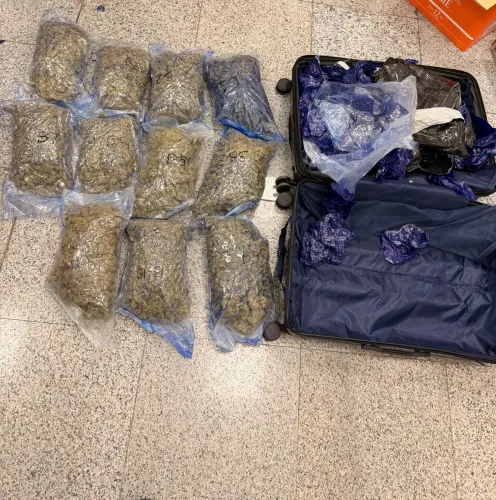
Ali initially told the officer he had visited Bangkok for business purposes. Suspecting he could be carrying contraband, the FRRO officer handed him over to AIU officials, who subsequently recovered 1.677 kg of hydroponic weed valued at around ₹2 crore from his luggage. Both cases point to a recurring pattern of Bangkok-linked drug trafficking through Indian airports.
Broader Pattern of Airport Drug Trafficking
Intelligence agencies have increasingly flagged the Bangkok–India air corridor as a conduit for high-value narcotics, often concealed within everyday items to evade initial screening. The use of consumer product packaging — cosmetic jars, food containers — reflects a growing sophistication among traffickers, according to enforcement officials. Notably, both the Pune and Lucknow seizures were triggered not by scanners alone but by behavioural profiling and travel-pattern analysis, underscoring the role of human intelligence in airport interdiction. Investigations in both cases remain ongoing.
Point of View
Both disguised in everyday packaging — are not coincidences; they are data points in a pattern. Smugglers are clearly probing the cosmetic-goods blind spot in baggage X-ray protocols. What is more telling is that both busts were triggered by behavioural profiling and passenger data analytics, not primary scanners — a signal that India's airports need to invest further in pre-clearance intelligence systems rather than rely on hardware alone. The NDPS Act provides strong post-arrest powers, but the real deterrent lies in disrupting the Bangkok supply chain upstream, which requires sustained coordination with Thai and Gulf narcotics agencies.
NationPress
3 Oct 2026
Frequently Asked Questions
What was seized at Pune airport on 1 October 2026?
Customs officials seized 1.243 kg of suspected cannabis extract (hashish) valued at approximately ₹1 crore from a woman passenger who arrived from Bangkok on Air India Express flight IX-241. The contraband was concealed inside three branded cosmetic jars.
How was the cannabis hidden in the Pune case?
The narcotic was packed inside three branded cosmetic containers — two labelled 'Rice & Yolk Hair Treatment' and one marked 'Body Scrub'. Officials found a waxy, semi-solid substance with a strong odour inside the jars, which tested positive for cannabis.
Who carried out the Pune airport drug seizure?
Officers of the Air Intelligence Unit (AIU) of Pune Customs and the Directorate of Revenue Intelligence (DRI), Pune Regional Unit, conducted the interception and seizure jointly, following behavioural profiling of the passenger.
What happened in the similar Lucknow airport drug case?
On 4 September, passenger Anvar Ali of Malihabad, Lucknow, was detained at Chaudhary Charan Singh International Airport after his Bangkok-linked travel pattern flagged suspicion. Customs officials recovered 1.677 kg of hydroponic weed worth around ₹2 crore from his luggage.
What law was invoked in the Pune arrest?
The passenger was arrested and the contraband seized under the Narcotic Drugs and Psychotropic Substances (NDPS) Act, 1985. Investigation is ongoing to determine the source and intended destination of the seized cannabis extract.