Centenarian Freedom Fighter Stands Firm Against Modern Political Turncoats
Synopsis
As Pt Ramkrishna Sharma celebrates 100 years, he reflects on a lifetime dedicated to principles over power. A veteran freedom fighter and socialist, Sharma critiques today's political landscape while advocating for unity and social equality.
Key Takeaways
Centenarian Legacy: Pt Ramkrishna Sharma's life reflects unwavering principles.
Critique of Modern Politics: He stands against turncoat politics.
Advocacy for Equality: Emphasizes the need for social and economic equality.
Historical Insight: Remembers key moments from India's past.
Health Philosophy: Simple diet and consistent activity contribute to his longevity.
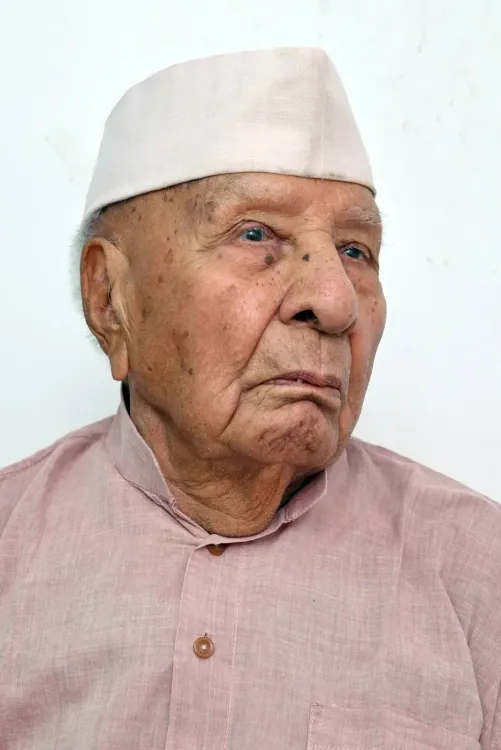
Jaipur, March 27 (NationPress) The remarkable journey of Pt Ramkrishna Sharma, a distinguished freedom fighter and socialist, unfolds as he celebrates his 100th birthday this Saturday. Having lived through the political landscape of pre-Independence India, he later played a pivotal role in shaping the nation’s democratic framework as a four-time MLA and a Member of Parliament from Bharatpur district. An individual of unwavering principles, he criticizes today's turncoat politics, valuing service and sacrifice over the pursuit of power.
Sharma’s life has been driven by a sense of purpose—challenging untouchability, championing farmers' rights, and advocating for water conservation in a region where scarcity is a pressing issue.
As he approaches his centenary, Sharma reflects on a lifetime filled with experiences, his voice calm yet resonating with the wisdom acquired over a century.
Having witnessed both an oppressed India and a sovereign nation, he embodies the essence of a freedom fighter, a four-time MLA, and a former MP—his life is a testament to the evolution of the country.
Yet, beyond his accolades lies a man who chose principles over privileges, values over aspirations.
As he gears up to celebrate his 100th birthday, Sharma focuses not on his age but on memories of a time when India was not yet liberated—a period marked by fragile hope and unyielding unity.
“We didn’t see caste, creed, or differences; we had a singular vision—an independent India,” he reminisces softly, adding, “Our sole dream was for the British to leave and for India to be free.”
There is a sense of quiet pride in his gaze as he discusses contemporary India. The expansive roads, the railways connecting remote areas, and the bridges uniting once-divided rivers are, for him, not mere indicators of progress but the realization of a promise. “The leaders of our time established a robust democratic nation,” he asserts.
“We granted voting rights to all, regardless of caste, creed, or gender. Even nations like the United States didn’t initiate their democracy this way.” He pauses, a faint smile crossing his face as he recalls, “The first elections… they were vibrant celebrations. People engaged with enthusiasm. There was hope.”
However, even at the age of 100, Sharma remains dissatisfied with mere nostalgia. His concerns are firmly rooted in the current landscape. “Voting participation must rise,” he emphasizes.
“For our nation to thrive, greater engagement is essential. True equality—social and economic—should be a reality for everyone,” he insists.
His own journey has been marked by sacrifice. During the Emergency, he endured nearly 19 months in prison, a time he recounts not with resentment but with an air of acceptance.
A pivotal moment in his political career took place just after Independence. On the day he was offered the role of District Congress Committee Secretary, Mahatma Gandhi suggested dissolving Congress to foster a healthy democratic opposition. Sharma did not hesitate.
“The very next day, I resigned,” he states plainly. He subsequently became a founding member of the Socialist Party, motivated by the belief that democracy requires not just power, but principled opposition. “The goal was to cultivate a policy-driven opposition,” he elaborates.
This was not the last time he would reject power. Throughout his career, opportunities arose—proposals to align his political strength with Congress, offers to join the BJP in 1980—but he turned them all down.
“I never subscribed to party-switching,” he asserts. “Politics should not be about convenience.”
When asked if he regrets not achieving greater political success, there’s no hint of remorse in his tone. “Had I aligned with Congress, I might have continuously served as MLA or MP,” he concedes. Yet, he shares another perspective, “I lacked the funds for a ticket, and even back then, money influenced politics.”
Instead, he chose a path defined by integrity over influence, embracing socialism. He became a key figure in India’s socialist movement, collaborating closely with iconic leaders like Dr. Ram Manohar Lohia and Jayaprakash Narayan.
Even his thoughts on history carry an unblemished honesty. Reflecting on Mahatma Gandhi, he states, “It is often said he frequently visited Harijan bastis, but I never had the chance to witness that.”
At 100, Sharma’s clarity remains sharp. He voices strong opposition to the trend of political defection. “We need stringent laws,” he declares.
“Those who switch parties should face a ban from contesting elections for 10 years. It is unethical.” Then, almost unexpectedly, the topic shifts to his health.
What is the secret to a century-long life? He grins. “Buttermilk and two chapatis,” he replies. “And walking—always walking.”
From his village, he walked 14 kilometers to school each day, and later 30 kilometers to attend college. Today, his philosophy remains straightforward: Live with integrity, stay active, and harbor no bitterness.
“I am content. I hold no grudges. I have served the nation with honesty and morality—that is sufficient,” he asserts.
As the nation reflects on its present and contemplates its future, Sharma offers a perspective forged by time.
He acknowledges the efforts of PM Narendra Modi, yet gently counters selective narratives. “It is unjust to claim that all development occurred post-2014,” he remarks.
“Initiatives like the Bhakhra Dam, IITs, and IIMs were established prior to that. Every era has contributed,” he emphasizes.
In an increasingly fast-paced world driven by ambition and shifting loyalties, Sharma stands as a beacon of something rare—steadfastness.
A century later, his life is not merely a tale of longevity but a narrative of consistency—a man who walked great distances for education, remained resolute in politics, endured imprisonment for democracy, and continues to believe that a nation’s strength lies in equality and principles.
As he turns 100, Sharma seeks no grand celebrations—only a remembrance of the values that forged a nation and the duty to uphold them.
Point of View
Pt Ramkrishna Sharma's journey is a compelling narrative of integrity and steadfastness. His critique of modern political dynamics serves as a reminder of the foundational values that can guide contemporary governance. His voice resonates with the need for equality and principled leadership in today's political landscape.
NationPress
3 Oct 2026
Frequently Asked Questions
Who is Pt Ramkrishna Sharma?
Pt Ramkrishna Sharma is a veteran freedom fighter and socialist who turned 100 on March 27, 2023. He has played a significant role in India's democratic journey.
What are Sharma's views on modern politics?
Sharma criticizes turncoat politics and emphasizes the importance of service and sacrifice over power. He advocates for increased voter participation and social equality.
What was a pivotal moment in Sharma's political career?
A key moment was when he resigned from the District Congress Committee Secretary role upon Mahatma Gandhi's suggestion to dissolve Congress for a healthier opposition.
How does he maintain his health at 100?
Sharma attributes his longevity to a simple diet of buttermilk and chapatis, along with a lifelong habit of walking.
What is Sharma's perspective on India's development?
Sharma believes that development in India has occurred over various eras, not solely after 2014, citing projects established before that time.