Centre rejects Bloomberg RBI gold sell-off claim, says share rose to 16.85%
Synopsis
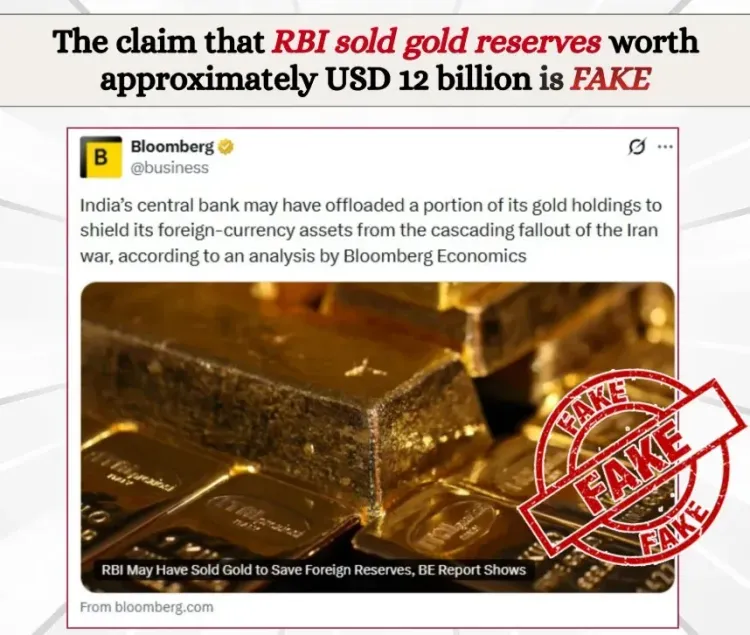
The Centre has flatly denied a Bloomberg Economics estimate that the RBI sold $12 billion in gold during West Asia tensions, pointing to official data showing the gold share in India's forex reserves actually rose to 16.85% by 22 May 2026 — a trajectory that flow-based sell-off claims struggle to explain.
Key Takeaways
The Centre rejected a Bloomberg Economics report alleging a large RBI gold sell-off, calling it ‘fake’.
Share of gold in India's forex reserves rose from 13.92% (end-September 2025) to 16.70% (31 March 2026) and 16.85% (22 May 2026).
Bloomberg's Abhishek Gupta had estimated the RBI sold nearly $12 billion in gold and bought $7.5 billion in foreign-currency assets in the two weeks to 22 May.
The PIB Fact Check Unit said the RBI's physical gold stock remains unchanged, per its Monthly Bulletin .
The Centre on Wednesday firmly rejected a Bloomberg Economics report claiming that the Reserve Bank of India (RBI) had offloaded a sizeable portion of its gold reserves to shield foreign currency assets amid West Asia tensions, calling the assertion ‘fake’ and unsupported by official data. According to the government, the share of gold in India's foreign exchange reserves has in fact climbed steadily — touching 16.85 per cent as of 22 May 2026.
What the government said
The clarification was issued by the Fact Check Unit of the Press Information Bureau (PIB), which cited official RBI data to counter the interpretation that the central bank had liquidated bullion during a period of heightened geopolitical uncertainty linked to the Iran-US standoff.
‘According to RBI, the share of gold in India's foreign exchange reserves rose from 13.92 per cent at end-September 2025 to 16.70 per cent on 31 March 2026, and further to 16.85 per cent as of 22 May 2026,’ the PIB's Fact Check Unit stated.
What the Bloomberg analysis claimed
The disputed assessment, authored by Abhishek Gupta, Senior India Economist at Bloomberg Economics, estimated that the RBI may have sold gold worth nearly $12 billion during the two weeks ending 22 May 2026, while simultaneously purchasing roughly $7.5 billion in foreign-currency assets. The reasoning hinged on shifts in the composition of India's reserves during a window of West Asia volatility.
Why the data tells a different story
The Centre argued that the physical stock of gold held by the RBI has remained unchanged and is regularly disclosed in the central bank's Monthly Bulletin. ‘The physical stock of gold is also disclosed by RBI in its Monthly Bulletin. The latest edition is available on the RBI website. The status remains unchanged as on date,’ the PIB said.
Notably, a rising gold share in the reserve mix is typically inconsistent with large-scale sales — it usually reflects either fresh accumulation or a valuation effect from higher bullion prices, both of which complicate the sell-off thesis.
The broader context
This is not the first time the government's fact-checking arm has pushed back against external analyses of India's reserve management. The RBI has steadily expanded its gold holdings over recent years as part of a broader diversification away from dollar-denominated assets — a trend mirrored across several emerging-market central banks.
The episode also underscores how reserve-composition data can be read very differently depending on whether one looks at flow estimates or stock disclosures. Markets and analysts will now watch the next RBI Monthly Bulletin for a fuller picture.
Point of View
And this is a textbook case. That said, the episode highlights a wider transparency gap — markets infer central-bank behaviour from composition shifts because granular operations data is rarely released in real time. A more frequent disclosure cadence would pre-empt such interpretive battles.
NationPress
20 Sept 2026
Frequently Asked Questions
What did the Centre say about the Bloomberg report on RBI gold sales?
The Centre, through the PIB Fact Check Unit, rejected the Bloomberg Economics report as ‘fake’ and unsupported by official data. It cited RBI figures showing the share of gold in India's forex reserves rose to 16.85% as of 22 May 2026.
What did the Bloomberg Economics report claim?
The report, by Senior India Economist Abhishek Gupta, estimated that the RBI may have sold nearly $12 billion worth of gold in the two weeks ending 22 May 2026 while buying about $7.5 billion in foreign-currency assets, allegedly to manage exposure during West Asia tensions.
How has the share of gold in India's forex reserves changed?
It rose from 13.92% at end-September 2025 to 16.70% on 31 March 2026, and further to 16.85% as of 22 May 2026, according to RBI data cited by the PIB.
Where does the RBI disclose its physical gold holdings?
The RBI publishes its physical gold stock in its Monthly Bulletin, available on the RBI website. The government said this stock position remains unchanged as on date.