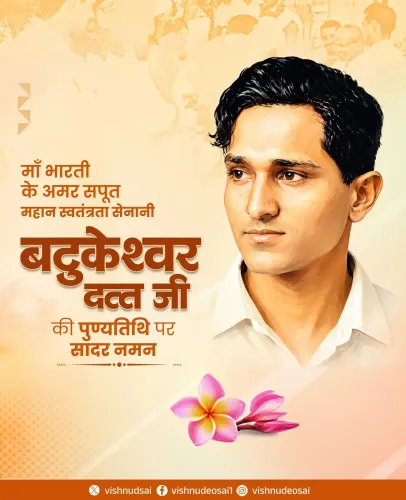
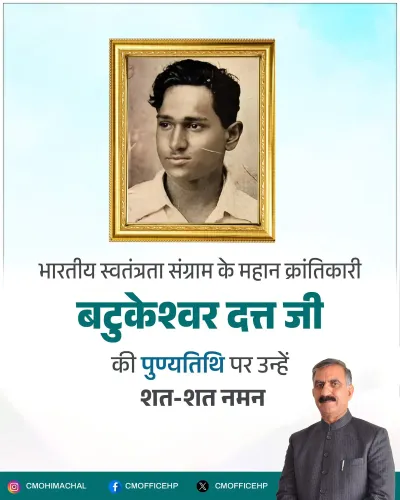
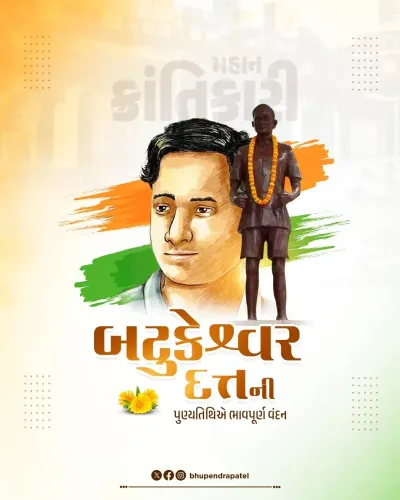
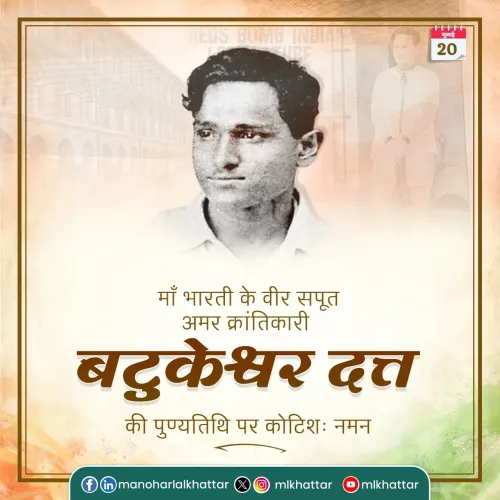
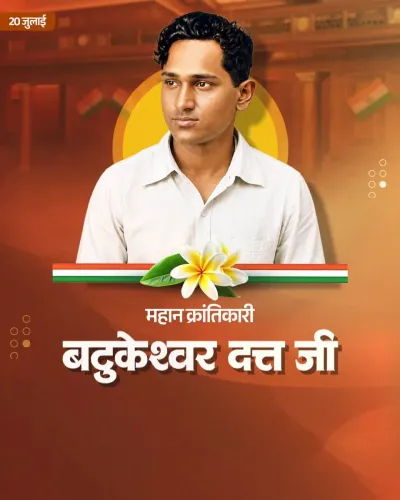
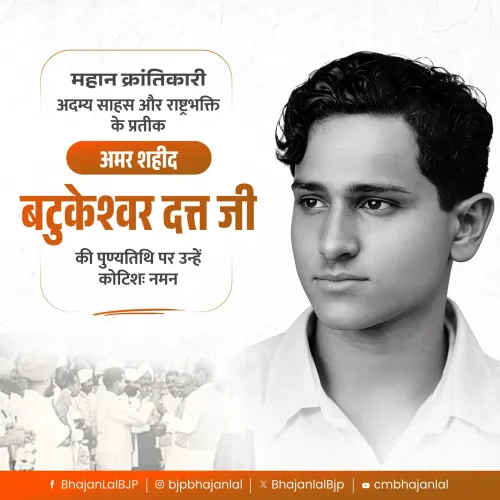
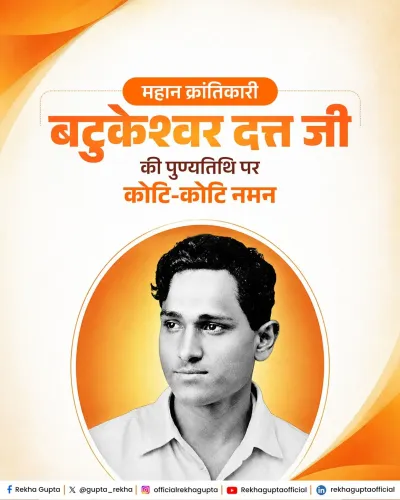
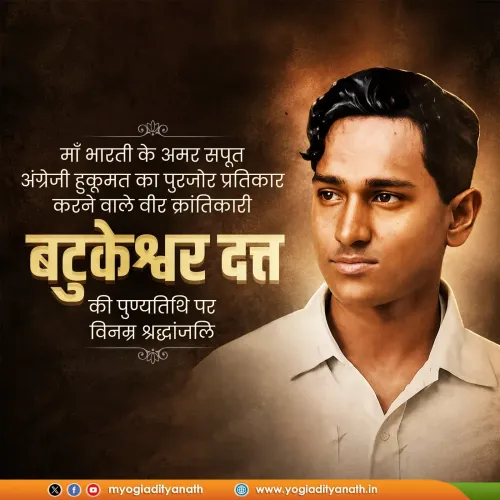
Chhattisgarh CMO pays tribute to revolutionary Batukeshwar Dutt
Synopsis
The Chief Minister's Office of Chhattisgarh on 20 July 2026 paid tribute to revolutionary Batukeshwar Dutt on his death anniversary, saluting the HSRA member who carried out the 1929 Central Legislative Assembly action alongside Bhagat Singh to protest British repression.
Key Takeaways
The Chief Minister's Office of Chhattisgarh paid official tribute to Batukeshwar Dutt on his death anniversary on 20 July 2026 .
Batukeshwar Dutt was a member of the Hindustan Socialist Republican Association (HSRA) and a close associate of Bhagat Singh .
On 8 April 1929 , Dutt and Bhagat Singh threw smoke bombs in the Central Legislative Assembly to protest the Public Safety Bill and Trade Disputes Bill .
The tribute is part of a nationwide practice of commemorating freedom fighters, aligned with the Azadi Ka Amrit Mahotsav framework launched in 2021 .
With Independence Day approaching on 15 August , further state-level commemorative events are expected across Chhattisgarh .
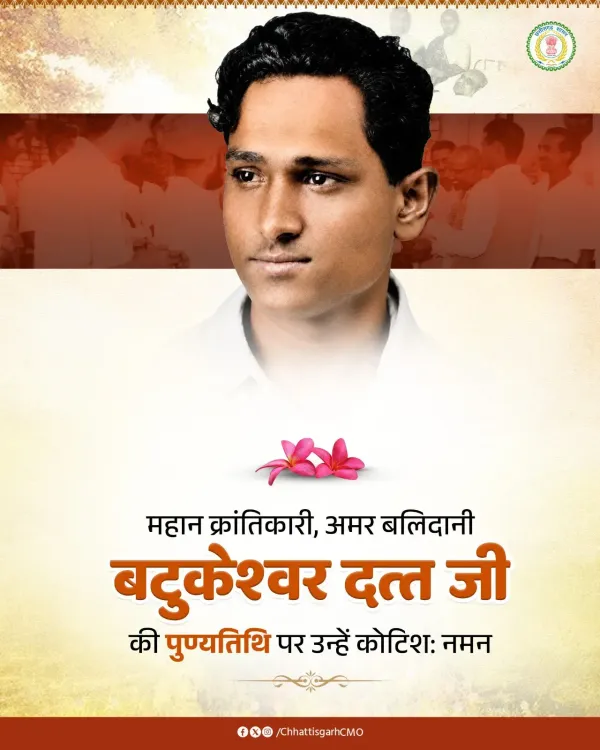
The Chief Minister's Office of Chhattisgarh paid homage to freedom fighter Batukeshwar Dutt on his death anniversary on Monday, 20 July 2026, honouring his legacy as a revolutionary who gave his life in the struggle against British colonial rule.
The official post, shared on X, read: 'Mahan krantikari, amar balidani Batukeshwar Dutt ji ki punyatithi par unhe sadar naman' — ('Respectful salutations to the great revolutionary and immortal martyr Batukeshwar Dutt on his death anniversary.')
Context
Batukeshwar Dutt was a pivotal figure in India's independence movement and a member of the Hindustan Socialist Republican Association (HSRA). On 8 April 1929, he and fellow revolutionary Bhagat Singh threw smoke bombs inside the Central Legislative Assembly in New Delhi to protest the Public Safety Bill and the Trade Disputes Bill, both of which were seen as instruments of British repression. The act was designed not to cause casualties but to 'make the deaf hear,' as the duo famously declared. Both were subsequently arrested and tried. Dutt was sentenced to transportation for life and endured years of imprisonment. Unlike Bhagat Singh, who was hanged in 1931, Dutt survived incarceration and lived to see Indian independence, though he spent his later years in relative obscurity and hardship.Policy Backdrop
The tribute is consistent with a well-established practice among Indian state governments of issuing official commemorations to independence-era revolutionaries on their birth and death anniversaries. These messages are shared across official social media channels and serve as instruments of civic education and national memory. At the national level, the Government of India launched the Azadi Ka Amrit Mahotsav in 2021 to mark 75 years of independence, with a mandate to celebrate and document the contributions of freedom fighters across the country. State-level tributes such as this one align with that broader commemorative framework, reinforcing a shared historical narrative that transcends political affiliations.Stakeholders and Impact
Such official tributes carry significance for students, educators, and citizens who engage with the history of India's freedom struggle. Commemorating figures like Batukeshwar Dutt — who remained less celebrated than contemporaries such as Bhagat Singh despite his equally consequential role — helps restore fuller historical visibility to the independence movement. For the Chhattisgarh government, the post reinforces the state's engagement with national heritage and positions the administration as an active participant in the country's collective memory-keeping. The use of Hindi in the message also signals an outreach to the state's primary linguistic community.What's Next
With Independence Day on 15 August approaching, state governments across India are expected to intensify commemorative activities honouring freedom fighters. Chhattisgarh may follow this tribute with school programmes, cultural events, or official functions that spotlight revolutionary icons of the independence era. The anniversary of the 1929 Central Legislative Assembly action and related milestones in the freedom struggle are likely to receive renewed attention in the weeks ahead.Point of View
Particularly as Independence Day approaches. Dutt's relative historical obscurity compared to Bhagat Singh makes such official recognition politically low-risk yet symbolically meaningful — it signals inclusive memory-keeping without partisan controversy. The post's alignment with the Azadi Ka Amrit Mahotsav framework also suggests that state administrations continue to draw political capital from the Centre's commemorative infrastructure well beyond its formal launch year. Cumulatively, these tributes shape a civic vocabulary around sacrifice and nationalism that governments across the spectrum deploy consistently.
NationPress
19 Oct 2026
Frequently Asked Questions
Who was Batukeshwar Dutt and why is he remembered?
Batukeshwar Dutt was an Indian revolutionary and member of the Hindustan Socialist Republican Association who, alongside Bhagat Singh, threw smoke bombs in the Central Legislative Assembly on 8 April 1929 to protest British repressive legislation. He is remembered as an immortal martyr of India's freedom struggle.
When did Batukeshwar Dutt die?
Batukeshwar Dutt passed away on 20 July 1965. His death anniversary is observed annually as a day to honour his contributions to India's independence movement.
What was the 1929 Central Legislative Assembly action?
On 8 April 1929, Batukeshwar Dutt and Bhagat Singh threw smoke bombs inside the Central Legislative Assembly in New Delhi to protest the Public Safety Bill and Trade Disputes Bill, which were seen as tools of British repression. The act was intended as a symbolic protest, not to cause casualties.
Why did the Chhattisgarh CMO pay tribute to Batukeshwar Dutt?
The Chief Minister's Office of Chhattisgarh paid tribute to mark Batukeshwar Dutt's death anniversary on 20 July 2026, in line with the established practice of Indian state governments honouring independence-era freedom fighters on significant anniversaries.
What is Azadi Ka Amrit Mahotsav and how does it relate to such tributes?
Azadi Ka Amrit Mahotsav is a Government of India initiative launched in 2021 to celebrate 75 years of independence by honouring freedom fighters and the independence movement. State-level tributes like the one from the Chhattisgarh CMO align with this broader national commemorative framework.