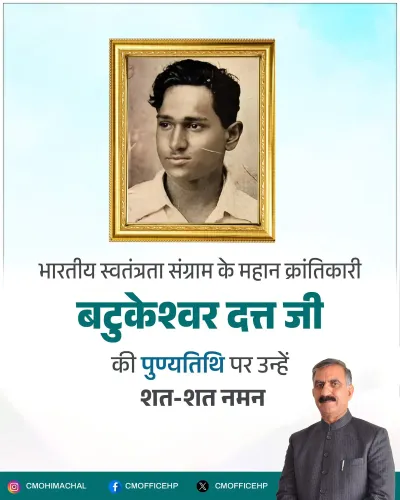
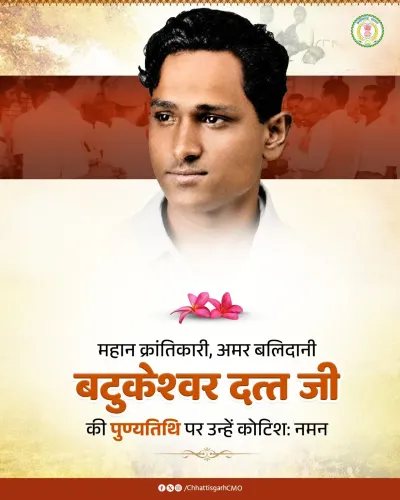
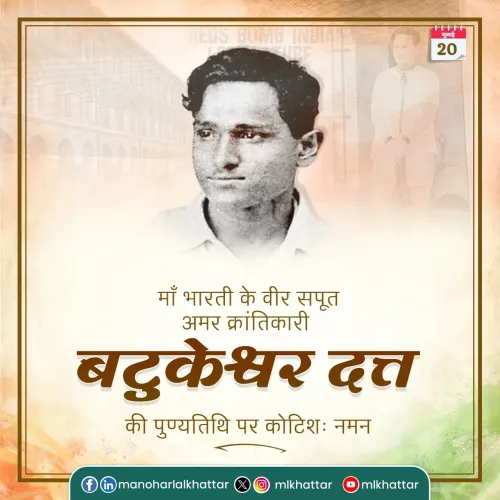
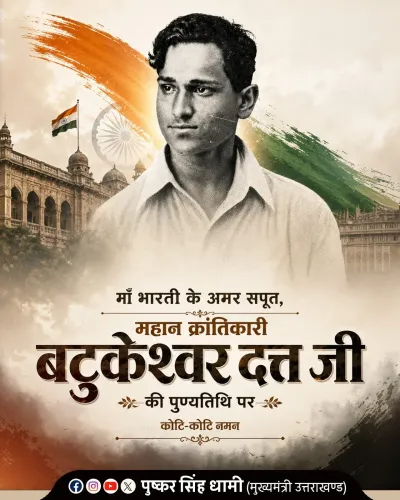
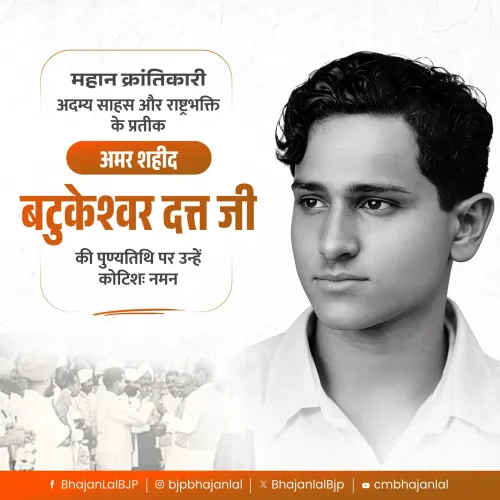
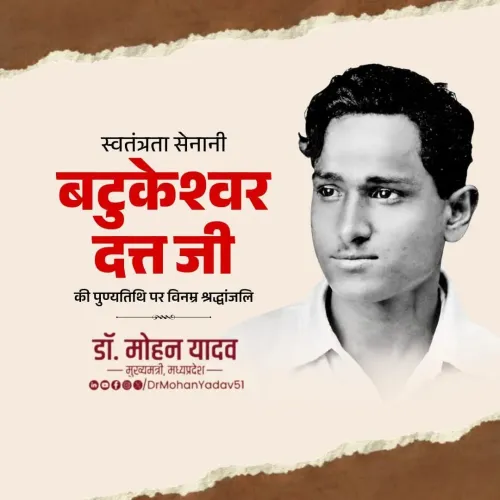
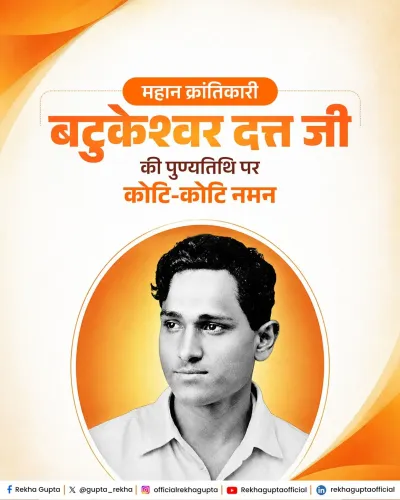
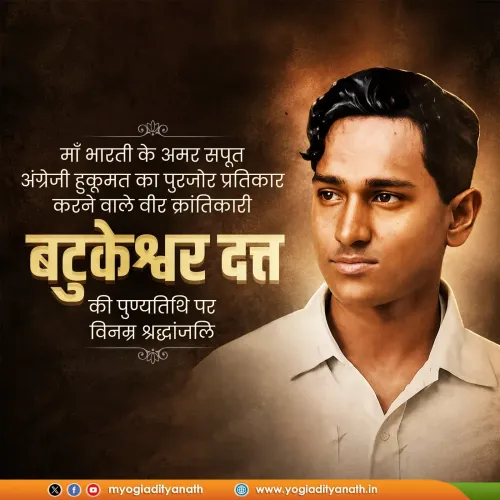
CM Bhupendra Patel Pays Tribute to Freedom Fighter Batukeshwar Dutt
Synopsis
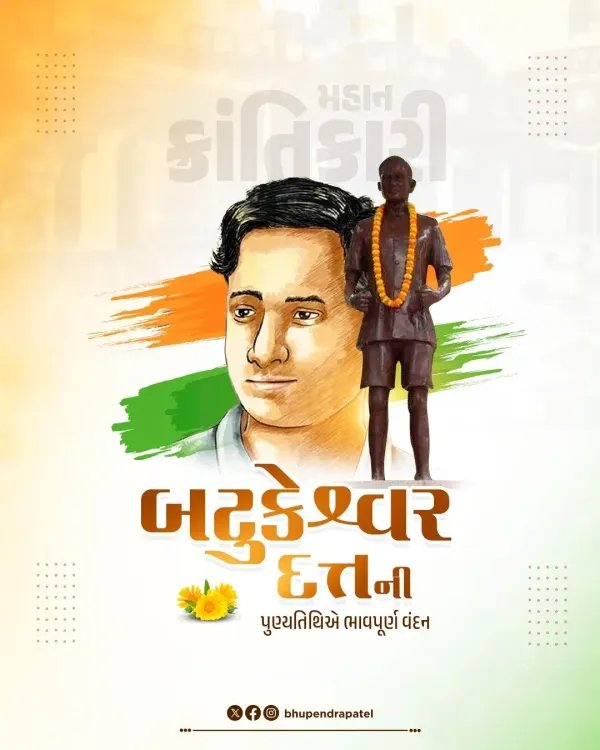
Gujarat Chief Minister Bhupendra Patel on 20 July 2026 paid tribute to revolutionary freedom fighter Batukeshwar Dutt on his death anniversary, honouring the HSRA leader who, alongside Bhagat Singh, threw bombs in the 1929 Central Legislative Assembly and endured imprisonment in the Cellular Jail.
Key Takeaways
Gujarat CM Bhupendra Patel posted a tribute to Batukeshwar Dutt on his death anniversary, 20 July 2026 .
Batukeshwar Dutt and Bhagat Singh threw smoke bombs in the Central Legislative Assembly on 8 April 1929 to protest colonial laws.
Dutt was sentenced to life imprisonment and served time in the Cellular Jail , Andaman Islands.
He passed away on 20 July 1965 , and his death anniversary is observed annually.
BJP -led governments have since 2014 made a sustained effort to integrate HSRA revolutionaries into official national memory and school curricula.
With 2027 centenary events approaching, larger state-level commemorations for 1929 revolutionaries are anticipated.
Gujarat Chief Minister Bhupendra Patel on Monday, 20 July 2026, paid homage to revolutionary freedom fighter Batukeshwar Dutt on his death anniversary, honouring the martyr's sacrifice and lifelong commitment to India's independence.
Posting in Gujarati on X, CM Patel wrote: 'Mahaan swatantrata senani Batukeshwar Dattji ni punyatithi par bhavpurna vandan' — offering heartfelt tribute to the great freedom fighter on his death anniversary. He added that Dutt's dedication and struggle for 'Maa Bharati' (Mother India) would forever inspire all citizens toward national service, and that his ideals and patriotism would remain immortal in the hearts of the people of India.
Context
Batukeshwar Dutt was a key figure in the Hindustan Socialist Republican Association (HSRA), the revolutionary organisation that sought to end British colonial rule through direct action. On 8 April 1929, he and Bhagat Singh threw smoke bombs in the Central Legislative Assembly in Delhi — not to cause casualties, but to 'make the deaf hear,' as their famous slogan declared. The act was a protest against the repressive Public Safety Bill and the Trade Disputes Bill being pushed by the colonial government.
Both were arrested immediately, having made no attempt to flee. Dutt was sentenced to transportation for life and endured years of harsh imprisonment in the Cellular Jail in the Andaman Islands, where he participated in hunger strikes demanding rights for political prisoners. He was released after independence and passed away on 20 July 1965.
Policy Backdrop
Since 2014, leaders of BJP-governed states and the central government have made a consistent practice of marking the birth and death anniversaries of HSRA revolutionaries, integrating figures like Bhagat Singh, Sukhdev, Rajguru, and Batukeshwar Dutt into official national memory. This effort runs alongside moves to include revolutionary icons more prominently in school curricula, foregrounding armed resistance as a complement to the Gandhian narrative of independence.
CM Patel, as a senior BJP leader and head of Gujarat — a state with deep historical ties to both the Gandhian and revolutionary strands of the independence movement — has regularly issued such tributes to freedom fighters across the political and ideological spectrum of the anti-colonial struggle.
Stakeholders and Impact
Annual commemorations of figures like Batukeshwar Dutt are aimed primarily at students and the general public, reinforcing awareness of lesser-celebrated heroes of the independence movement. While Bhagat Singh is widely remembered, Dutt's individual contribution — including his post-independence life of relative obscurity despite his central role in the 1929 Assembly bombing — is often overlooked in mainstream historical discourse.
Such tributes by sitting chief ministers carry institutional weight, signalling to state educational bodies and cultural organisations that these figures warrant formal recognition and study.
What's Next
With the 2027 centenary of several landmark events connected to the HSRA approaching — including the 1929 Assembly incident — state governments in BJP-ruled states are expected to plan larger commemorations, memorials, and curriculum updates honouring the revolutionaries of that era. CM Patel's tribute on Dutt's death anniversary reflects an ongoing political and cultural effort to ensure this generation of freedom fighters receives sustained, institutionalised recognition in India's national memory.
Point of View
Deliberate effort by BJP-affiliated governments to expand India's official pantheon of freedom fighters beyond Gandhian icons to include armed revolutionaries of the HSRA. This is not merely ceremonial — it reflects a sustained political project, active since 2014, to reshape how India's independence struggle is remembered in public life and classrooms. With the 2027 centenary of the 1929 Assembly incident on the horizon, such annual tributes are likely the groundwork for larger institutional commemorations. The pattern signals that revolutionary figures will receive increasing state patronage in official memory-making going forward.
NationPress
19 Oct 2026
Frequently Asked Questions
Who was Batukeshwar Dutt?
Batukeshwar Dutt was an Indian revolutionary freedom fighter and member of the Hindustan Socialist Republican Association (HSRA) . He is best known for throwing smoke bombs alongside Bhagat Singh in the Central Legislative Assembly on 8 April 1929 to protest oppressive colonial legislation. He was imprisoned in the Cellular Jail and died on 20 July 1965 .
Why did Batukeshwar Dutt and Bhagat Singh bomb the Central Legislative Assembly?
The bombing on 8 April 1929 was a deliberate act of protest, not an attempt to cause casualties. Dutt and Bhagat Singh used smoke bombs to demonstrate against the Public Safety Bill and the Trade Disputes Bill , declaring their intent 'to make the deaf hear.' Both surrendered immediately after the act.
When is Batukeshwar Dutt's death anniversary?
Batukeshwar Dutt's death anniversary falls on 20 July . He passed away on 20 July 1965 .
Why did Gujarat CM Bhupendra Patel pay tribute to Batukeshwar Dutt?
Gujarat Chief Minister Bhupendra Patel posted a tribute on 20 July 2026 — Batukeshwar Dutt's death anniversary — honouring his sacrifice for India's independence and calling his ideals and patriotism an eternal inspiration for national service.