Is PM Modi's Assurance Leading to Maoist Eradication in Chhattisgarh?
Synopsis
As Chhattisgarh approaches a milestone in eradicating Maoism, Prime Minister Modi's assurances resonate through the nation. With security forces neutralizing key figures, the state's efforts reflect a commitment to peace and progress, marking a pivotal year in India's battle against insurgency.
Key Takeaways
Security forces have neutralized over 280 Maoists in 2025.
Operation Black Forest resulted in the elimination of key Maoist leaders.
Maoist influence in Chhattisgarh has significantly declined.
Rehabilitation policies are contributing to an increase in surrenders.
PM Modi assures a Maoist-free India by 2026.
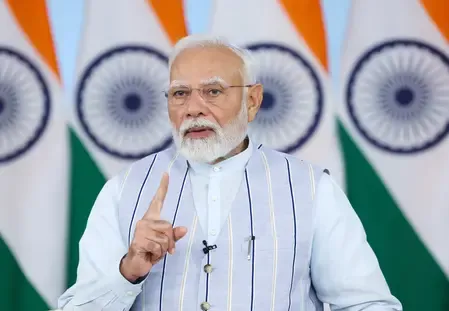
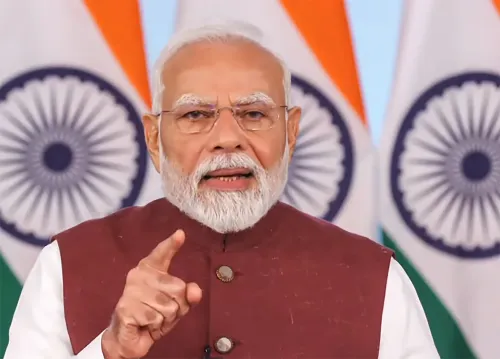
New Delhi, Dec 25 (NationPress) “I express my pride in our forces for this extraordinary achievement. Our administration is dedicated to rooting out the scourge of Maoism and ensuring a future filled with peace and advancement for our citizens,” stated Prime Minister Narendra Modi on his official social media platform in May 2025, commending security personnel following the elimination of 27 Maoists, which included CPI-Maoist General Secretary Nambala Keshava Rao, also known as Basavaraju.
This assertion encapsulated the year's progress, as PM Modi consistently highlighted the imminent decline of the insurgency.
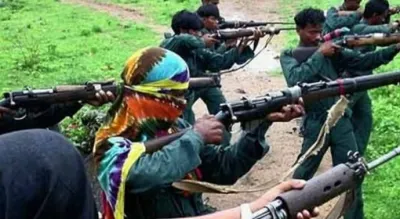
The origins of Naxalism in Chhattisgarh can be traced back to the Naxalbari uprising in West Bengal in 1967, which sparked armed Marxist-Leninist resistance against oppression. Following the establishment of Chhattisgarh in 2000, the Dandakaranya's dense forests emerged as a stronghold for the Communist Party of India (Maoist), created in 2004 through the consolidation of various factions.
Maoists capitalized on discontent regarding land rights, displacement due to mining activities, and inadequate development to recruit individuals from indigenous communities, forming “liberated zones” with alternative governance structures. The Jhiram Ghati ambush on May 25, 2013, in Sukma exemplified the violence, resulting in the deaths of 32 individuals, including Congress leaders Nand Kumar Patel and V.C. Shukla, along with Salwa Judum founder Mahendra Karma, which intensified the national resolve against Naxalism.
One of the most brutal episodes illustrating early Naxalite audacity in central India was the assassination of Likhiram Kavre, the then Transport Minister in the Congress government of undivided Madhya Pradesh under Digvijaya Singh.
On the night of December 15-16, 1999 (or February 16 in some accounts), a group of 10 to 12 armed People's War Group (PWG) Naxalites invaded Kavre's native Sonpuri village in Balaghat district. After conducting reconnaissance the day before and confirming his identity by contacting local villagers, they brutally murdered him in a premeditated act of vengeance for a police encounter in Andhra Pradesh that resulted in the deaths of four PWG cadres.
The assailants left behind a poster claiming responsibility for the revenge attack, marking one of the most horrific political assassinations in the region's history and highlighting the expansion of Maoist violence into Madhya Pradesh's border areas.
The year 2025 commenced ominously with a Maoist IED attack on January 6 in Bijapur, resulting in the deaths of eight DRG personnel and a civilian driver -- the most significant assault in two years. Nevertheless, security forces swiftly regained the initiative. On February 9, a major confrontation in Bijapur's Indravati National Park led to the elimination of 31 Maoists, although two security personnel also lost their lives.
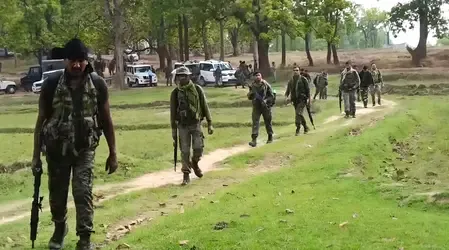
As spring arrived, significant victories unfolded. “Operation Black Forest” (or Operation Kagar), initiated on April 21, 2025, along the Chhattisgarh-Telangana border in Karreguttalu Hills, lasted until May 11 and resulted in the neutralization of 31 Maoists, including key PLGA battalion members with bounties totaling Rs 1.72 crore. Forces dismantled arms factories and infrastructure in this previously impenetrable stronghold.
The most devastating blow occurred on May 21 in the Abujhmarh forests of Narayanpur, where 27 Maoists, including Basavaraju with a bounty ranging from Rs 1.5-3 crore, were killed. This decapitation strike, involving DRG units, shattered the Maoist central leadership and was celebrated as a pivotal moment. Operations continued unabated. In December alone, encounters in Bijapur on December 3 resulted in the deaths of 12 Maoists, while ongoing gunfights in the Bhairamgarh-Indravati area further weakened their ranks.
In total, 2025 witnessed the neutralization of over 280 Maoists statewide -- predominantly in Bastar -- with Bijapur accounting for 144 eliminations. Surrenders surged to unprecedented levels: over 1,000-1,300 cadres laid down their arms, including senior leaders, driven by rehabilitation initiatives and increasing pressure. Arrests surpassed 500-680, with hundreds of weapons recovered.
These achievements reflect improved intelligence capabilities, forward operating bases, drone surveillance, and coordinated deployments by central forces -- CRPF, CoBRA, BSF -- and state police, all working towards the March 2026 eradication target. Civilian and security force casualties have significantly decreased compared to previous decades, while Maoist violence has diminished amid internal disillusionment.
“I assure you that the day is not far when every corner of Chhattisgarh and India will be entirely free from Maoist terror,” PM Modi asserted in November during Chhattisgarh's silver jubilee celebrations in Nava Raipur. He noted that Maoist influence has diminished from 125 to merely three districts, adding, “The day is not far when India will be completely liberated from Naxalism and Maoist violence -- this too is Modi’s guarantee.”
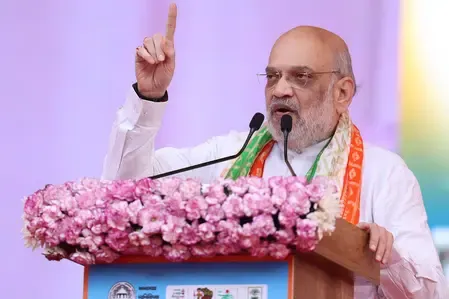
Union Home Minister Amit Shah reinforced this message in December at the closing of the Bastar Olympics. He stated, “Under the leadership of Prime Minister Narendra Modi, we have resolved to make Bastar and India free from Maoism. By the Bastar Olympics 2026, Red terror will be eliminated.”
He added, “We are on the verge of achieving our goal to eradicate Left-Wing Extremism by March 31, 2026.”
PM Modi attributed past Congress policies for exacerbating Naxalism through neglect, stating in March, “Over the decades, Naxalism received encouragement... due to Congress's policies,” while acknowledging the progress in development that brings peace. Chief Minister Vishnu Deo Sai echoed this sentiment, stating, “The backbone of Naxalism is broken,” with Deputy CM Vijay Sharma declaring that 80% of the state is now Maoist-free.
Enhanced intelligence, camps, drones, and rehabilitation programs have driven this success. Violence has drastically decreased, paving the way for infrastructure improvements like roads, schools, and electricity. As PM Modi affirmed, “Chhattisgarh is steadily liberating itself from the grip of Maoist terrorism,” 2025 positioned the state -- and India -- on the brink of a Maoist-free era, honoring decades of sacrifices.
As 2025 draws to a close, Chhattisgarh stands poised to become Maoist-free, with officials optimistic about meeting the 2026 deadline ahead of schedule. The year's operations have not only devastated Maoist ranks but also opened remote regions for development, signaling the insurgency's twilight after decades of strife.
Point of View
The government's efforts in Chhattisgarh signify a pivotal shift. While the focus remains on eradication, it's essential to acknowledge the complexities surrounding this issue. The rise in surrenders and recent neutralizations underscore a potential turning point, yet the socio-economic factors at play must not be overlooked. As leaders pledge to eliminate this threat, the nation watches closely.
NationPress
2 Oct 2026
Frequently Asked Questions
What recent actions have been taken against Maoists in Chhattisgarh?
In 2025, security forces neutralized over 280 Maoists, including key leaders, as part of ongoing operations to eradicate Maoism in Chhattisgarh.
How has the government addressed Naxalism historically?
Prime Minister Modi highlighted past Congress policies that he claims contributed to the persistence of Naxalism and emphasized the current government's commitment to development and peace.
What impact did Operation Black Forest have?
Operation Black Forest, launched in April 2025, resulted in the elimination of 31 Maoists and the dismantling of infrastructure in a key stronghold.
What is the current status of Maoist influence in Chhattisgarh?
Maoist influence has reportedly reduced from 125 to three districts in Chhattisgarh, as officials express confidence in achieving a Maoist-free state by 2026.
What measures are being implemented to rehabilitate former Maoists?
The government has introduced rehabilitation policies that have led to a surge in surrenders, with over 1,000 cadres laying down their arms in recent months.