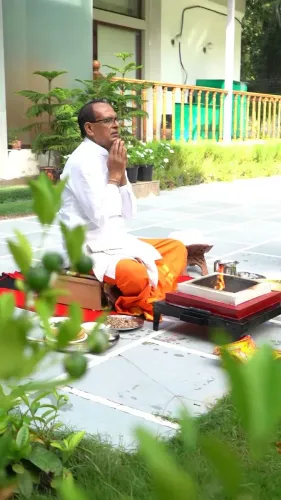
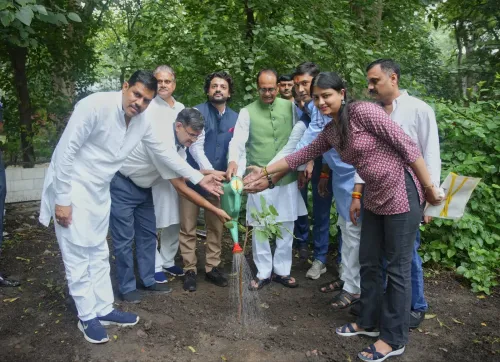
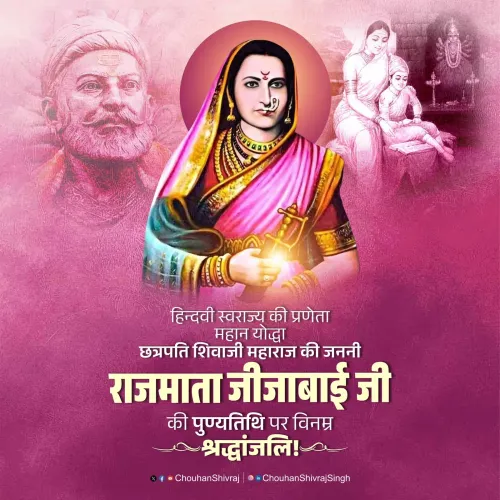
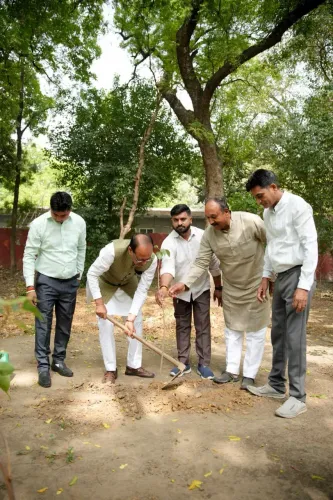
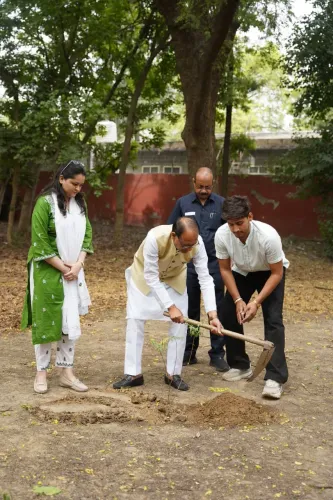
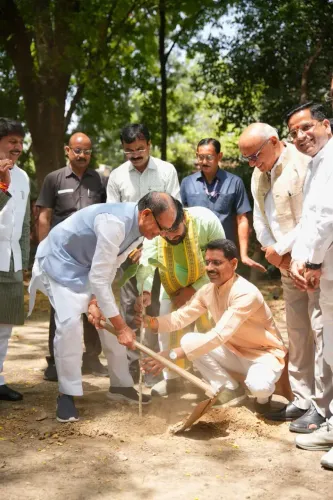
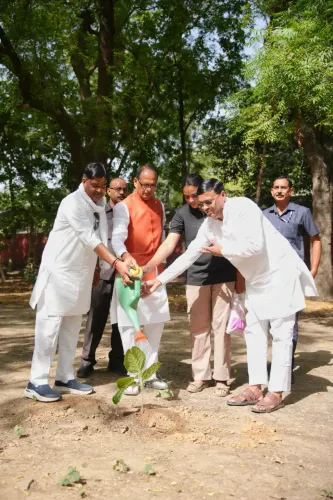
Shivraj Singh Chouhan plants sapling on mother's shraddha
Synopsis
Union Agriculture Minister Shivraj Singh Chouhan marked his late mother's shraddha on Tritiya tithi during Pitru Paksha by planting a sapling, and appealed to all Indians to plant a tree in memory of their ancestors during the 16-day period of veneration.
Key Takeaways
Shivraj Singh Chouhan observed his late mother's shraddha on Tritiya tithi of Pitru Paksha 2026 on 29 September 2026 .
He planted a sapling as an act of remembrance and dedicated it to her memory.
Pitru Paksha is a 16-day Hindu lunar fortnight devoted to ancestor veneration through shraddha rituals.
Chouhan appealed to all Indians to plant at least one sapling in memory of their ancestors during Shraddha Paksha.
He drew a metaphorical parallel: just as ancestors provided shade and blessings, so does a tree to future generations.
The appeal carries an implicit environmental dimension, linking personal faith observance to community-level afforestation.
On the tithee of Tritiya during Pitru Paksha 2026, Union Agriculture Minister Shivraj Singh Chouhan observed the shraddha of his late mother with a gesture both personal and public — planting a sapling in her memory and calling on every Indian to do the same for their ancestors.
In his post on Tuesday, 29 September, Chouhan wrote: 'Our culture and existence is because of our ancestors. Pitru Paksha is an opportunity to venerate our forebears as we would the divine. Today, on Tritiya tithi, it is the shraddha day of my late mother — I planted a sapling in her sacred memory. May our revered mother's blessings remain with us and may we continue on the righteous path.'
He ended with a direct appeal: 'I request you all that during Shraddha Paksha, as we reverently remember our ancestors, we must plant at least one sapling in their memory. Just like our forebears, the cool shade of a tree's blessings always stays with us.'
Pitru Paksha — sixteen days of remembrance
Pitru Paksha is a 16-day Hindu lunar fortnight dedicated to ancestor veneration through shraddha rituals — offerings of water, sesame, and food made to the departed. Observed in the Krishna Paksha of the month of Bhadrapada, it is among Hinduism's most widely practised ancestral rites, drawing participation from millions of Hindu families across India and the diaspora. Each of the sixteen days corresponds to a specific tithi on which families observe shraddha for relatives who died on that same lunar day.
A sapling as memorial — blending grief with growth
Chouhan's choice of a tree-planting as an act of remembrance draws on a layered cultural metaphor: the ancestor who gave you shade in life, and the tree whose canopy shelters those who come after. It is an image that resonates deeply in rural India, where banyan and peepal trees planted by ancestors are still standing landmarks on family land.
The appeal also carries an implicit environmental undertone. India's afforestation targets under various national programmes depend heavily on community participation, and faith-linked nudges — tying ecological action to deeply personal moments like shraddha — have historically seen strong local uptake. Whether this call translates into a measurable planting movement during Shraddha Paksha 2026 is worth watching.
As a four-term former Chief Minister of Madhya Pradesh and now a Union Cabinet minister overseeing agriculture and rural development, Chouhan has long cultivated a public identity rooted in cultural and agricultural themes. The sapling, here, is not just a memorial — it is a message.
Point of View
Culturally resonant act. By coupling ancestral veneration — one of Hinduism's most emotionally charged practices — with tree planting, he sidesteps the usual resistance to top-down green mandates and frames ecological action as devotion. For a minister overseeing both agriculture and rural development, the imagery of trees as living legacies also reinforces his constituency's lived relationship with land. Whether the appeal translates into organised planting drives will test the reach of faith-linked environmental messaging beyond the political moment.
NationPress
29 Sept 2026
Frequently Asked Questions
What is Pitru Paksha and why is it observed?
Pitru Paksha is a 16-day Hindu lunar fortnight during which families perform shraddha rituals — offerings of water, food, and prayers — to honour and seek blessings from deceased ancestors. It falls in the Krishna Paksha of the month of Bhadrapada.
Why did Shivraj Singh Chouhan plant a sapling today?
Chouhan planted a sapling on 29 September 2026 to mark the shraddha tithi of his late mother, which fell on Tritiya during Pitru Paksha 2026. He chose tree planting as a living memorial and extended the same appeal to all Indians.
What appeal did Shivraj Singh Chouhan make during Pitru Paksha?
He urged all Indians to plant at least one sapling in memory of their ancestors during Shraddha Paksha, comparing the lasting shade and blessings of a tree to the enduring grace of one's forebears.
What is Tritiya tithi in the context of shraddha?
In Pitru Paksha, each of the 16 days corresponds to a specific lunar tithi. Shraddha is performed on the tithi that matches the day on which an ancestor passed away — Tritiya is the third tithi of the fortnight.
Who is Shivraj Singh Chouhan?
Shivraj Singh Chouhan is Union Minister of Agriculture and Farmers Welfare and Rural Development in the Government of India, a senior BJP leader, and a four-term former Chief Minister of Madhya Pradesh.