CM Bhagwant Mann invokes Guru Granth Sahib on Punjab's path forward
Synopsis
Punjab CM Bhagwant Mann posted a Punjabi prayer on November 11, 2026, crediting Sri Guru Granth Sahib Ji's grace for Punjab's progress and invoking the Sikh ideal of Sarbat da Bhala — well-being for all humanity.
Key Takeaways
Punjab CM Bhagwant Mann posted on X on November 11, 2026 , invoking Sri Guru Granth Sahib Ji's grace in Punjabi.
He attributed Punjab's ongoing progress and prosperity to the Guru's boundless mercy ( apaar rehmat te mehar ).
Mann prayed for humanity to walk the path of truth, service, humility, and Sarbat da Bhala — the Sikh principle of collective well-being.
Sri Guru Granth Sahib Ji was compiled in 1604 and installed as the eternal Guru of the Sikhs in 1708 .
Invoking Sikh ethical principles in public governance messaging is a consistent pattern among Punjab chief ministers across party lines.
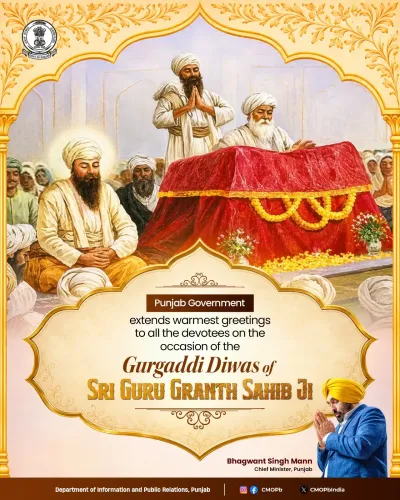
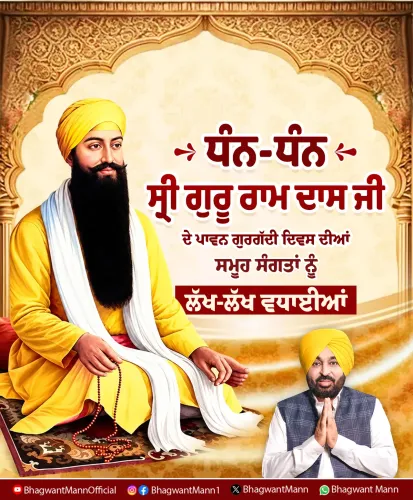
On a morning steeped in Sikh devotion, Punjab Chief Minister Bhagwant Mann turned to the eternal scripture of Sikhism to frame his government's journey — invoking the boundless grace of Sri Guru Granth Sahib Ji as the guiding force behind the state's march toward progress and prosperity.
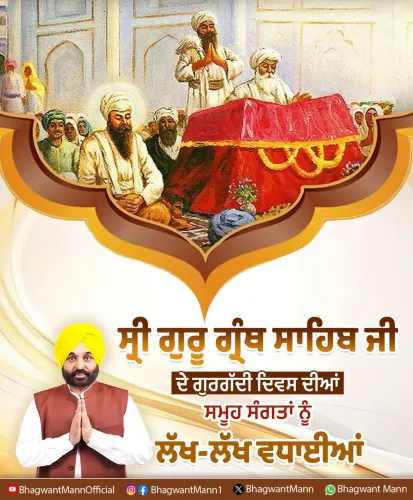
Posting in Punjabi on Wednesday, November 11, 2026, Mann wrote: 'Dhann-Dhann Sri Guru Granth Sahib Ji di apaar rehmat te mehar sadka aseen Punjab di tarakki ate khushhaali de raah te nirantar aage vadh rahe haan' — translating to: 'By the boundless grace and mercy of Blessed Sri Guru Granth Sahib Ji, we continue to move steadily forward on the path of Punjab's progress and prosperity.' He added a prayer that the Guru bless all of humanity with the strength to walk the path of truth, service, humility, and 'Sarbat da Bhala' — the Sikh ideal of well-being for all.
The weight of 'Sarbat da Bhala' in Punjab's public life
Sarbat da Bhala — literally 'welfare of all' — is one of Sikhism's most resonant ethical principles, embedded in the Ardas, the daily Sikh prayer. It calls for the collective flourishing of all humanity, cutting across divisions of faith, caste, or geography. For a Chief Minister governing a state with a substantial Sikh population, invoking it is both spiritually grounded and politically significant.
Punjab chief ministers across party lines have long linked state narratives to Sikh ethical frameworks, particularly around major dates on the Sikh calendar. The practice is a durable thread in Punjab's political fabric — but under Mann, who leads the Aam Aadmi Party government that swept to power in 2022, it has been woven into a broader governance-and-faith messaging pattern that speaks directly to the state's cultural heartbeat.
Sri Guru Granth Sahib Ji — a scripture installed as living Guru
Sri Guru Granth Sahib Ji, compiled in 1604 under Guru Arjan Dev Ji and installed as the eternal, living Guru of the Sikhs in 1708 by Guru Gobind Singh Ji, is not merely a religious text — it is the sovereign spiritual authority for Sikhs worldwide. Its invocation at the opening of a governance statement is not ceremonial filler; it signals a deliberate anchoring of political intent in the Guru's teaching of truthful, selfless public service.
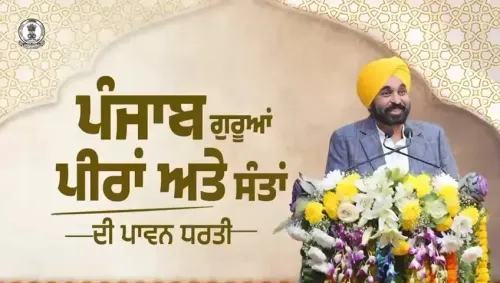
Mann's post, accompanied by a video, carries the warmth of a personal prayer rather than a policy announcement — but in Punjab, the two have rarely been entirely separate.
Point of View
Aligning the state's progress narrative with Sikh ethics is not mere optics. For AAP, still consolidating its identity in Punjab four years after its 2022 landslide, such messaging reinforces cultural legitimacy alongside administrative performance claims. The invocation of Sarbat da Bhala — a principle of universal, non-sectarian welfare — also allows the government to signal inclusive intent to communities beyond the Sikh majority, broadening the message's political reach without diluting its spiritual weight.
NationPress
11 Nov 2026
Frequently Asked Questions
What did Bhagwant Mann post about Guru Granth Sahib?
On November 11, 2026, Punjab CM Bhagwant Mann posted in Punjabi attributing the state's progress and prosperity to the grace of Sri Guru Granth Sahib Ji, and prayed for all humanity to follow the path of truth, service, humility, and Sarbat da Bhala.
What does Sarbat da Bhala mean?
'Sarbat da Bhala' is a Sikh principle meaning 'well-being for all' or 'welfare of all humanity.' It is part of the daily Sikh Ardas (prayer) and calls for the collective flourishing of all people regardless of faith or background.
Why do Punjab chief ministers often reference Guru Granth Sahib in public statements?
Punjab has a substantial Sikh majority population, and Sri Guru Granth Sahib Ji is the living eternal Guru for Sikhs. Chief ministers across party lines routinely invoke Sikh values in public messaging, linking governance narratives to the state's deep religious and cultural identity.
When was Sri Guru Granth Sahib Ji compiled and installed as the eternal Guru?
Sri Guru Granth Sahib Ji was compiled in 1604 under Guru Arjan Dev Ji and installed as the eternal, living Guru of the Sikhs in 1708 by Guru Gobind Singh Ji.
Which party does Bhagwant Mann belong to and when did he become Punjab CM?
Bhagwant Mann is a leader of the Aam Aadmi Party (AAP). He became Chief Minister of Punjab in 2022 after AAP won a landslide majority in the state assembly elections.