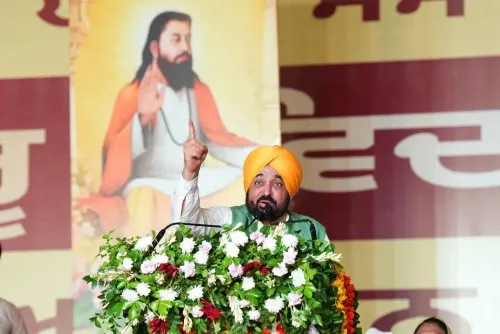
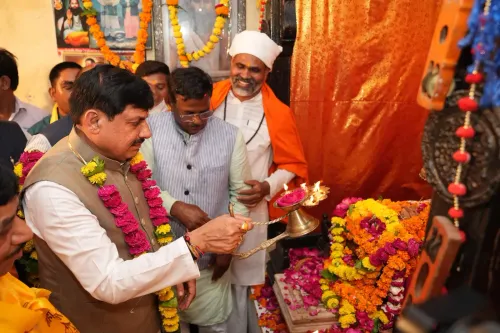
CM Bhagwant Mann lays foundation of Guru Ravidas study centre in Jalandhar
Synopsis
Punjab Chief Minister Bhagwant Singh Mann laid the foundation stone of the Sri Guru Ravidas Ji Bani Adhyayan Centre at Dera Sachkhand Ballan, Jalandhar, on 10 August 2026. The institution, spread over 10.4 acres at a total cost of ₹37 crore, will be fully funded by the Punjab Government for construction.
Key Takeaways
Punjab CM Bhagwant Singh Mann laid the foundation stone of the Sri Guru Ravidas Ji Bani Adhyayan Centre on 10 August 2026 .
The centre is located at Dera Sachkhand Ballan in Jalandhar , a major Ravidassia religious institution.
The project spans 10.4 acres with a total cost of ₹37 crore . ₹11 crore has been spent on land acquisition and ₹60 lakh on necessary permissions; the Punjab Government will fund all construction costs.
Padma Shri Sant Niranjan Das Ji and several other prominent saints were present at the foundation ceremony.
The centre will focus on scholarly and devotional study of the life, philosophy, and sacred Bani of Sri Guru Ravidas Ji Maharaj .
A ₹37 crore institution dedicated to the life, philosophy, and sacred Bani of one of India's most revered saint-poets took shape on Monday, 10 August 2026, when Punjab Chief Minister Bhagwant Singh Mann laid the foundation stone of the Sri Guru Ravidas Ji Bani Adhyayan Centre at Dera Sachkhand Ballan in Jalandhar — in the presence of some of the most respected spiritual figures of the Ravidassia tradition.
The ceremony brought together Padma Shri Sant Niranjan Das Ji of Dera Sachkhand Ballan, Sant Pargat Nath Ji of Bal Nath Ashram, Sant Pardeep Dass Ji of Kathar, Sant Teja Singh Ji, Sant Nirmal Das Ji of Jaure Wale, and Sant Lekh Raj Ji, lending the occasion deep spiritual weight.
10.4 acres and a ₹37 crore commitment
The centre will be built across 10.4 acres at a total project cost of ₹37 crore. Of this, ₹11 crore has already been spent on acquiring the land and ₹60 lakh on securing necessary permissions. The Punjab Government has committed to bearing the full remaining construction expenditure — a signal that this is a state-backed cultural project, not a token gesture.
The institution is envisioned as a premier centre for scholarly and devotional study of Sri Guru Ravidas Ji Maharaj — the 15th-16th century saint-poet whose Bani is enshrined in the Guru Granth Sahib and whose teachings on equality and dignity remain central to millions of followers across Punjab and the global Ravidassia diaspora.
Dera Sachkhand Ballan: the spiritual anchor
Dera Sachkhand Ballan is among the most significant Ravidassia institutions in the country, rooted in Jalandhar and carrying decades of influence across the community. Hosting the new Adhyayan Centre here is not incidental — it places the institution at the heart of an already-active spiritual ecosystem led by Sant Niranjan Das Ji, whose Padma Shri recognition underscores the dera's national standing.
Punjab's political landscape has long been shaped by the social and moral authority of its deras. State governments across party lines have periodically funded institutions tied to revered saints and Gurus, recognising both the cultural value and the community bonds such projects reinforce. This initiative follows that pattern — but the scale of the financial commitment and the specific focus on textual study and philosophy mark it as more than a ceremonial announcement.
The next milestone to watch: construction timelines and whether the Punjab Government pairs this project with parallel announcements for study centres tied to other traditions — a move that would reflect a broader cultural-education policy rather than a standalone gesture.
Point of View
The community's foremost institution, reinforces the state's relationship with a dera that carries substantial moral authority across Punjab and the diaspora. The move fits a longer arc in which Punjab governments have used cultural and religious patronage to build community trust, but the scale of public funding and the explicit scholarly mandate suggest an ambition beyond routine ceremonial politics. Whether this triggers parallel announcements for other faith communities will be the real test of whether this is policy or targeted outreach.
NationPress
10 Aug 2026
Frequently Asked Questions
What is the Sri Guru Ravidas Ji Bani Adhyayan Centre?
It is a state-funded institution being built at Dera Sachkhand Ballan in Jalandhar, Punjab, dedicated to the scholarly and devotional study of the life, philosophy, and sacred Bani of Sri Guru Ravidas Ji Maharaj.
How much will the Guru Ravidas Adhyayan Centre in Jalandhar cost?
The total project cost is ₹37 crore. Of this, ₹11 crore was spent on land and ₹60 lakh on permissions; the Punjab Government will bear all remaining construction costs.
Where is the Guru Ravidas Bani Adhyayan Centre located?
The centre will be built on 10.4 acres at Dera Sachkhand Ballan in Jalandhar district, Punjab.
Who laid the foundation stone of the Guru Ravidas study centre?
Punjab Chief Minister Bhagwant Singh Mann laid the foundation stone on 10 August 2026, in the presence of Padma Shri Sant Niranjan Das Ji and other prominent saints.
Who is Sant Niranjan Das Ji of Dera Sachkhand Ballan?
Sant Niranjan Das Ji is the spiritual head of Dera Sachkhand Ballan, a major Ravidassia institution in Jalandhar, and a Padma Shri awardee recognised for his contributions to the community.