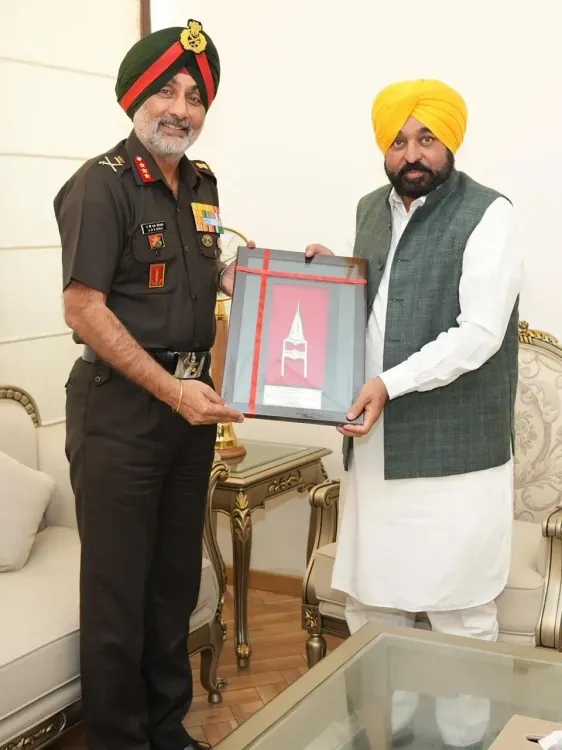
CM Bhagwant Mann meets Lt Gen A.D.S. Aujla, salutes Army's spirit
Synopsis
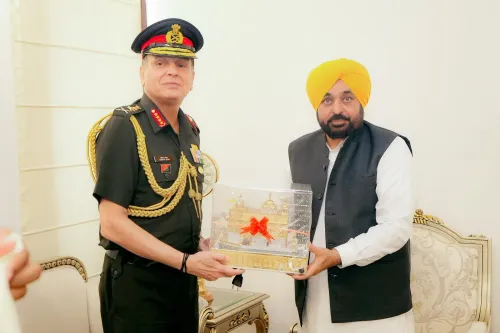
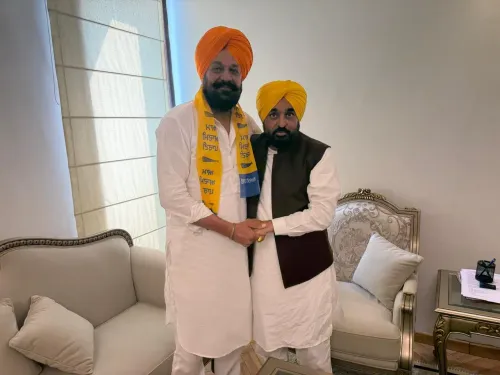
Punjab Chief Minister Bhagwant Mann met Lieutenant General A.D.S. Aujla on October 14, 2026, saluting the Indian Army's spirit, reaffirming Punjab's military heritage, and receiving a commemorative memento from the senior officer.
Key Takeaways
Punjab CM Bhagwant Mann met Lieutenant General A.D.S.
Aujla of the Indian Army on October 14, 2026 .
Mann saluted the Indian Army's 'unparalleled spirit' in defending the country and guarding its borders.
He described the commemorative memento presented by Lt Gen Aujla as a matter of deep personal pride.
Mann reaffirmed that the Punjab government stands 'shoulder to shoulder' with its soldiers for their welfare.
Punjab has historically supplied a large share of Indian Army personnel, given its border proximity to Pakistan.
A salute, a memento, and a message — Punjab Chief Minister Bhagwant Mann met Lieutenant General A.D.S. Aujla of the Indian Army on Wednesday, October 14, 2026, calling it a 'special meeting' and honouring the armed forces' unmatched dedication to guarding the nation's borders.
Posting in Punjabi on X, CM Mann wrote: 'Aaj Bharati fauj de Lieutenant General A.D.S. Aujla ji naal ikk khaas mulakaat hoi' — 'Today I had a special meeting with Lieutenant General A.D.S. Aujla of the Indian Army.' He offered a heartfelt salute to the Indian Army's 'unparalleled spirit in defending the country and guarding its borders,' and described the commemorative memento presented by Lt Gen Aujla as a matter of deep personal pride.
Punjab's bond with the uniform
Punjab occupies a singular place in India's military history. The state shares a border with Pakistan and has historically contributed a disproportionately large share of personnel to the Indian Army — a tradition woven into the cultural identity of towns and villages across the state. Sikh and Jat regiments raised from the region have served in every major conflict since Independence.
CM Mann acknowledged this legacy directly, stating that 'Punjab has always been the land of brave soldiers' and that the Punjab government stands 'shoulder to shoulder' with its soldiers for their welfare. He closed with the rallying cry 'Inquilab Zindabad!' — 'Long live the revolution!'
Civil-military engagement in a border state
Meetings between Punjab's chief ministers and senior army commanders are an established feature of governance in the state, given its strategic location and the density of military families within its population. Successive governments — regardless of party — have made public gestures of solidarity with the armed forces a visible part of their political identity.
For the Aam Aadmi Party government, which came to power in 2022, such engagements also carry a political dimension: projecting strong nationalist credentials in a state where ex-serviceman households represent a significant and vocal voter bloc. Veteran welfare, timely pension disbursements, and support for the families of soldiers killed in service remain active policy concerns in Chandigarh.
The exchange of a commemorative memento — a gesture standard in formal civil-military protocol — underscored the ceremonial warmth of the meeting. Whether it signals a forthcoming announcement on ex-servicemen welfare schemes or remains a one-off courtesy call, the symbolism lands clearly: in Punjab, the soldier is never far from the seat of government.
Point of View
Now in its fourth year, such gestures double as soft proof of nationalist credibility — a space the party has consciously worked to occupy since entering state power in 2022. The exchange of a memento, a standard civil-military courtesy, is unlikely to signal major policy movement on its own, but it keeps the government's solidarity messaging with veterans consistently visible. Watchers will look for whether this meeting precedes a concrete welfare announcement for ex-servicemen.
NationPress
14 Oct 2026
Frequently Asked Questions
Who is Lieutenant General A.D.S. Aujla?
Lieutenant General A.D.S. Aujla is a senior Indian Army officer who met Punjab Chief Minister Bhagwant Mann on October 14, 2026. Further biographical details about his current command have not been officially confirmed.
Why did Bhagwant Mann meet the Indian Army officer?
CM Bhagwant Mann described the meeting as a 'special meeting' to honour the Indian Army's spirit in defending the nation's borders and to discuss the welfare of soldiers, reflecting Punjab's tradition of civil-military engagement.
What did Lieutenant General Aujla present to CM Bhagwant Mann?
Lieutenant General A.D.S. Aujla presented CM Bhagwant Mann with a commemorative memento during their meeting, which Mann described as a matter of deep personal pride.
What has the Punjab government done for ex-servicemen welfare?
The Punjab government under CM Bhagwant Mann has repeatedly stated it stands 'shoulder to shoulder' with soldiers and their families. Veteran welfare, including pension disbursements and support for the families of soldiers, remains an active policy concern for the state.
Why does Punjab have a strong connection with the Indian Army?
Punjab shares a border with Pakistan and has historically contributed a large share of personnel to the Indian Army. Sikh and Jat regiments from the region have served in every major conflict since India's Independence, making military service a deep part of the state's cultural identity.