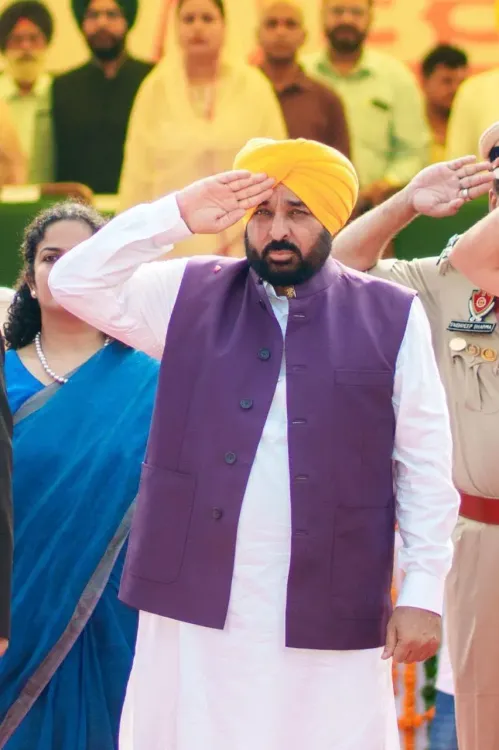
CM Bhagwant Mann pays tribute at Hussainiwala on 80th Independence Day
Synopsis
On India's 80th Independence Day, Punjab Chief Minister Bhagwant Mann paid homage at Hussainiwala in Firozpur — the cremation site of Bhagat Singh — and cited 69,093 youth jobs, 88% canal-water coverage, and SSF security deployments as milestones toward the martyrs' vision of a prosperous Punjab.
Key Takeaways
Punjab CM Bhagwant Mann observed India's 80th Independence Day at the national martyrs' memorial in Hussainiwala, Firozpur on August 15, 2026 .
He paid tribute to Bhagat Singh , Rajguru , Sukhdev , and other freedom fighters at their cremation site on the India-Pakistan border.
Mann cited 69,093 government jobs provided to Punjab youth since the AAP government took office in March 2022 .
He claimed 88 per cent of farmland now receives canal irrigation water, addressing a longstanding agricultural concern.
The Special Security Force (SSF) was highlighted as a key instrument for maintaining law and order in the state.
Mann called for strengthening communal harmony and peace in Punjab, invoking Bhagat Singh's dream of a Rangla Punjab .
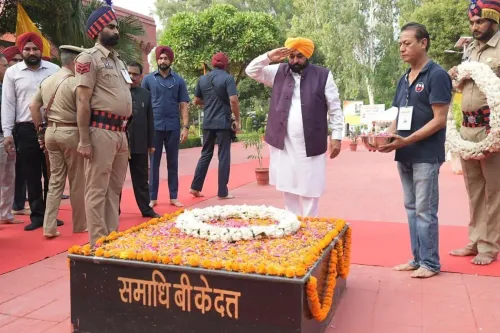
At the sacred ground of Hussainiwala in Firozpur — where the ashes of Bhagat Singh, Rajguru, and Sukhdev were consigned to the Sutlej — Punjab Chief Minister Bhagwant Mann led the state's 80th Independence Day observance on Saturday, August 15, 2026, invoking the martyrs' vision as the benchmark for his government's work.
Posting in Punjabi from the memorial, Mann wrote: 'Shaheed-e-Azam Bhagat Singh ji aur hor kaumi yodhiyan nu shardanjali' — 'I paid homage to Martyr-of-the-Nation Bhagat Singh and other national warriors.' He closed with the revolutionary salute Inquilab Zindabad, the slogan Bhagat Singh himself made immortal.
Hussainiwala: where martyrdom meets statecraft
Hussainiwala is not merely a memorial — it is a political and emotional fulcrum for Punjab. Situated on the India-Pakistan border in Firozpur district, the national martyrs' memorial marks the cremation site of three of India's most celebrated revolutionaries. Every Punjab government since independence has used August 15 ceremonies here to frame its own agenda in the language of sacrifice. Bhagwant Mann, himself a son of the Malwa belt and the state's first Aam Aadmi Party chief minister, is no exception — and he arrives with a specific set of numbers to anchor that claim.
The scorecard Mann brought to the martyrs' memorial
Mann cited 69,093 government jobs delivered to Punjab's youth since the AAP government took office in March 2022 — a figure that goes to the heart of the party's core election promise of large-scale public-sector recruitment. He also claimed that 88 per cent of farmland now receives canal irrigation water, a number significant in a state where water access has long been a flashpoint between farmers, the state, and neighbouring Haryana and Rajasthan. Reforms in school education and health services, and the deployment of the Special Security Force (SSF) to shore up internal security, completed his Independence Day ledger.
The post called on all Punjabis to strengthen 'shanti aur bhaicharak sanjh' — 'peace and communal harmony' — a phrase that carries particular weight in a state still shaped by the memory of the 1980s militancy era. Punjab's post-1984 political culture has made communal cohesion a near-mandatory theme for any leader addressing the state on a national occasion.
AAP's 2022 promise meets a 2026 reckoning
When AAP swept Punjab in March 2022 with a historic majority, employment and governance reform were the twin pillars of its mandate. Four years on, Mann is using the republic's most watched civic moment to present those pillars as standing. The invocation of Bhagat Singh's dream of a 'Rangla Punjab' — a colourful, prosperous Punjab — is a deliberate framing: it places the government's welfare agenda inside a nationalist moral tradition rather than a partisan one. Whether the numbers hold up to independent scrutiny will be the question the opposition presses in the months ahead. For now, the chief minister planted his flag at the most symbolically charged address in the state.
As the tricolour rose over Hussainiwala, Mann's message was pointed: the martyrs dreamed of a Punjab worth living in — and his government intends to be judged by how close it gets.
Point of View
Bhagwant Mann makes a deliberate symbolic choice — Bhagat Singh's cremation ground lends a nationalist moral authority that transcends party lines. Pairing that imagery with specific welfare numbers (jobs, irrigation, security) is a classic AAP playbook move: converting governance into a patriotic narrative ahead of what will inevitably be a mid-term accountability conversation. The emphasis on communal harmony signals awareness that Punjab's peace is never taken for granted, and that any disruption would be the sharpest weapon the opposition could wield. How rigorously the cited figures are scrutinised in coming months will define whether this Independence Day framing holds or frays.
NationPress
15 Aug 2026
Frequently Asked Questions
Why did Bhagwant Mann go to Hussainiwala on Independence Day 2026?
Hussainiwala in Firozpur is the cremation site of freedom fighters Bhagat Singh, Rajguru, and Sukhdev, making it the most symbolically significant location in Punjab for Independence Day tributes. Mann led the state's 80th Independence Day ceremony there to honour the martyrs and present his government's achievements.
What is Hussainiwala and why is it historically important?
Hussainiwala is a village in Firozpur district, Punjab, on the India-Pakistan border. It houses the National Martyrs Memorial marking the spot where Bhagat Singh, Rajguru, and Sukhdev were cremated after their execution by the British in 1931.
How many jobs has the AAP government given in Punjab?
Chief Minister Bhagwant Mann stated on Independence Day 2026 that 69,093 government jobs have been provided to Punjab's youth since the AAP government took office in March 2022. This figure has not been independently verified.
What is the SSF that Bhagwant Mann mentioned?
The Special Security Force (SSF) is a Punjab state security unit that the AAP government has deployed to strengthen internal law and order. Mann cited it as part of his administration's efforts to ensure the safety of the state.
What does 'Rangla Punjab' mean?
'Rangla Punjab' is a Punjabi phrase meaning 'Colourful' or 'Vibrant Punjab,' evoking a prosperous and culturally rich state. Bhagwant Mann used it to describe the vision of the martyrs and his government's goal for Punjab's future.