CM Bhagwant Mann Welcomes Congress, BJP Leaders Into AAP
Synopsis
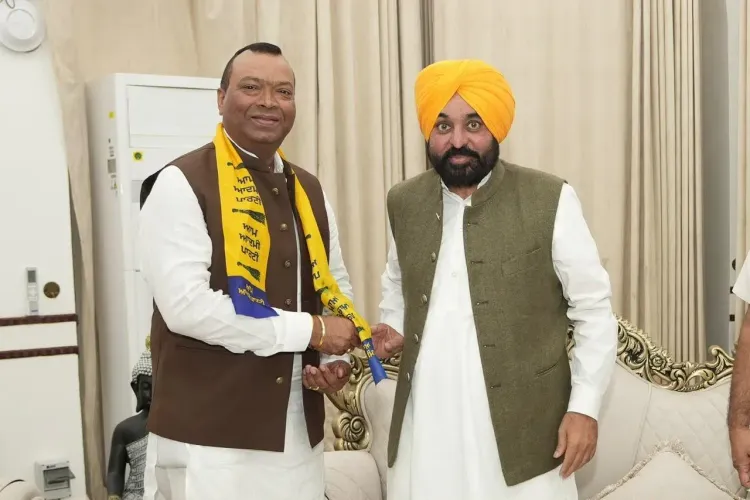
Punjab CM Bhagwant Mann announced on November 17, 2026 that Jalandhar Congress VP Mike Khosla, BJP Yuva Morcha spokesperson and industrialist Prashant Gambhir, and former DSP Surinder Pal Dogri have joined AAP, bolstering the party's organisational base ahead of the 2027 assembly elections.
Key Takeaways
Three prominent figures — a Congress district leader, a BJP youth wing spokesperson, and a retired police officer — joined AAP on November 17, 2026 .
Mike Khosla , sitting vice-president of Jalandhar Congress , crossed over to AAP, representing a direct blow to Congress's city-level organisation.
Prashant Gambhir , BJP Yuva Morcha's chief spokesperson and an industrialist, cited faith in AAP's policies as his reason for switching.
Retired DSP Surinder Pal Dogri was described by CM Mann as having an 'unblemished and outstanding' record in the Punjab Police.
CM Mann framed the inductions under AAP's vision of a 'Rangla Punjab' — a colourful, prosperous Punjab.
The joinings are part of a broader pre-election consolidation drive ahead of the 2027 Punjab assembly elections .
Three political figures from rival camps — a sitting Congress vice-president, a BJP Yuva Morcha spokesperson, and a decorated former police officer — walked into the Aam Aadmi Party fold on Tuesday, November 17, 2026, as Punjab Chief Minister Bhagwant Mann announced the inductions in a post on X, calling it a strengthening of the party ahead of a new chapter.
Writing in Punjabi, Mann said: 'Today several important personalities have joined the Aam Aadmi Party family... Mike Khosla, the current vice-president of Jalandhar Congress, and Prashant Gambhir, the chief spokesperson of BJP Yuva Morcha and an industrialist, have expressed faith in the party's policies... Along with them, Surinder Pal Dogri, who served as a DSP in Punjab Police with an unblemished and distinguished record, is also warmly welcomed into the party.'
Mann closed his post with the rallying phrase 'Rangla Punjab' — 'a colourful, prosperous Punjab' — a slogan AAP has used as shorthand for its governance vision in the state since coming to power.
Who crossed the aisle — and from where
The three joinings span the full spectrum of Punjab's opposition landscape. Mike Khosla held the post of vice-president of Jalandhar Congress, making his switch a direct organisational blow to a party that once dominated the city. Prashant Gambhir combined a role as BJP Yuva Morcha's chief spokesperson with his identity as an industrialist — a profile AAP has actively courted as it tries to broaden its appeal in Punjab's business community.
Surinder Pal Dogri arrives from outside electoral politics entirely, having served as a Deputy Superintendent of Police (DSP) in the Punjab Police. Mann described his tenure as 'spotless and outstanding,' framing the retired officer's entry as the addition of administrative credibility to the party's ranks.
AAP's induction playbook ahead of 2027
AAP swept the 2022 Punjab assembly elections with a thumping majority, ending Congress's hold on the state and reducing BJP to a marginal presence. Since then, the party has periodically absorbed leaders from both Congress and BJP, using high-profile inductions to signal momentum and widen its organisational footprint beyond its founding core.
The pattern is familiar in Indian state politics: as the 2027 Punjab assembly elections draw closer, the ruling party is actively recruiting experienced figures who bring local networks, community credibility, and cross-party name recognition. A sitting district-level Congress office-bearer, a BJP youth wing face, and a career police officer represent exactly the kind of diverse coalition-building that defines pre-election consolidation.
For AAP, every defection is also a headline — proof, the party argues, that its governance model is winning converts rather than losing them.
The question now is whether these inductions translate into electoral arithmetic when Punjab votes — and whether the opposition can stanch the flow before the campaign season truly begins.
Point of View
Absorbing Congress functionaries now reflects a maturing political machine that has moved from protest movement to establishment operator. The addition of a career police officer like Surinder Pal Dogri also hints at AAP's attempt to build credibility with Punjab's law-and-order-conscious electorate, a consistent pressure point in the state. With 2027 approaching, the opposition's inability to retain mid-tier leadership is a structural weakness that compounds with every high-visibility defection announcement.
NationPress
17 Nov 2026
Frequently Asked Questions
Who joined AAP in Punjab on November 17 2026?
Jalandhar Congress vice-president Mike Khosla , BJP Yuva Morcha chief spokesperson and industrialist Prashant Gambhir , and former Punjab Police DSP Surinder Pal Dogri joined Aam Aadmi Party on November 17, 2026, as announced by CM Bhagwant Mann.
Why did Mike Khosla leave Congress to join AAP?
According to CM Bhagwant Mann's post, Mike Khosla expressed faith in AAP's policies as his reason for joining the party. No other detailed statement from Khosla has been independently verified.
What is 'Rangla Punjab' that Bhagwant Mann refers to?
'Rangla Punjab' — meaning 'colourful, prosperous Punjab' — is a slogan and governance vision used by AAP since it came to power in Punjab in 2022, representing its promise of development and positive transformation for the state.
How does this affect AAP ahead of the 2027 Punjab elections?
These inductions expand AAP's organisational base by bringing in experienced leaders with established networks in Congress and BJP circles, potentially strengthening the party's reach in Jalandhar and other areas ahead of the 2027 Punjab assembly elections.
Who is Surinder Pal Dogri?
Surinder Pal Dogri is a former Deputy Superintendent of Police (DSP) in the Punjab Police, described by CM Bhagwant Mann as having served with an unblemished and distinguished record before joining AAP.