CM Bhajan Lal Hails Amrit Bharat Express Across Rajasthan
Synopsis
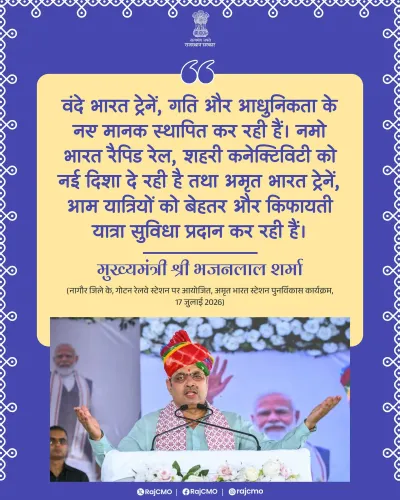
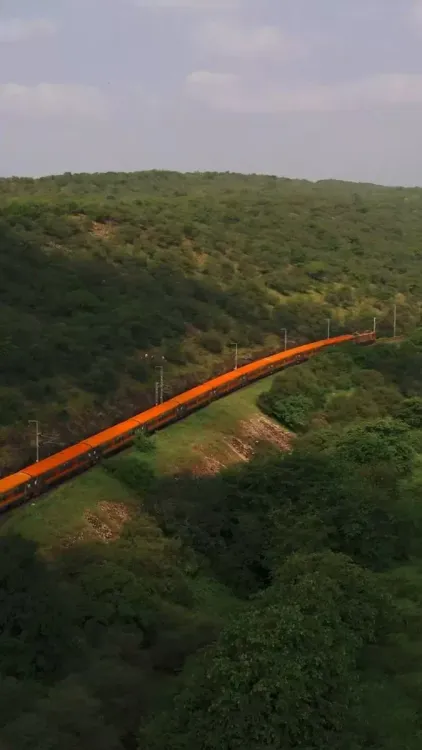
Rajasthan Chief Minister Bhajan Lal Sharma celebrated the Amrit Bharat Express passing through the state on 14 October 2026, calling it a symbol of modern India's development and crediting PM Modi's railway modernisation drive for boosting Rajasthan's tourism identity.
Key Takeaways
Rajasthan CM Bhajan Lal Sharma posted on 14 October 2026 celebrating the Amrit Bharat Express as it travels through Rajasthan.
He described the train as 'an extraordinary symbol of nature's unmatched beauty and modern India's development journey.' The Amrit Bharat Express is part of Indian Railways' modernisation drive launched in the early 2020s to upgrade long-distance services.
Sharma credited Prime Minister Narendra Modi with giving Rajasthan's beauty and pride 'a new identity' through railway modernisation.
The post invoked Rajasthan's iconic hospitality phrase 'पधारो म्हारे देश!' ('Welcome to our land!'), positioning the train as a tourism draw.
The state's Aravalli hills and Thar Desert are highlighted as the scenic backdrop for the train's journey through India's largest state.
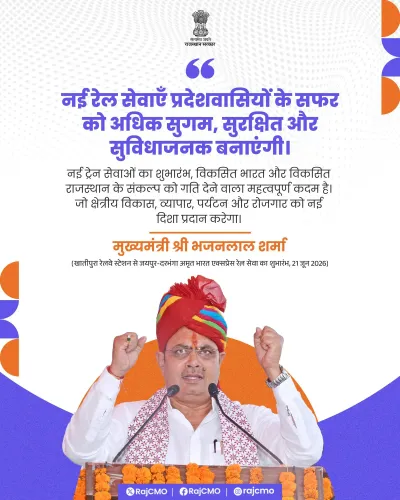
From the sculpted ridges of the Aravalli hills to the golden sweep of the Thar Desert, a modern train is threading together Rajasthan's landscapes — and Rajasthan Chief Minister Bhajan Lal Sharma wants the country to notice. On Wednesday, 14 October 2026, Sharma took to X to celebrate the Amrit Bharat Express as it passes through the state, calling it a symbol of both natural splendour and India's development journey.
Sharma's post, written in Hindi, opens with a lyrical flourish: 'राजस्थान की गौरवशाली धरती से गुजरती अमृत भारत एक्सप्रेस' — 'The Amrit Bharat Express passing through Rajasthan's glorious land.' He frames the train not merely as a transport upgrade but as 'an extraordinary symbol of nature's unmatched beauty and modern India's development journey.' The closing line — 'पधारो म्हारे देश!' ('Welcome to our land!') — is Rajasthan's most iconic hospitality phrase, pitched directly at prospective travellers.
Amrit Bharat Express: Railways as a Tourism Engine
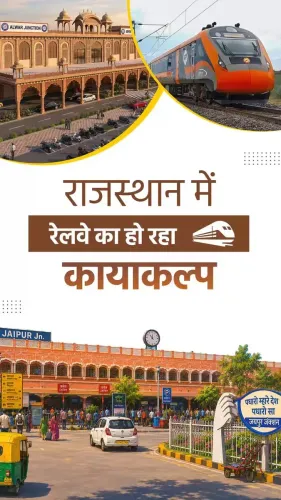
The Amrit Bharat Express is part of Indian Railways' modernisation push that began in the early 2020s, designed to replace ageing long-distance services with upgraded stock, better amenities, and wider route connectivity. The initiative fits squarely within a pattern visible across successive Union Budgets: infrastructure investment that doubles as a regional tourism catalyst, linking cultural and natural landmarks with improved rail access.
Rajasthan — India's largest state by area — brings an outsized profile to this equation. The Aravalli range in its east and the Thar Desert in its west are among South Asia's most photographically distinctive terrains, and the state's tourism sector stands to gain directly from higher-frequency, higher-comfort rail connectivity.
Modi Government's Railway Push, Filtered Through State Pride
Sharma explicitly credits Prime Minister Narendra Modi, writing that under Modi's leadership, 'the modernisation of Indian Railways is giving new momentum to the country's development journey while giving Rajasthan's beauty and pride a new identity.' The framing is deliberate — a BJP Chief Minister amplifying a central government infrastructure narrative and tying it to his state's heritage brand in a single stroke.
The broader political logic is familiar: when large infrastructure projects visibly move through a state, state-level leaders have every incentive to translate that visibility into local pride — and local votes. But the underlying rail investment is real, and for passengers and the Rajasthan tourism sector, so are the potential benefits.
The next test will be whether new Amrit Bharat Express route announcements and state-level tourism tie-ups materialise in upcoming railway timetables — turning the Chief Minister's lyrical invitation into itineraries that travellers can actually book.
Point of View
With its outsized tourism potential, the convergence of connectivity and heritage promotion carries genuine economic logic beyond politics. The real question is whether route expansions and tourism-rail tie-ups follow with the same energy as the rhetoric.
NationPress
14 Oct 2026
Frequently Asked Questions
What is the Amrit Bharat Express?
The Amrit Bharat Express is a modernised long-distance train service introduced by Indian Railways in the early 2020s, designed to replace older express trains with upgraded amenities and improved connectivity across Indian states.
Which route does the Amrit Bharat Express take through Rajasthan?
The exact operational route details have not been officially confirmed in the context of this announcement; CM Bhajan Lal Sharma's post references the train passing through Rajasthan's Aravalli hills and Thar Desert regions without specifying stations or halts.
What did Rajasthan CM Bhajan Lal Sharma say about the Amrit Bharat Express?
Sharma called the train 'an extraordinary symbol of nature's unmatched beauty and modern India's development journey,' credited PM Modi's railway modernisation drive, and invited travellers to experience Rajasthan's culture and hospitality.
How does the Amrit Bharat Express benefit Rajasthan tourism?
Improved rail connectivity through Rajasthan's scenic landscapes — the Aravalli hills and the Thar Desert — is expected to make the state more accessible to domestic tourists, boosting the local tourism sector.
What does 'Padharo Mhare Desh' mean?
'Padharo Mhare Desh' ( पधारो म्हारे देश ) is a traditional Rajasthani phrase meaning 'Welcome to our land,' widely used as the state's signature hospitality greeting.