CM Bhajan Lal Hails Baranika Ilangovan's Asian Games Bronze
Synopsis
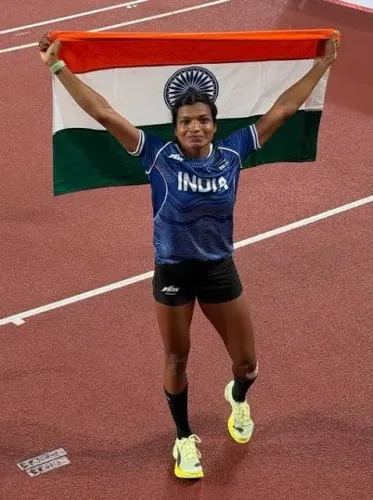
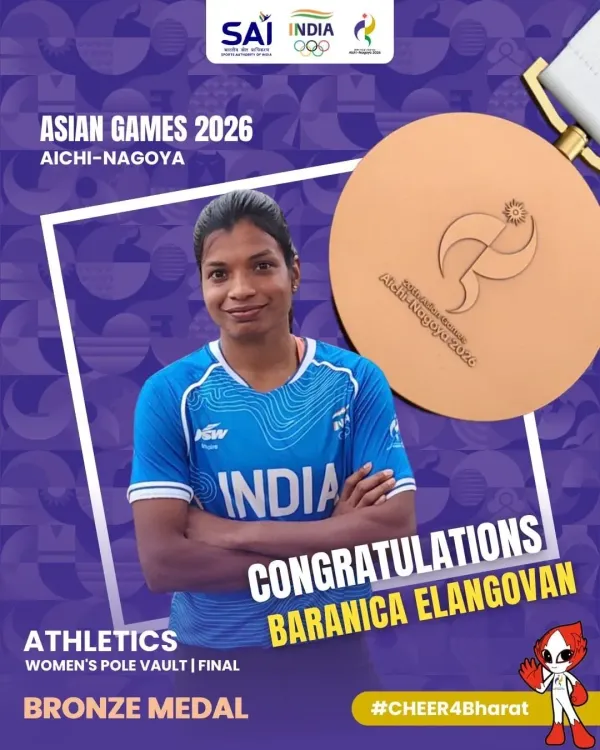
Rajasthan Chief Minister Bhajan Lal Sharma congratulated Baranika Ilangovan for winning a bronze medal in the women's pole vault at the 2026 Asian Games in Aichi-Nagoya, Japan, calling her achievement an inspiration for young Indian athletes.
Key Takeaways
Baranika Ilangovan won a bronze medal in women's pole vault at the 2026 Asian Games in Aichi-Nagoya, Japan .
Rajasthan CM Bhajan Lal Sharma posted congratulations on 25 September 2026 via X under #AsianGames2026 and #Cheer4Bharat .
Sharma described the achievement as a product of Ilangovan's 'talent, relentless hard work, and unbreakable resolve.' The pole vault podium finish signals India's growing competitiveness in technically demanding field events beyond traditional disciplines.
The Khelo India programme , launched in 2017 , forms part of the policy backbone supporting elite athlete pathways to continental competitions.
With the 2028 Los Angeles Olympics approaching, Asian Games medals carry direct implications for national selection and funding priorities.
A pole vault plant, a soaring arc, and a bronze medal — Baranika Ilangovan etched her name into Indian athletics history at the 2026 Asian Games in Aichi-Nagoya, Japan, and the congratulations came swiftly from the highest offices. Rajasthan Chief Minister Bhajan Lal Sharma on Friday, 25 September 2026 took to X to celebrate the achievement, calling it a reflection of the athlete's talent, relentless hard work, and unbreakable resolve.
Writing in Hindi, CM Sharma offered his hardik badhai evam shubhkamnayein — heartfelt congratulations and best wishes — to Ilangovan, noting that her success has 'raised Indian athletics to a new height and ignited enthusiasm among young players to realise big dreams.' The message was posted under the hashtags #AsianGames2026 and #Cheer4Bharat.
Women's Pole Vault Bronze — What It Means for Indian Athletics
The women's pole vault is among the most technically demanding disciplines in track and field, requiring a precise fusion of sprinting speed, gymnastic flexibility, and upper-body strength. A continental podium finish in this event signals that Indian athletics is extending its competitive reach well beyond the traditional strongholds of sprinting and throwing events. For a sport that has historically struggled for grassroots infrastructure in India, the 2026 Asian Games bronze represents a measurable step forward.
Khelo India's Long Shadow Over a Single Medal
Behind every continental medallist is a policy chain. The Khelo India programme, launched in 2017, was designed precisely to identify talent at the grassroots and funnel it toward elite international competition. State governments — including Rajasthan under successive administrations — have aligned their own sports funding with the central scheme, expanding training academies and competition calendars for young athletes. CM Sharma's public congratulations are part of that broader ecosystem: official recognition that doubles as a signal to aspiring athletes and their families that the state is watching, and investing.
A Pattern of Political Salutes to Sporting Achievement
Indian chief ministers routinely deploy social media to connect government with sporting glory, and the practice has grown sharper and faster since the mid-2010s — timed to land while national attention is still on the scoreboard. The gesture carries real political economy: it associates leadership with youth aspiration in a domain that cuts across caste, class, and region. Sharma's post fits squarely in that tradition, but the specificity — a women's field event, a technical discipline, an athlete from outside the usual medal-producing states — gives it a distinctly contemporary texture.
With the 2028 Los Angeles Olympics now on the horizon, every Asian Games podium finish feeds directly into national selection debates and funding priorities. Ilangovan's bronze in Aichi-Nagoya is not just a medal — it is an argument for what India can do when training systems and individual grit converge.
Point of View
It links the Rajasthan government with a moment of athletic pride that transcends state boundaries. The choice to specifically highlight a women's technical field event aligns with a broader BJP-era narrative around sports infrastructure and female athletic empowerment. More structurally, such messages reinforce the Khelo India pipeline's political legitimacy: every medal becomes evidence that state-and-centre investment in grassroots sport is working. The real test will be whether institutional follow-through — training grants, coaching support, competition pathways — matches the social-media warmth.
NationPress
26 Sept 2026
Frequently Asked Questions
Who is Baranika Ilangovan?
Baranika Ilangovan is an Indian athlete who won a bronze medal in the women's pole vault event at the 2026 Asian Games held in Aichi-Nagoya, Japan.
Where are the 2026 Asian Games being held?
The 2026 Asian Games are being hosted by Aichi-Nagoya in Japan.
Why did CM Bhajan Lal Sharma congratulate Baranika Ilangovan?
Rajasthan Chief Minister Bhajan Lal Sharma congratulated Baranika Ilangovan on winning the bronze medal in women's pole vault at the 2026 Asian Games, praising her talent and hard work.
What is the Khelo India programme?
The Khelo India programme was launched in 2017 by the central government to promote grassroots sports development and identify talent for international competitions across India.
What is India's next big athletics target after the 2026 Asian Games?
The 2028 Los Angeles Olympics is India's next marquee target, and Asian Games podium finishes like Ilangovan's bronze directly influence national selection debates and funding priorities.