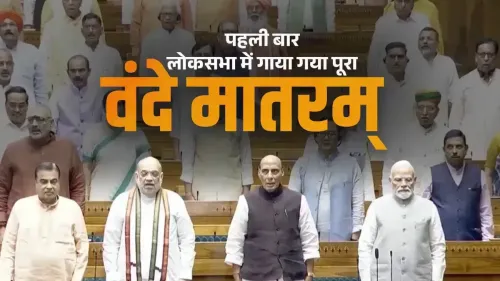
CM Bhajan Lal Hails 'Vande Mataram' Rendition in Parliament
Synopsis
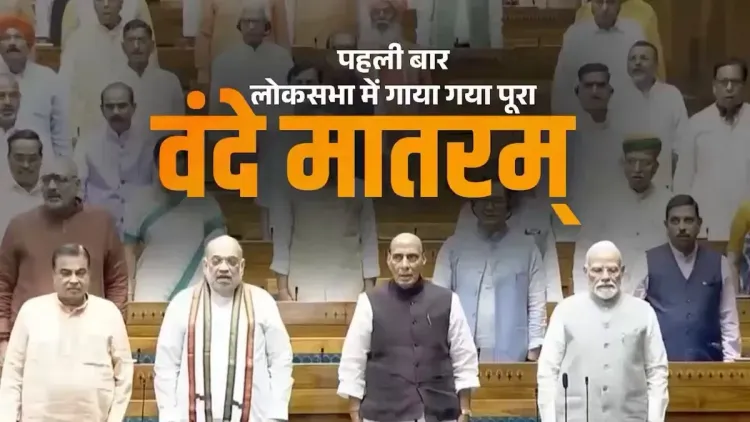
Rajasthan Chief Minister Bhajan Lal Sharma marked the apparent 150th anniversary of Vande Mataram with a post celebrating its full rendition in Parliament, linking the national song's legacy to India's freedom movement and the Viksit Bharat vision.
Key Takeaways
Rajasthan CM Bhajan Lal Sharma posted on 13 August 2026 celebrating the rendition of Vande Mataram in Parliament.
The post used #VandeMatram150 , indicating a 150th anniversary commemoration of the national song.
Vande Mataram was composed by Bankim Chandra Chatterjee in the late 19th century and adopted as India's national song by the Constituent Assembly in 1950 .
Sharma framed the moment as a confluence of the freedom struggle, national self-respect, and the Viksit Bharat development vision.
The post came on the eve of Independence Day, 14 August , amplifying its patriotic significance.
A 150-year-old poem, born in the crucible of colonial resistance, rang through the halls of India's Parliament — and Rajasthan Chief Minister Bhajan Lal Sharma wants every citizen to feel the weight of that moment. On 13 August 2026, Sharma took to X to mark what he described as the complete rendition of Vande Mataram inside the legislature, calling it a confluence of sacrifice, national pride, and the vision of a prosperous India.
Sharma wrote that the song, echoing through Parliament, 'connects every citizen to their roots' and carries the message that 'the spirit of patriotism was immortal yesterday and runs through our veins with the same energy today.' The post was accompanied by the hashtag #VandeMatram150, marking what appears to be the song's 150th anniversary commemoration.
'Vande Mataram' — From Bankim's Pen to Parliament's Chamber
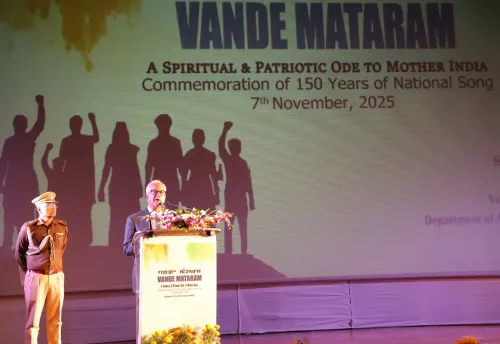
Vande Mataram — 'I bow to thee, Mother' — was composed by Bankim Chandra Chatterjee in the late 19th century and became a rallying cry of India's independence movement. The Constituent Assembly formally adopted it as India's national song in 1950, placing it alongside the national anthem as a symbol of sovereign identity. Its full rendition has historically carried particular emotional resonance — the complete version, beyond the two commonly sung stanzas, is a rarer, more deliberate act of cultural reclamation. For Sharma, the Parliament setting amplifies that resonance. The 'temple of democracy,' as he framed it, becomes the stage where historical memory and constitutional aspiration meet. He linked the moment explicitly to the goal of a Viksit Bharat — 'Developed India' — the BJP's overarching national development vision, threading cultural heritage into a forward-looking political narrative.BJP's Pattern of Linking Heritage to Governance
This is not an isolated gesture. State-level BJP leaders have periodically connected parliamentary or governmental actions on national symbols to the independence movement and contemporary development goals. Invoking Vande Mataram in a legislative setting — and amplifying it on social media — fits a deliberate pattern: using cultural milestones to reinforce both constitutional pride and the party's governance identity. With Independence Day falling the very next day, 14 August, the timing sharpens the symbolism further. The 150th anniversary of the song, if formally commemorated in Parliament, would mark a significant cultural programme — one that bridges the colonial-era freedom struggle with the present legislative institution. For 140 crore Indians, Sharma argued, the song is not an artifact of the past. It is a living pulse. Whether in a schoolroom, a cricket stadium, or the Central Hall of Parliament, Vande Mataram has always done one thing — remind a vast, diverse nation of the single thread that ties it together.Point of View
He draws a direct line from colonial-era sacrifice to the party's present governance agenda. The #VandeMatram150 hashtag suggests a coordinated commemorative campaign, not a spontaneous reaction. On the eve of Independence Day, such messaging is calibrated to reach beyond the party base and speak to a broader national sentiment.
NationPress
28 Sept 2026
Frequently Asked Questions
What is Vande Mataram and why is it significant?
Vande Mataram is India's national song, composed by Bankim Chandra Chatterjee in the late 19th century. It served as a rallying anthem during the independence movement and was adopted by the Constituent Assembly in 1950 .
Why did Bhajan Lal Sharma post about Vande Mataram on 13 August 2026?
Bhajan Lal Sharma posted to mark the apparent rendition of Vande Mataram in Parliament, coinciding with what the hashtag #VandeMatram150 suggests is the song's 150th anniversary, and on the eve of Independence Day.
What is Viksit Bharat, mentioned in the post?
Viksit Bharat , meaning 'Developed India,' is the BJP-led government's overarching vision for India's economic and social development, frequently invoked by party leaders alongside cultural and national heritage themes.
When was Vande Mataram officially adopted as India's national song?
The Constituent Assembly adopted Vande Mataram as India's national song in 1950 , the same year the Constitution came into force.
Who wrote Vande Mataram?
Vande Mataram was written by Bankim Chandra Chatterjee , the 19th-century Bengali author and poet, and first appeared in his novel Anandamath .