CM Bhajan Lal Sharma calls for scientific e-waste management
Synopsis
Rajasthan Chief Minister Bhajan Lal Sharma on 15 June 2026 called for scientific and safe e-waste management, linking it to resource recycling, environmental protection, and the circular economy as pillars of sustainable development.
Key Takeaways
Rajasthan CM Bhajan Lal Sharma on 15 June 2026 publicly emphasised scientific and safe management of electronic waste as a priority.
He framed e-waste management as central to resource recycling, environmental conservation, and circular economy goals.
India's E-Waste (Management) Rules were first notified in 2016 and significantly revised in 2022 to strengthen compliance and recycling targets.
The Ministry of Environment, Forest and Climate Change governs national e-waste policy, with state pollution boards handling enforcement.
NITI Aayog has promoted circular economy frameworks as a route to resource efficiency and reduced environmental harm.
Stakeholders including electronics manufacturers, recycling industries, and informal waste workers are directly affected by formalisation of the sector.
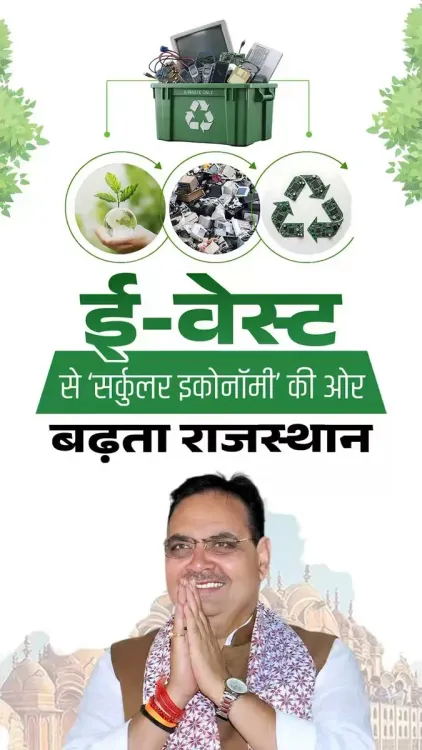
Rajasthan Chief Minister Bhajan Lal Sharma on Monday, 15 June 2026 underscored the importance of scientific and safe electronic waste management, calling it a critical step toward better resource utilisation and a cleaner future. The statement, shared on his official X account, also highlighted the state government's ongoing commitment to recycling, environmental protection, and building a circular economy.
In his post, Chief Minister Sharma wrote: 'तकनीकी प्रगति के इस दौर में ई-वेस्ट का वैज्ञानिक एवं सुरक्षित प्रबंधन संसाधनों के बेहतर उपयोग और स्वच्छ भविष्य की दिशा में एक महत्वपूर्ण कदम है' ['In this era of technological progress, scientific and safe management of e-waste is an important step toward better utilisation of resources and a clean future']. He further stated that the government is continuously working toward sustainable development and a green future by promoting resource recycling, environmental conservation, and the circular economy.
Context
India's rapid growth in electronics consumption has made it one of the largest generators of electronic waste in the world. Discarded mobile phones, computers, televisions, and household appliances accumulate in vast quantities, posing serious risks to soil, water, and public health when processed informally. Rajasthan, with its expanding urban centres and growing middle-class consumer base, is no exception to this national challenge.
Chief Minister Sharma's remarks align with a broader national conversation around responsible disposal and recovery of valuable materials — including metals such as gold, copper, and lithium — locked inside discarded electronics. The post was accompanied by a video, indicating an audio-visual communication effort around the theme.
Policy Backdrop
The Government of India first notified the E-Waste (Management) Rules in 2016, establishing a regulatory framework that placed extended producer responsibility on electronics manufacturers and mandated scientific collection and recycling channels. These rules were significantly revised in 2022 to tighten compliance mechanisms, set higher recycling targets, and bring the informal recycling sector into a more formalised structure.
The Ministry of Environment, Forest and Climate Change oversees national policy on e-waste, while state pollution control boards are responsible for on-the-ground enforcement. NITI Aayog has also issued strategy documents promoting circular economy models as a pathway to resource efficiency and reduced environmental degradation, providing a policy framework within which state-level action is increasingly being framed.
Stakeholders and Impact
The push for scientific e-waste management directly affects electronics manufacturers, who bear extended producer responsibility obligations, as well as urban consumers who generate the bulk of discarded devices. The formal recycling industry stands to benefit from clearer collection pipelines and greater volumes of material, while state pollution control boards face the operational challenge of monitoring compliance across a large and geographically diverse state.
For informal waste workers — who currently handle a significant share of e-waste processing in hazardous conditions — formalisation of the sector carries both opportunity and risk: greater safety standards and livelihood integration on one hand, potential displacement from existing income streams on the other.
What's Next
Attention will now turn to whether the Rajasthan government follows the Chief Minister's statement with concrete operational steps — including state-level e-waste collection targets, designated recycling facilities, and awareness campaigns targeting urban households and institutions. Multiple states across India have launched collection drives and formal recycling infrastructure in recent years to complement central regulations, and Rajasthan's next moves will be watched for similar follow-through.
At the national level, parliamentary scrutiny of extended producer responsibility compliance and the pace of formalisation in the recycling sector will shape the broader environment within which state governments operate. Bhajan Lal Sharma's public framing of e-waste management as a development priority signals that the issue is being elevated beyond regulatory compliance into the domain of political commitment — a shift that could accelerate state-level action in Rajasthan.
Point of View
He aligns Rajasthan with a policy language increasingly favoured at the central level, potentially signalling intent to announce concrete state-level programmes. The timing is notable as India's revised 2022 e-waste rules are now in active implementation, and states face growing pressure to demonstrate action beyond rhetoric. Whether this translates into measurable infrastructure — collection points, certified recyclers, public awareness drives — will determine the statement's lasting political and policy weight.
NationPress
14 Sept 2026
Frequently Asked Questions
What did Rajasthan CM Bhajan Lal Sharma say about e-waste?
CM Bhajan Lal Sharma stated on 15 June 2026 that scientific and safe management of e-waste is an important step toward better resource utilisation and a clean future, and that his government is working continuously toward sustainable development through recycling and circular economy promotion.
What are India's e-waste management rules?
India first notified the E-Waste (Management) Rules in 2016, placing extended producer responsibility on electronics manufacturers. The rules were revised in 2022 to set higher recycling targets and bring the informal recycling sector into a more formalised structure.
What is a circular economy in the context of e-waste?
A circular economy approach to e-waste means recovering valuable materials from discarded electronics — such as metals and components — and reintroducing them into the production cycle, reducing both resource extraction and environmental pollution.
Which ministry handles e-waste policy in India?
The Ministry of Environment, Forest and Climate Change is the central ministry responsible for national e-waste policy, while state pollution control boards handle on-the-ground enforcement and compliance monitoring.
Why is e-waste a growing concern in Rajasthan and India?
India is one of the world's largest generators of electronic waste due to rapid growth in electronics consumption. Informal processing of e-waste poses serious risks to soil, water, and public health, making scientific management and formalised recycling infrastructure an urgent priority.