CM Bhajan Lal Pays Tribute to Folk Legend Gavri Devi
Synopsis
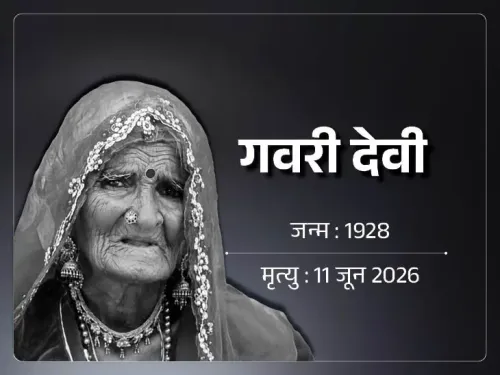
Rajasthan Chief Minister Bhajan Lal Sharma on 29 June 2026 honoured legendary Mand folk singer Gavri Devi, known as 'Maru Kokila,' on her death anniversary, calling her contribution to folk music priceless and an enduring inspiration for future generations.
Key Takeaways
CM Bhajan Lal Sharma paid tribute to folk legend Gavri Devi on her death anniversary on 29 June 2026 .
Gavri Devi is celebrated as 'Maru Kokila' — the Nightingale of the Desert — for her mastery of the Mand folk-singing tradition of Rajasthan.
She was awarded the Padma Shri , India's fourth-highest civilian honour, for her contribution to Indian folk music.
Mand is a classical-folk genre rooted in the Marwar and Thar Desert regions, known for its semi-classical structure and lyrical depth.
The Chief Minister described her contribution as 'priceless' and said it would 'continue to inspire generations to come.' The tribute reflects Rajasthan 's ongoing state effort to recognise and preserve its intangible cultural heritage.
Rajasthan Chief Minister Bhajan Lal Sharma on Monday, 29 June 2026, paid tribute to legendary folk singer Gavri Devi, fondly known as 'Maru Kokila' (the Nightingale of the Desert), on her death anniversary, honouring her as a towering figure in Rajasthan's Mand singing tradition.
Context
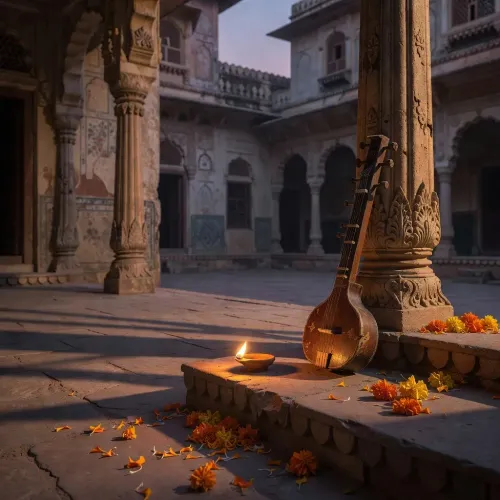
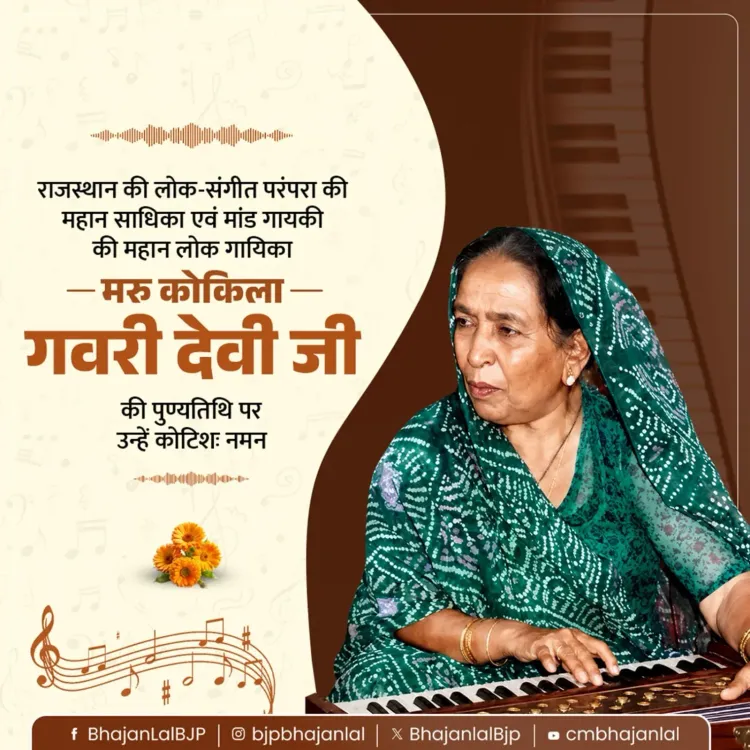
In his post, CM Sharma offered 'kotishaha naman' — a reverent salute — to Gavri Devi, describing her as a 'mahan sadhika' (great devotee) of Rajasthan's folk-music tradition and a 'mahan lok gayika' (great folk singer) of the Mand style. He wrote that her contribution to folk music is 'priceless and will always be remembered, continuing to inspire generations to come.' The tribute was accompanied by an image shared on the Chief Minister's official X account.
Policy Backdrop
Mand is a classical-folk genre native to the Marwar and Thar Desert regions of Rajasthan, characterised by its semi-classical melodic structure, lyrical depth, and association with royal courts and desert culture. Gavri Devi is widely credited with bringing Mand singing to national and international recognition, becoming one of its most celebrated exponents. She received the Padma Shri, India's fourth-highest civilian honour, in recognition of her immense contribution to Indian folk music. Her passing left a significant void in the living tradition of Rajasthani folk arts.
The Government of Rajasthan has historically supported folk arts through cultural bodies and festivals such as the Rajasthan International Folk Festival (RIFF) held at Mehrangarh Fort, Jodhpur. Institutional remembrance of artists like Gavri Devi is part of a broader state effort to sustain interest in endangered classical-folk forms among younger audiences.
Stakeholders and Impact
Artists, cultural organisations, and folk-music practitioners across Rajasthan look to such official tributes as affirmations of state support for intangible cultural heritage. For communities in the Thar Desert belt — where Mand music is woven into social and ceremonial life — recognition from the Chief Minister carries symbolic weight in legitimising preservation efforts. Students and scholars of Indian classical and folk music also benefit when high-profile remembrances draw public attention to endangered genres.
What's Next
The death anniversary tribute is likely to prompt renewed discussion among cultural institutions and the state government about documentation, archiving, and promotion of the Mand tradition. With Rajasthan positioning itself as a cultural-tourism destination, sustained investment in living folk traditions — and in honouring their masters — will remain central to both heritage policy and the state's cultural identity for years ahead.
Point of View
But it also signals the BJP-led Rajasthan government's intent to position itself as a custodian of the state's rich folk heritage. Honouring Padma Shri recipients and folk icons aligns with the broader cultural-nationalism arc that the party has emphasised at both state and national levels. For Rajasthan, where folk arts are also a pillar of the tourism economy, such tributes carry practical policy resonance beyond symbolism. The gesture is likely to be welcomed across political lines, given Gavri Devi's non-partisan stature as a national cultural treasure.
NationPress
29 Jun 2026
Frequently Asked Questions
Who was Gavri Devi, the folk singer?
Gavri Devi was a celebrated Rajasthani folk singer known as 'Maru Kokila' or the Nightingale of the Desert. She was one of the foremost exponents of the Mand singing tradition of Rajasthan and was awarded the Padma Shri for her contribution to Indian folk music.
What is Mand singing in Rajasthan?
Mand is a classical-folk musical genre native to the Marwar and Thar Desert regions of Rajasthan. It is characterised by a semi-classical melodic structure, rich lyrical content, and historical association with the royal courts of the region.
Why did CM Bhajan Lal Sharma pay tribute to Gavri Devi?
CM Bhajan Lal Sharma paid tribute to Gavri Devi on her death anniversary on 29 June 2026, honouring her lifelong contribution to Rajasthan's folk-music heritage, particularly the Mand tradition, and calling her an enduring inspiration for future generations.
What award did Gavri Devi receive?
Gavri Devi received the Padma Shri, India's fourth-highest civilian honour, in recognition of her outstanding contribution to Indian folk music and the Mand singing tradition of Rajasthan.
What is 'Maru Kokila' meaning?
'Maru Kokila' is a Hindi-Rajasthani honorific meaning 'Nightingale of the Desert.' It was a title given to Gavri Devi to honour her exceptionally melodious voice and her mastery of the desert folk-music tradition of Rajasthan.