CM Bhajan Lal pays tribute to Padma Shri Kanhaiyalal Sethia
Synopsis
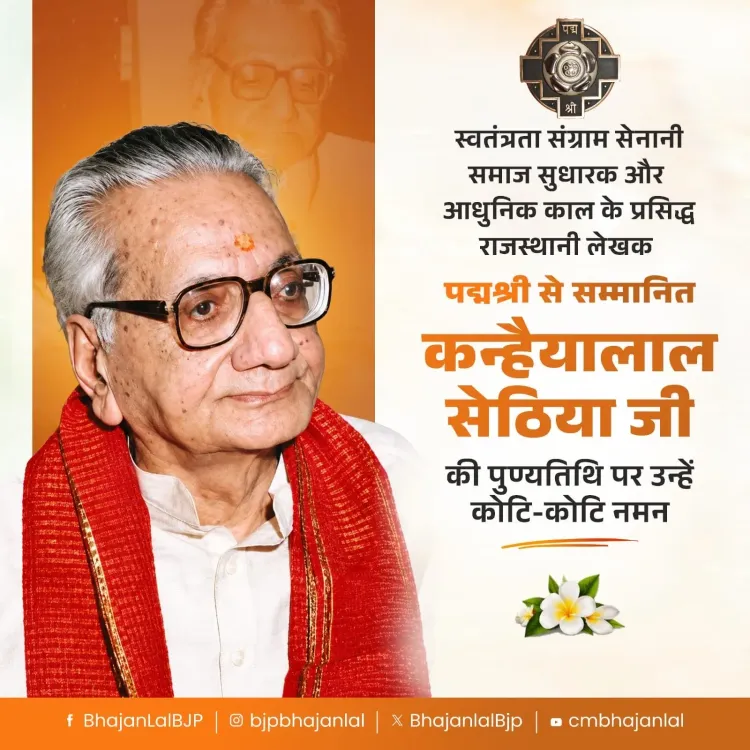
Rajasthan CM Bhajan Lal Sharma paid tribute on the death anniversary of Padma Shri Kanhaiyalal Sethia, hailing the freedom fighter and Rajasthani poet's immortal works as a beacon for future generations and his culture-defining legacy on the global stage.
Key Takeaways
Rajasthan CM Bhajan Lal Sharma marked the death anniversary of Padma Shri Kanhaiyalal Sethia with a tribute on November 11, 2026.
Sethia's celebrated works include 'Pathal aur Pithal' and 'Dharti Dhoran Ri' , both landmarks of Rajasthani literature.
Sethia was a freedom fighter , social reformer, and recipient of the Padma Shri — India's fourth-highest civilian honour.
CM Sharma credited Sethia with placing Rajasthan's valour and cultural consciousness on the global stage .
Sethia's legacy remains intertwined with the unresolved campaign for Rajasthani language recognition under the Indian Constitution's Eighth Schedule.
On the death anniversary of Padma Shri Kanhaiyalal Sethia, Rajasthan Chief Minister Bhajan Lal Sharma offered a deeply felt tribute to the poet widely regarded as the voice of Rajasthani language and culture, calling his literary legacy a timeless guide for future generations.
In his post on Wednesday, November 11, 2026, CM Sharma wrote: 'पाथल और पीथल' ('Pathal aur Pithal') and 'धरती धोरां री' ('Dharti Dhoran Ri') — through these immortal works, Sethia placed the valour and cultural consciousness of marudhra (the desert land of Rajasthan) on the global stage. The Chief Minister offered what he called 'kotishaः naman' — a salute of a hundred million folds — to the freedom fighter and social reformer.
The poet who gave Rajasthani its anthem
Kanhaiyalal Sethia, born in Sujangarh, Rajasthan, is considered the father of modern Rajasthani poetry. His epic poem 'Pathal aur Pithal' is taught across Rajasthan and is credited with sparking a renewed pride in Rajasthani identity. 'Dharti Dhoran Ri' is so deeply embedded in popular memory that it functions, for many Rajasthanis, as an unofficial anthem of the state. Sethia was honoured with the Padma Shri — India's fourth-highest civilian award — in recognition of his towering contribution to literature and cultural preservation.
Beyond verse, Sethia was a committed freedom fighter who participated in India's independence movement and a social reformer who used literature as a vehicle for conscience. That rare combination of political courage and artistic brilliance is precisely why CM Sharma invoked both dimensions in his tribute.
Rajasthani language and the politics of recognition
The tribute lands at a moment when the campaign for official recognition of the Rajasthani language under the Eighth Schedule of the Indian Constitution remains active and unresolved. Sethia spent decades advocating for that recognition, arguing that a language spoken by tens of millions deserved constitutional standing. Indian state leaders regularly mark the death anniversaries of regional literary giants, but Sethia's anniversary carries added resonance: each official tribute implicitly keeps the language-recognition debate in public view.
CM Sharma's post signals continued state-level attention to Rajasthani cultural heritage — an alignment that the Rajasthani literary community watches closely as it pushes for greater institutional support for writers and scholars working in the language.
Sethia's ojasvi sahitya — his vigorous, luminous literature — was never decorative. It was argumentative, patriotic, and rooted in the red soil of the Thar. That is the inheritance CM Sharma invoked today, and it is one Rajasthan has not finished debating.
Point of View
Which serves both a heritage-preservation agenda and an implicit political signalling to Rajasthani-language advocates. Sethia's legacy is inseparable from the long-pending demand for Rajasthani's inclusion in the Eighth Schedule — a demand that successive central governments have deferred. Official tributes from sitting chief ministers keep that aspiration visible without committing state resources or legislative action. For the Rajasthani literary community, such acknowledgements are welcome but increasingly insufficient without concrete policy follow-through.
NationPress
11 Nov 2026
Frequently Asked Questions
Who was Kanhaiyalal Sethia?
Kanhaiyalal Sethia was a Padma Shri-awarded Rajasthani poet, freedom fighter, and social reformer from Sujangarh, Rajasthan. He is widely regarded as the father of modern Rajasthani poetry, best known for epic works like 'Pathal aur Pithal' and 'Dharti Dhoran Ri'.
What is 'Dharti Dhoran Ri'?
'Dharti Dhoran Ri' is one of Kanhaiyalal Sethia's most celebrated poems celebrating the land and spirit of Rajasthan. It is so beloved that many Rajasthanis consider it an unofficial cultural anthem of the state.
Why did CM Bhajan Lal Sharma pay tribute to Kanhaiyalal Sethia?
CM Bhajan Lal Sharma paid tribute on Sethia's death anniversary, honouring his legacy as a freedom fighter, social reformer, and Padma Shri laureate who elevated Rajasthani language and culture to a global platform.
What award did Kanhaiyalal Sethia receive?
Kanhaiyalal Sethia was honoured with the Padma Shri, India's fourth-highest civilian award, in recognition of his exceptional contributions to Rajasthani literature and cultural preservation.
Is Rajasthani language officially recognised by the Indian Constitution?
No. Despite being spoken by tens of millions, Rajasthani has not yet been included in the Eighth Schedule of the Indian Constitution, which lists officially recognised Indian languages. Sethia was among its most prominent advocates during his lifetime.