CM Bhajan Lal Sharma Pays Tribute to Dr Ram Manohar Lohia
Synopsis
Rajasthan Chief Minister Bhajan Lal Sharma paid tribute to Dr Ram Manohar Lohia on his 59th death anniversary, honouring the socialist icon's Saptakranti doctrine, his mass-movement vision of democracy, and his enduring call for an egalitarian Indian society.
Key Takeaways
Rajasthan CM Bhajan Lal Sharma paid tribute to Dr Ram Manohar Lohia on his death anniversary, 12 October 2026 .
Sharma honoured Lohia as the pioneer of Saptakranti (Seven Revolutions) and a great freedom fighter.
He credited Lohia with giving democracy the character of a mass movement and awakening the cause of social justice.
Lohia died on 12 October 1967 , leaving a political and philosophical legacy that cuts across party lines.
The tribute is notable as a BJP chief minister formally honouring a socialist icon whose ideas underpin backward-caste and social-justice politics in India.
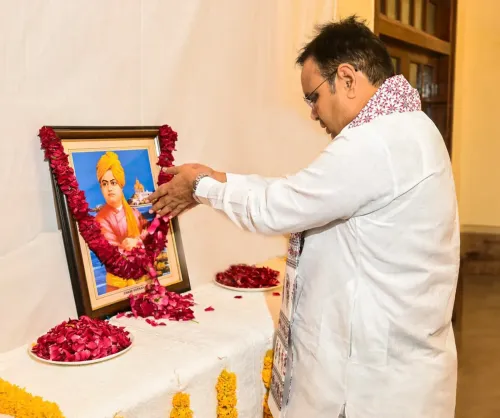
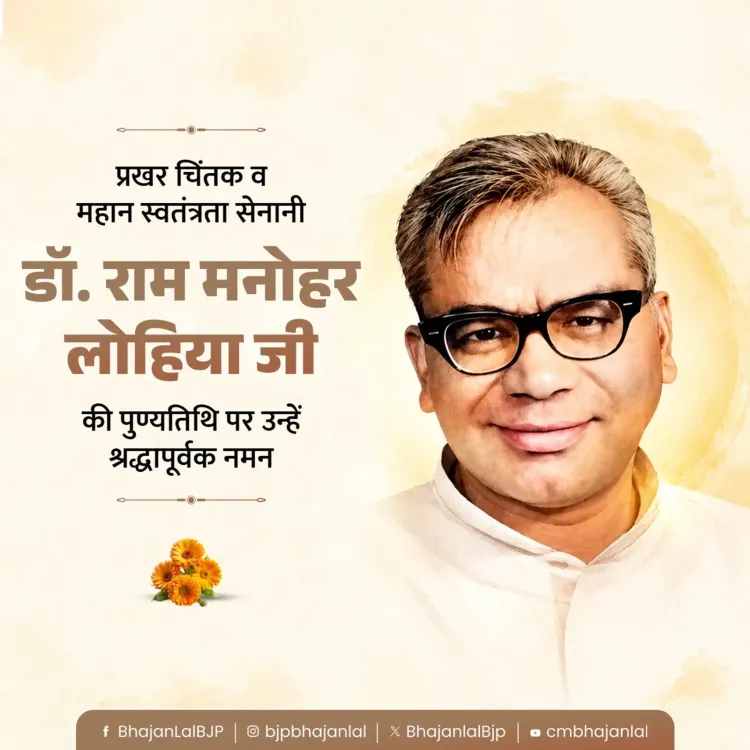
On the death anniversary of one of independent India's most electrifying voices, Rajasthan Chief Minister Bhajan Lal Sharma on Monday, 12 October 2026, paid a heartfelt tribute to Dr Ram Manohar Lohia — the socialist thinker, freedom fighter, and architect of the Saptakranti ('Seven Revolutions') philosophy that reshaped Indian political thought.
Sharma's post, written in Hindi, offered a moving tribute: 'On the death anniversary of Dr Ram Manohar Lohia, the pioneer of Saptakranti and a great freedom fighter, a heartfelt tribute! His contribution to giving democracy the form of a mass movement and igniting the flame of social justice is unforgettable. His ideas will continue to inspire the nation to build an egalitarian society for ages to come.'
The Saptakranti legacy and why it still resonates
Dr Ram Manohar Lohia died on 12 October 1967, leaving behind a doctrine — Saptakranti — that called simultaneously for seven interlocking revolutions: against inequality of gender, race, caste, and class; against colonial domination; for economic equity; and for individual civil liberty. It was a framework decades ahead of its institutional vocabulary. His insistence that political democracy without social democracy was an empty promise remains a fault line in Indian public debate today.
Lohia was also the theorist who weaponised the concept of backward caste politics long before it became an electoral arithmetic. His call for proportional representation across government jobs and legislatures seeded movements that would flower into the Mandal era and beyond. In a country still debating caste census and reservation reform, his ideas are anything but archived history.
A BJP chief minister honours a socialist icon
The tribute carries a notable political texture. CM Sharma leads a BJP government in Rajasthan, while Lohia's intellectual lineage flows most directly through socialist and backward-caste parties — the Samajwadi Party chief among them. When a BJP chief minister places Lohia's mass-movement vision and social-justice legacy at the centre of a formal tribute, it signals the breadth of the socialist leader's cross-ideological footprint. No single party owns Lohia's memory; every corner of Indian politics has claimed a piece of it.
Sharma's acknowledgement that Lohia 'gave democracy the form of a mass movement' is particularly pointed: it is a phrase that cuts across party lines, echoing in the grammar of grassroots mobilisation that Indian voters across the spectrum respond to instinctively.
Point of View
Engaging with Lohia's social-justice vocabulary is part of a broader effort to signal inclusivity toward backward-caste and marginalised communities — a constituency that has grown electorally decisive. Lohia's Saptakranti framework, particularly its insistence on caste and gender equity alongside political freedom, remains a live challenge to every ruling dispensation, not a settled achievement. Tributes like this one are as much a conversation about unfinished business as they are about historical reverence.
NationPress
12 Oct 2026
Frequently Asked Questions
Who was Dr Ram Manohar Lohia?
Dr Ram Manohar Lohia was a prominent Indian socialist politician and freedom fighter, known for his Saptakranti (Seven Revolutions) philosophy advocating simultaneous revolutions against caste, gender, racial, and economic inequality. He died on 12 October 1967.
What is Saptakranti?
Saptakranti, or 'Seven Revolutions,' is a political philosophy developed by Dr Ram Manohar Lohia calling for seven interlocking social and political revolutions — encompassing gender equality, caste equity, anti-colonialism, racial justice, economic fairness, and civil liberty.
Why did CM Bhajan Lal Sharma pay tribute to Lohia?
Rajasthan Chief Minister Bhajan Lal Sharma paid tribute on Dr Lohia's death anniversary, 12 October, acknowledging his unforgettable contribution to democracy as a mass movement and his role in igniting the flame of social justice in India.
When is Ram Manohar Lohia's death anniversary?
Dr Ram Manohar Lohia's death anniversary, known as Punyatithi, falls on 12 October each year. He passed away on 12 October 1967.
What is Bhajan Lal Sharma's political position?
Bhajan Lal Sharma is the Chief Minister of Rajasthan and a leader of the Bharatiya Janata Party (BJP), having assumed office after the BJP's victory in the Rajasthan state assembly elections.