CM Bhajan Lal reaffirms women empowerment pledge for Rajasthan
Synopsis
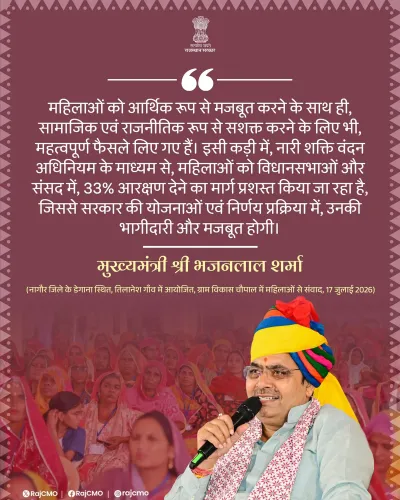
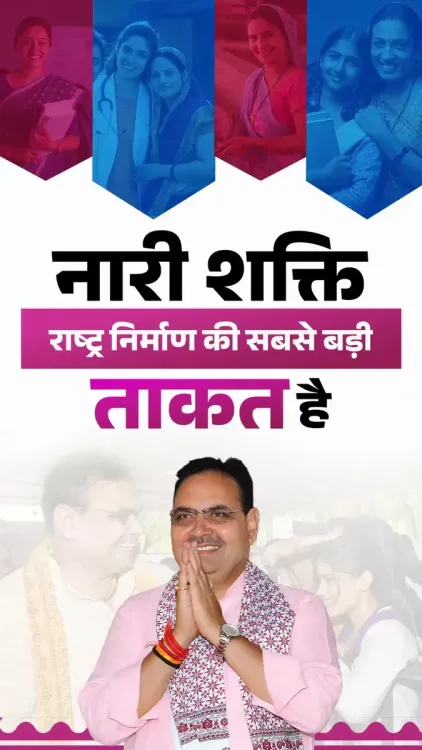
Rajasthan Chief Minister Bhajan Lal Sharma on 17 June 2026 declared that an empowered woman is the strongest foundation of a developed Rajasthan, reaffirming his BJP-led government's commitment to women's honour, safety, self-reliance, and holistic development.
Key Takeaways
CM Bhajan Lal Sharma posted on 17 June 2026 reaffirming the Rajasthan government's commitment to women's empowerment.
The post identifies women's safety, self-reliance, honour, and all-round development as the four pillars of the government's stated policy focus.
The BJP-led Rajasthan government has held office since December 2023 , with women-centric schemes as a flagship priority.
The Mukhyamantri Rajshree Yojana , launched in 2016 , is among the key existing schemes underpinning this agenda in the state.
Self-help groups are a primary channel for delivering economic empowerment at the grassroots level in Rajasthan.
Follow-up budget announcements and new welfare guidelines in the next legislative session will be the key test of implementation.
Rajasthan Chief Minister Bhajan Lal Sharma on Wednesday, 17 June 2026 reaffirmed his government's commitment to women's empowerment, stating that an empowered woman is the strongest foundation of a prosperous society and a developed Rajasthan. The declaration, made via a post on X, signals a continued policy focus on safety, self-reliance, and holistic development for women across the state.
Context
In his post, CM Sharma wrote in Hindi: 'सशक्त महिला ही समृद्ध समाज और विकसित राजस्थान की सबसे मजबूत आधारशिला है' ['An empowered woman is the strongest cornerstone of a prosperous society and a developed Rajasthan']. He added that his government is working with full commitment for the 'honour, safety, self-reliance and all-round development' of women. The statement comes as the BJP-led Rajasthan government, which assumed office in December 2023, continues to position women-centric governance as a flagship priority.
Policy Backdrop
The Rajasthan government's approach to women's welfare draws on a policy lineage that includes schemes such as the Mukhyamantri Rajshree Yojana, originally launched in 2016 and subsequently revised, which provides financial support linked to the birth and education of girl children. The 2023 BJP election manifesto for Rajasthan reiterated commitments to expand women-welfare measures spanning safety infrastructure, economic participation, and health. Self-help groups have been identified as a key vehicle for channelling economic empowerment at the grassroots level.
The broader pattern mirrors initiatives in other BJP-governed states such as Madhya Pradesh and Maharashtra, where linking female security and economic participation to overall state development indicators has become a consistent governance template since the mid-2010s. For Rajasthan, this translates into a dual focus: institutional mechanisms for safety and legal protection on one hand, and livelihood-linked schemes on the other.
Stakeholders and Impact
The primary beneficiaries of this stated policy direction are women across Rajasthan, particularly those in rural areas who are enrolled in or seeking to join self-help groups and government-backed livelihood programmes. Women's safety infrastructure — including helplines, fast-track courts, and police outreach — also falls within the ambit of the government's declared commitments. Civil society organisations working on gender issues in the state are likely to track whether the rhetorical commitment translates into specific budgetary allocations in the upcoming legislative session.
Politically, the emphasis on women's welfare serves a dual purpose: addressing genuine development gaps in a state where female labour force participation and safety indices have historically lagged, while also consolidating a voter base that proved decisive in the 2023 assembly elections.
What's Next
Observers will watch the next Rajasthan legislative session for concrete follow-through — including budget line items for women's safety infrastructure and enhanced funding for self-help group networks. Any new scheme announcements or amendments to existing welfare orders will be the clearest measure of whether this reaffirmation moves from statement to policy action. The government's track record on implementation timelines will be a key benchmark for both opposition parties and civil society in the months ahead.
Point of View
While aspirational in tone, fits a well-established pattern in BJP-ruled states of using high-visibility declarations to reinforce a policy identity ahead of budget cycles and legislative sessions. The real test will lie in the specificity of scheme expansions and budgetary allocations that follow — areas where Rajasthan has historically had gaps between stated intent and ground-level delivery. For now, the post functions as a policy signal directed at both voters and bureaucratic machinery.
NationPress
21 Sept 2026
Frequently Asked Questions
What did Rajasthan CM Bhajan Lal Sharma say about women empowerment?
CM Bhajan Lal Sharma stated on 17 June 2026 that an empowered woman is the strongest cornerstone of a prosperous society and a developed Rajasthan, and that his government is fully committed to women's honour, safety, self-reliance, and all-round development.
What schemes does the Rajasthan government have for women's welfare?
The Rajasthan government's women welfare framework includes the Mukhyamantri Rajshree Yojana, which provides financial support linked to the birth and education of girl children, along with safety infrastructure and self-help group support programmes.
When did Bhajan Lal Sharma become Chief Minister of Rajasthan?
Bhajan Lal Sharma became Chief Minister of Rajasthan in December 2023 after the BJP won the state assembly elections.
What is the Mukhyamantri Rajshree Yojana in Rajasthan?
The Mukhyamantri Rajshree Yojana is a Rajasthan government scheme originally launched in 2016 that provides financial assistance to families linked to the birth, health, and education of girl children, and has been revised over the years.
How does Rajasthan's women empowerment policy compare to other BJP states?
Rajasthan's approach mirrors similar initiatives in BJP-governed states like Madhya Pradesh and Maharashtra, where linking female safety and economic participation to overall state development indicators has been a consistent governance strategy since the mid-2010s.