CM Bhajan Lal Reviews Development Works in Bharatpur
Synopsis
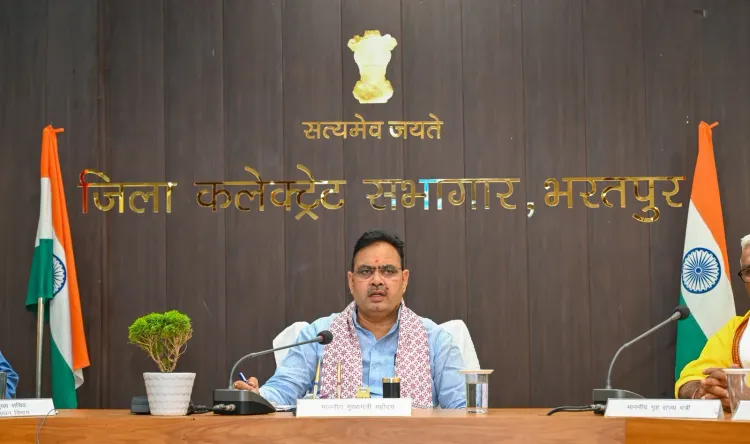
Rajasthan Chief Minister Bhajan Lal Sharma on 25 May 2026 reviewed ongoing development works and welfare schemes with officials at the Bharatpur District Collectorate, directing that all projects be completed on time and with high quality for swift public benefit.
Key Takeaways
Bhajan Lal Sharma chaired a review meeting at the Bharatpur District Collectorate auditorium on 25 May 2026 .
The CM directed officials to complete all projects within set timelines and to a high quality standard.
The meeting covered ongoing development works and public welfare schemes across Bharatpur district .
Sharma emphasised 'holistic and balanced development' to strengthen progress in every region of Rajasthan .
The review is part of a district-level monitoring mechanism instituted by the BJP government after the December 2023 elections.
Subsequent compliance reports from district officials are expected as part of the 2026-27 budget cycle oversight.
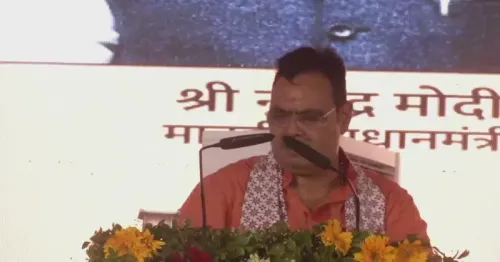
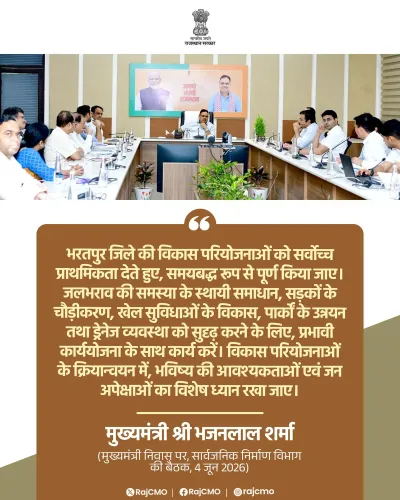
Rajasthan Chief Minister Bhajan Lal Sharma on Monday, 25 May 2026 chaired a review meeting with district officials at the Bharatpur District Collectorate auditorium, conducting a detailed assessment of ongoing development projects and public welfare schemes across the district.
Addressing officials, the Chief Minister stated — in translation from Hindi — that 'all projects must be completed within the set timeline and with high quality, so that the common people on the ground can receive their benefits swiftly.' The original post notes: धरातल पर आमजन को इनका त्वरित लाभ मिल सके ('so that people at the grassroots can receive swift benefits').
Sharma also underlined that the state government is 'continuously working for the holistic and balanced development of the state, so that the pace of development in every region can be further strengthened.'
Context
Bharatpur, located in eastern Rajasthan bordering Uttar Pradesh, is a district of agricultural significance and home to the Keoladeo National Park, a UNESCO World Heritage Site. The district has historically been the site of periodic high-level administrative reviews given its strategic location and development needs.
The BJP government under Sharma came to power in Rajasthan following the December 2023 assembly elections. Since assuming office, the administration has instituted district-level monitoring mechanisms aimed at accelerating the execution of pending infrastructure and welfare projects across the state's 33 districts.
Policy Backdrop
The Bharatpur review is part of a broader governance model adopted by the Sharma administration, which emphasises direct CM-level oversight of project delivery at the district tier. This approach mirrors practices in other BJP-governed states that have stressed decentralised oversight as a tool for equitable regional growth and reducing inter-district disparities.
Officials at such meetings are typically directed to synchronise state-funded schemes with centrally sponsored programmes, ensuring that welfare benefits — ranging from housing and rural roads to drinking water and health infrastructure — reach intended beneficiaries without administrative delay. The stress on 'high quality' execution signals accountability expectations beyond mere deadline compliance.
Stakeholders and Impact
The primary beneficiaries of time-bound project completion are the common citizens of Bharatpur district, particularly those in rural areas dependent on state-delivered infrastructure and welfare entitlements. District administration officials are the immediate stakeholders, bearing direct responsibility for implementation timelines and quality standards set at the review.
The meeting's emphasis on 'balanced development' also carries significance for regions within Rajasthan that have historically lagged in receiving their proportionate share of state investment. By personally chairing district reviews, the Chief Minister signals political accountability alongside administrative oversight.
What's Next
The Bharatpur review is expected to be followed by compliance reports from district officials on the specific projects discussed. Rajasthan's broader 2026-27 budget cycle will serve as the next major checkpoint for assessing whether district-level execution has kept pace with the government's stated commitment to balanced, high-quality development.
Further district review meetings across Rajasthan are anticipated as the administration continues its pattern of direct field-level monitoring — a practice that will be closely watched as a gauge of governance effectiveness ahead of future electoral cycles.
Point of View
A region that has often felt peripheral to Jaipur-centric policy attention. How consistently this model is applied across all 33 districts will ultimately determine whether it shifts outcomes or remains a symbolic exercise.
NationPress
20 Sept 2026
Frequently Asked Questions
Why did CM Bhajan Lal Sharma visit Bharatpur on 25 May 2026?
CM Bhajan Lal Sharma visited Bharatpur to chair a review meeting with district officials, assessing the progress of ongoing development projects and public welfare schemes in the district.
What instructions did Bhajan Lal Sharma give to Bharatpur officials?
He directed officials to complete all projects within their set timelines and to maintain high quality standards, ensuring that the benefits of these schemes reach common citizens swiftly.
What is Rajasthan's district review model under CM Bhajan Lal Sharma?
Since taking office after the December 2023 elections, CM Sharma's government has instituted district-level monitoring meetings led by the Chief Minister to accelerate execution of pending infrastructure and welfare projects across Rajasthan's 33 districts.
What is the significance of Bharatpur for Rajasthan's development agenda?
Bharatpur is a strategically located eastern Rajasthan district bordering Uttar Pradesh, with agricultural importance and tourism significance. It is a focal point for ensuring balanced regional development across the state.
What comes after the Bharatpur review meeting?
District officials are expected to submit compliance reports on the projects reviewed. Progress will be assessed as part of Rajasthan's 2026-27 budget cycle, with further district review meetings anticipated statewide.