CM Bhajan Lal pays tribute to Bhagat Singh on birth anniversary
Synopsis
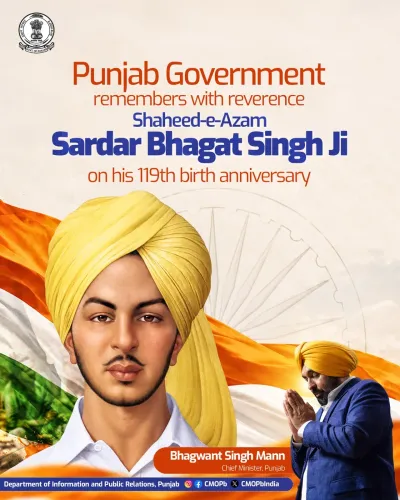
Rajasthan Chief Minister Bhajan Lal Sharma paid tribute to revolutionary martyr Bhagat Singh on his birth anniversary, September 28, describing him as an enduring symbol of youth power, sacrifice, and patriotism whose legacy continues to inspire national service.
Key Takeaways
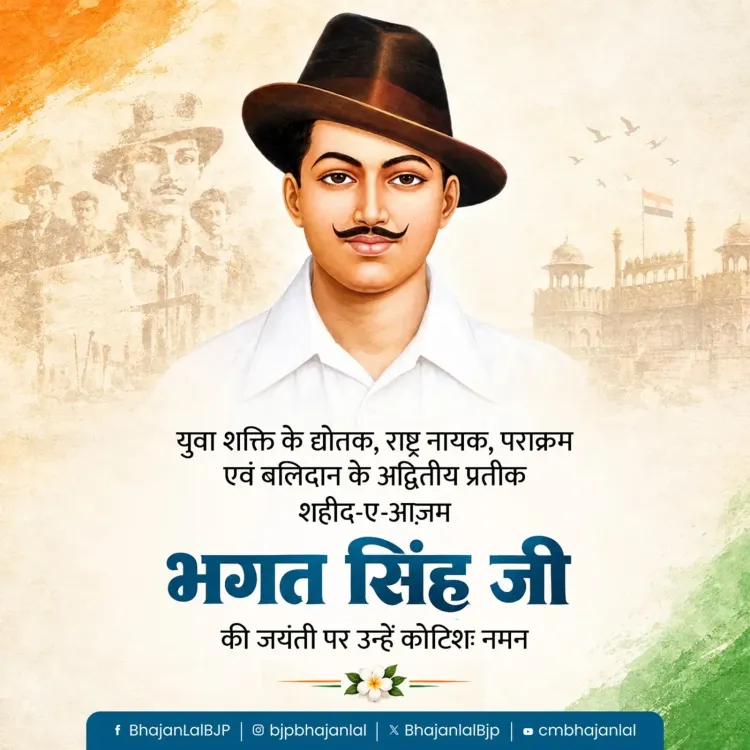
Rajasthan CM Bhajan Lal Sharma posted a tribute to Shaheed-e-Azam Bhagat Singh on his birth anniversary, 28 September .
Sharma described Bhagat Singh as 'the beacon of youth energy and an unmatched symbol of valour and supreme sacrifice.' Bhagat Singh was born on 28 September 1907 and executed by British authorities on 23 March 1931 , aged just 23 .
He was a key figure in the Hindustan Socialist Republican Association (HSRA) and is widely known by the title Shaheed-e-Azam .
Indian elected leaders across parties observe the tradition of public tributes to Bhagat Singh each year on his birth anniversary.
On the birth anniversary of one of India's most revered revolutionary martyrs, Rajasthan Chief Minister Bhajan Lal Sharma on Monday, 28 September offered his tribute to Shaheed-e-Azam Bhagat Singh, calling him an unparalleled symbol of youth power, valour, and supreme sacrifice.
In his post, CM Sharma wrote — 'युवा शक्ति के द्योतक, पराक्रम एवं सर्वोच्च बलिदान के अद्वितीय प्रतीक' — saluting Bhagat Singh as 'the beacon of youth energy and an unmatched symbol of valour and supreme sacrifice.' He added that Bhagat Singh's indomitable courage, sharp ideas, and unbreakable love for the nation continue to inspire every Indian toward national service even today.
The man behind the legend: Bhagat Singh's revolutionary arc
Born on 28 September 1907 in what is now Punjab, Pakistan, Bhagat Singh rose to become one of the most electrifying figures of India's independence movement. A key organiser within the Hindustan Socialist Republican Association (HSRA), he believed that colonial rule could only be dismantled through direct confrontation. His acts of defiance — including the 1929 Central Legislative Assembly bombing, carried out to 'make the deaf hear' rather than to kill — were designed as political statements as much as physical acts. Arrested in the Lahore Conspiracy Case, Bhagat Singh refused a defence that might have saved his life. He was executed by British authorities on 23 March 1931, aged just 23. The title Shaheed-e-Azam — 'the greatest martyr' — was not bestowed by any government decree; it was conferred by the collective grief and admiration of a nation that watched a young man walk to the gallows smiling.A ritual of remembrance across party lines
CM Sharma's tribute follows a well-established pattern in Indian political life: every 28 September, elected leaders across the spectrum issue public homages to Bhagat Singh, drawing on themes of sacrifice and nationalism to connect contemporary governance with the fire of the independence era. The gesture carries particular resonance for Rajasthan, a state with a deep martial tradition, where the language of sacrifice and national service holds enduring public weight. Yet the annual commemoration is more than ceremonial. Bhagat Singh's legacy — socialist in orientation, secular in practice, fiercely anti-imperial in method — remains genuinely contested territory in India's political memory, claimed with equal fervour across ideological lines. That contestation is itself a measure of how permanently he is woven into the national fabric. At 23, Bhagat Singh had already become immortal. Nearly a century later, every September, the country remembers why.Point of View
The framing of Bhagat Singh's sacrifice as an inspiration for 'national service' subtly links the freedom movement's moral capital to the present government's agenda. Yet Bhagat Singh's own socialist and secular convictions complicate any single-party claim to his memory, making these annual tributes a quiet arena of competitive patriotism. The persistence of this ritual, year after year, underlines how potent the independence era's emotional vocabulary remains in shaping contemporary political messaging.
NationPress
28 Sept 2026
Frequently Asked Questions
When is Bhagat Singh's birth anniversary?
Bhagat Singh's birth anniversary falls on 28 September each year. He was born on 28 September 1907.
Why is Bhagat Singh called Shaheed-e-Azam?
Bhagat Singh is called Shaheed-e-Azam , meaning 'the greatest martyr,' because he sacrificed his life for India's independence at the age of just 23, becoming a supreme symbol of patriotic sacrifice in the national memory.
What was Bhagat Singh's role in the independence movement?
Bhagat Singh was a key organiser of the Hindustan Socialist Republican Association (HSRA) . He is famous for the 1929 Central Legislative Assembly bombing and was executed in the Lahore Conspiracy Case on 23 March 1931.
What did Rajasthan CM Bhajan Lal Sharma say about Bhagat Singh?
CM Bhajan Lal Sharma described Bhagat Singh as a beacon of youth energy and an unmatched symbol of valour and supreme sacrifice, adding that his courage and patriotism continue to inspire every Indian toward national service.
Which leaders pay tribute to Bhagat Singh on his birth anniversary?
Indian elected leaders across political parties routinely pay public tribute to Bhagat Singh on 28 September each year, making it one of the most widely observed birth anniversary commemorations in Indian political life.