Assam Plans ₹501 Cr Caustic Soda Plant to Diversify Industry
Synopsis
Assam's Chief Minister's Office has announced a ₹501 crore caustic soda plant, marking a significant push to diversify the state's economy beyond tea and oil into core chemicals manufacturing and strengthen Northeast India's industrial supply chains.
Key Takeaways
The Chief Minister's Office of Assam announced a ₹501 crore caustic soda plant on November 12, 2026 .
Caustic soda is a foundational industrial chemical used across pulp, textiles, aluminium, soaps, and water treatment sectors.
The project is part of Assam CM Himanta Biswa Sarma 's strategy to diversify the state's economy beyond oil, tea, and agriculture.
Northeast India currently relies heavily on chemical imports from manufacturing hubs in western and southern India.
Key execution milestones — land acquisition, environmental approvals, power supply, and commissioning timeline — have not yet been publicly confirmed.
Improved central government connectivity infrastructure in the Northeast has made the region increasingly attractive for large industrial investments.
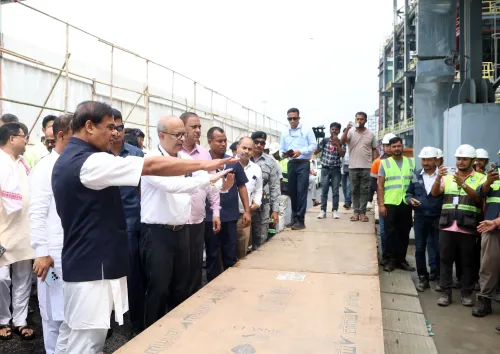
A ₹501 crore caustic soda plant is set to reshape Assam's industrial landscape — the Chief Minister's Office of Assam announced the project on Thursday, November 12, 2026, signalling the state's sharpest push yet to move beyond oil and tea into core chemicals manufacturing.
Why caustic soda — and why now?
Caustic soda, or sodium hydroxide, is not a niche product. It is a foundational industrial chemical used in pulp and paper, textiles, aluminium refining, soaps, and water treatment — sectors that any manufacturing economy leans on. For Assam, a state whose economic identity has long been defined by tea gardens, crude oil, and agriculture, anchoring a large-scale chemical plant of this nature represents a deliberate pivot toward value-added industry.
The scale of the investment — ₹501 crore — places this firmly in the category of a major state-backed industrial commitment, not a pilot or a letter of intent. At that price point, the plant would need to serve both domestic Assam demand and broader Northeast India supply chains, a region historically dependent on chemical imports from distant manufacturing hubs in Gujarat and Andhra Pradesh.
CM Sarma's industrial blueprint for the Northeast
Chief Minister Himanta Biswa Sarma, who has led the state since 2021, has positioned Assam as the commercial gateway of northeastern India, pushing for private investment in sectors from semiconductors to petrochemicals. A caustic soda facility fits squarely into that arc — it creates upstream supply capacity that makes Assam more attractive to downstream industries that consume the chemical in bulk.
Northeastern India has long suffered from an infrastructure deficit that inflated logistics costs and kept manufacturing investment away. Central government connectivity drives — road, rail, and pipeline — have begun to shift that calculus, and state governments across the region have been racing to convert improved connectivity into factory floors and industrial estates.
What the project still needs to prove
Large chemical plant announcements carry weight only when they clear the full gauntlet of execution: land acquisition, environmental impact assessment, grid-level power supply (chlor-alkali processes are electricity-intensive), and water access. None of those clearances have been publicly confirmed at this stage. The commissioning timeline — a critical metric for investors deciding whether to build complementary supply chains nearby — also remains to be detailed.
Still, the signal from Guwahati is unambiguous: Assam is competing for industrial capital, and it is raising the stakes with nine-figure commitments in core chemicals.
When the plant breaks ground will tell us everything about whether this announcement marks a turning point or a headline — but the size of the bet makes it impossible to ignore.
Point of View
Meaning execution risk is real and high. For CM Sarma, delivering on a project of this scale before the next electoral cycle would substantially validate his 'industrial gateway' pitch for Assam. The announcement also carries a subtle message to chemical investors in Gujarat and Andhra Pradesh: the Northeast is no longer content to be a consumption market for their output.
NationPress
12 Nov 2026
Frequently Asked Questions
What is the Assam caustic soda plant project?
Assam has announced a ₹501 crore caustic soda plant as part of its push to diversify the state's industrial economy beyond traditional sectors like tea and oil.
What is caustic soda used for in industry?
Caustic soda, or sodium hydroxide, is a core industrial chemical used in pulp and paper manufacturing, textiles, aluminium refining, soap production, and water treatment processes.
Who announced the Assam caustic soda plant?
The announcement was made by the Chief Minister's Office of Assam on November 12, 2026, under Chief Minister Himanta Biswa Sarma's administration.
Where will the Assam caustic soda plant be located?
The specific location of the plant has not been publicly confirmed yet; details on the project site, land acquisition, and environmental approvals are awaited.
How does this plant fit Assam's industrial strategy?
CM Himanta Biswa Sarma has positioned Assam as Northeast India's commercial gateway, and a large-scale caustic soda plant creates foundational chemical supply capacity to attract downstream manufacturing industries to the region.