CM Himanta Sees Assam as India's Emerging Tech and Green Hub
Synopsis
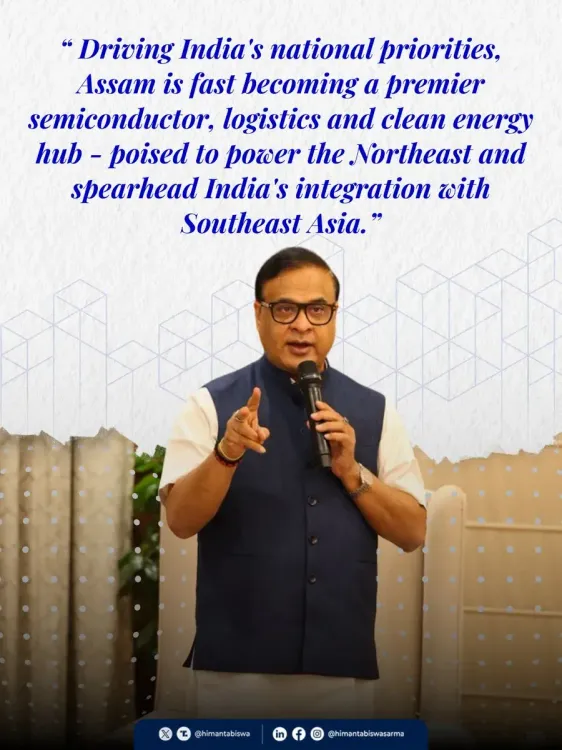
Assam Chief Minister Himanta Biswa Sarma declared on June 16, 2026 that Assam is emerging as a hub for semiconductors, logistics, and green energy. Invoking national ambition, he stated the state will drive India's progress, reflecting the convergence of India's Semiconductor Mission and Act East Policy in the Northeast.
Key Takeaways
CM Himanta Biswa Sarma declared on June 16, 2026 that Assam is at a pivotal juncture and will drive India's national progress.
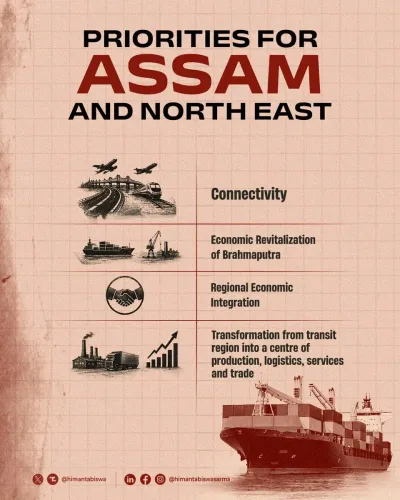
Sarma identified semiconductors, logistics, and green energy as the three futuristic sectors anchoring Assam's economic transformation.
The India Semiconductor Mission , backed by a Rs 76,000 crore Union Cabinet outlay approved in 2021 , provides the central policy framework for Assam's chip-sector ambitions.
India's Act East Policy (relaunched 2014 ) has directed investment in logistics and clean energy across the Northeast, reinforcing Assam's strategic position.
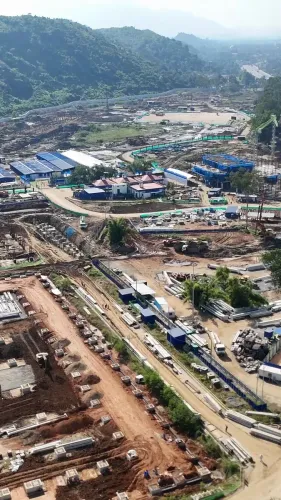
Assam's location bordering Bhutan, Bangladesh, and Arunachal Pradesh makes it a natural logistics hub for Southeast Asian trade routes.
Progress on formal semiconductor proposals and investment summit outcomes will be the key near-term indicators of whether this vision translates into industrial reality.
Assam Chief Minister Himanta Biswa Sarma on Tuesday, June 16, 2026, declared that Assam is at a pivotal moment in its history, positioning the northeastern state as an emerging force in semiconductors, logistics, and green energy that will drive India's national progress in the years ahead.
Context
Posting on X, CM Sarma stated: 'Assam today stands at an important juncture in its history. It is becoming an emerging semiconductor hub, a focal centre in logistics, green energy and other futuristic sectors. Assam will drive India's progress in the coming days.' The statement frames Assam not as a beneficiary of central schemes but as an active engine of national growth — a notable rhetorical shift for a state historically associated with oil, tea, and agriculture.
Sarma, who has served as Chief Minister since 2021 and is the convenor of the North-East Democratic Alliance (NEDA), has consistently sought to recast Assam's economic identity. This post signals that the state's diversification push has reached a stage where its leadership feels confident projecting it on a national scale.
Policy Backdrop
The claim of semiconductor ambitions aligns with the India Semiconductor Mission, approved by the Union Cabinet in 2021 with an outlay of Rs 76,000 crore to attract chip design, fabrication, and assembly investment across the country. Northeastern states have been identified as potential beneficiaries of this mission, given their strategic location and land availability.
Simultaneously, India's Act East Policy, relaunched in 2014, has channelled investment into logistics corridors, renewable energy, and downstream industries across the Northeast. Assam's geographic position — bordering Bhutan, Bangladesh, and Arunachal Pradesh — makes it a natural logistics pivot for trade with Southeast Asia. The convergence of these two national agendas — semiconductor self-reliance and northeastern economic integration — underpins the vision CM Sarma articulated.
Since 2020, India has pursued supply-chain resilience through production-linked incentive schemes, and state governments have competed to attract electronics and clean-energy manufacturing. Assam's bid to position itself in this race reflects a broader national pattern of regional states staking claims in emerging industrial sectors.
Stakeholders and Impact
The sectors named — semiconductors, logistics, and green energy — carry direct implications for Assam's youth, who represent a large share of the state's population and have historically faced limited high-skill employment within the state. A credible industrial transition in these sectors could significantly alter local employment patterns.
Tech investors and global supply-chain players scouting for India locations outside established hubs such as Bengaluru, Pune, and Chennai are a key audience for this signal. State-level political messaging of this kind often precedes formal investment summits or memoranda of understanding with industry partners. Stakeholders in Assam's legacy sectors — oil and tea — will also watch whether new industrial priorities redirect state resources and policy attention.
What's Next
The immediate indicator to watch is whether Assam advances any formal proposals under the India Semiconductor Mission or announces outcomes from state investment summits in the near term. Progress on logistics infrastructure — particularly multimodal corridors linking Assam to Southeast Asian markets under the Act East Policy — will be a concrete measure of the state's capacity to fulfil the ambition CM Sarma has publicly staked. If Assam secures anchor investments in even one of the three sectors named, it would mark a structural economic turning point for the entire northeastern region.
Point of View
He is repositioning the Northeast in India's development narrative ahead of what are likely to be significant investment and electoral cycles. The invocation of semiconductors is strategically timed: with the India Semiconductor Mission actively seeking state partners, public signals of readiness can influence where central and private capital flows. This also fits a pattern of BJP-governed states competing to be seen as industrial frontrunners, using social media to set the agenda before formal policy announcements. The real test will be whether Assam can translate this rhetorical ambition into signed projects and measurable job creation in sectors that are genuinely new to the state's economic base.
NationPress
19 Sept 2026
Frequently Asked Questions
Why is Assam being called an emerging semiconductor hub?
Assam CM Himanta Biswa Sarma described the state as an emerging semiconductor hub on June 16, 2026, citing its positioning under national schemes like the India Semiconductor Mission, which carries a Rs 76,000 crore Union Cabinet outlay to attract chip manufacturing across India, including in the Northeast.
What is the India Semiconductor Mission and how does it relate to Assam?
The India Semiconductor Mission is a central government programme approved in 2021 with Rs 76,000 crore to develop chip design, fabrication, and assembly in India. Northeastern states like Assam are potential beneficiaries given their land availability and strategic location near Southeast Asian trade routes.
What sectors is Assam focusing on for economic growth in 2026?
According to CM Himanta Biswa Sarma's June 2026 statement, Assam is focusing on semiconductors, logistics, and green energy as its primary futuristic growth sectors, moving beyond its traditional reliance on oil, tea, and agriculture.
What is the Act East Policy and its role in Assam's development?
India's Act East Policy, relaunched in 2014, aims to improve connectivity and economic integration between the Northeast and Southeast Asia. It has channelled investment into logistics corridors and renewable energy in states like Assam, reinforcing the state's role as a trade and industrial hub.
What is NEDA and what is Himanta Biswa Sarma's role in it?
NEDA, the North-East Democratic Alliance, is a BJP-led coalition of political parties in the northeastern states. Himanta Biswa Sarma, Assam's Chief Minister since 2021, serves as its convenor and is a key political figure shaping the region's governance and development agenda.