CM Bhajan Lal Sharma Celebrates Appointment Letters for Rajasthan Youth
Synopsis
The Chief Minister's Office of Rajasthan on 25 June 2026 celebrated the distribution of government appointment letters, describing the moment as a point of pride for every young recruit, in a post tagging CM Bhajan Lal Sharma under the hashtag 'Our Foremost Rajasthan'.
Key Takeaways
The Chief Minister's Office of Rajasthan posted on 25 June 2026 celebrating government appointment letters for youth.
CM Bhajan Lal Sharma was tagged, signalling his administration's focus on public sector employment.
The post carried the hashtag #आपणो_अग्रणी_राजस्थान (Our Foremost Rajasthan), part of the state government's branding campaign.
Rajasthan has periodically conducted large-scale recruitment drives in education, police, and health to fill long-pending vacancies.
Appointment letter ceremonies are a key mode of governance communication for BJP -ruled states, linking electoral promises to visible delivery.
Youth aspirants and their families, especially from rural Rajasthan , are the primary beneficiaries of such recruitment rounds.
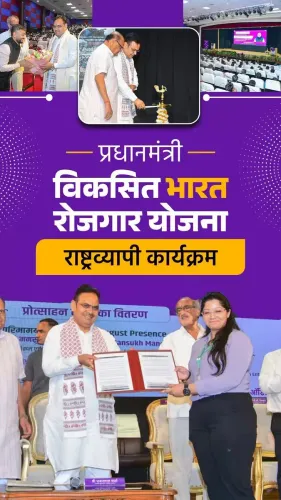
The Chief Minister's Office of Rajasthan on Thursday, 25 June 2026, highlighted the significance of government job appointment letters for young people in the state, tagging Chief Minister Bhajan Lal Sharma in a post that carried the hashtag #आपणो_अग्रणी_राजस्थान (Our Foremost Rajasthan).
Context
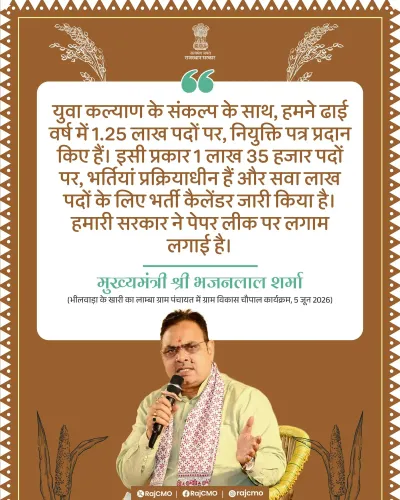
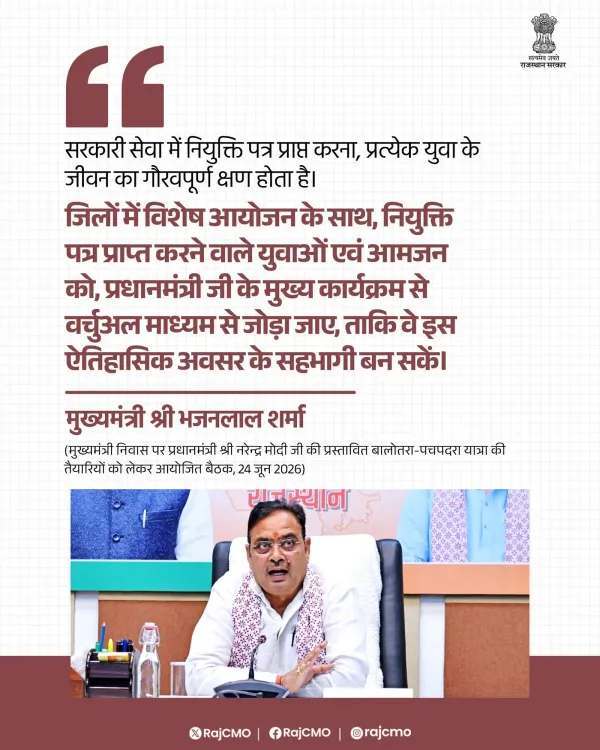
The post reads: 'सरकारी सेवा में नियुक्ति पत्र प्राप्त करना, प्रत्येक युवा के जीवन का गौरवपूर्ण क्षण होता है' — 'Receiving an appointment letter in government service is a proud moment in every young person's life.' The message was accompanied by an image and signals the distribution of appointment letters to newly recruited government employees in Rajasthan. The post is framed as a celebratory acknowledgement of recruits entering public service, with the Chief Minister's Office underscoring the emotional and professional weight that a government job carries for aspirants and their families.Policy Backdrop
Chief Minister Bhajan Lal Sharma took charge of Rajasthan in December 2023 after the Bharatiya Janata Party won the state assembly elections. Since then, the state government has positioned public sector recruitment as a central pillar of its governance agenda. Rajasthan has a long history of large-scale recruitment drives across departments — particularly in education, police, and health — to address backlogs of unfilled vacancies. Appointment letter distribution ceremonies have become a visible and politically resonant mode of demonstrating administrative delivery, allowing governments to put a human face on employment numbers. Across BJP-ruled states, such ceremonies are routinely used to fulfil electoral commitments on reducing unemployment and strengthening public services, making them a standard feature of governance communication.Stakeholders and Impact
The primary beneficiaries of such recruitment rounds are young job aspirants from across Rajasthan — many of whom spend years preparing for competitive examinations. For these recruits and their families, particularly those from rural or semi-urban backgrounds, a government appointment letter represents financial security and social mobility. Beyond the individual, large-scale inductions into departments such as education and policing have direct implications for service delivery to citizens — filling teacher vacancies improves school attendance outcomes, while additional constables strengthen law enforcement capacity across the state's vast geography. The hashtag #आपणो_अग्रणी_राजस्थान — a Rajasthani-Hindi blend meaning 'Our Foremost Rajasthan' — is part of the state government's broader branding effort to project Rajasthan as a leading, progressive state under the current administration.What's Next
The state government is expected to continue recruitment drives across additional departments during the current term. Observers will watch for official announcements on total vacancies filled, upcoming examination calendars, and further appointment letter ceremonies that could indicate the scale and pace of the administration's hiring push. For young aspirants still in the pipeline, the messaging from the Chief Minister's Office serves as both an encouragement and a signal that the government intends to keep public sector employment generation at the forefront of its political and administrative narrative.Point of View
' the administration converts a bureaucratic act into an emotional, shareable narrative. For CM Bhajan Lal Sharma, who took office in December 2023 on a platform that included employment generation, such communication reinforces his administration's delivery credentials ahead of future electoral cycles. The 'Aapno Agrani Rajasthan' hashtag signals a deliberate effort to build a cohesive state-identity brand around the BJP government's tenure. Across India, BJP-ruled states have increasingly used appointment letter ceremonies as high-visibility proof points — Rajasthan is now firmly part of that pattern.
NationPress
25 Jun 2026
Frequently Asked Questions
What did the Rajasthan CMO post about on 25 June 2026?
The Chief Minister's Office of Rajasthan posted that receiving a government appointment letter is a proud moment in every young person's life, tagging CM Bhajan Lal Sharma and using the hashtag 'Our Foremost Rajasthan.'
Who is Bhajan Lal Sharma?
Bhajan Lal Sharma is a BJP leader who became Chief Minister of Rajasthan in December 2023 following the party's victory in the state assembly elections.
What is the meaning of #आपणो_अग्रणी_राजस्थान?
The hashtag is a Rajasthani-Hindi phrase meaning 'Our Foremost Rajasthan,' used by the state government as part of its branding campaign to project Rajasthan as a leading and progressive state.
Which departments recruit most in Rajasthan government jobs?
Rajasthan has historically conducted large-scale recruitments in education, police, and health departments to fill long-pending vacancies across the state.
Why do Indian state governments hold appointment letter distribution ceremonies?
State governments use appointment letter ceremonies as visible, emotionally resonant proof of employment generation, connecting administrative delivery to electoral commitments on reducing unemployment.