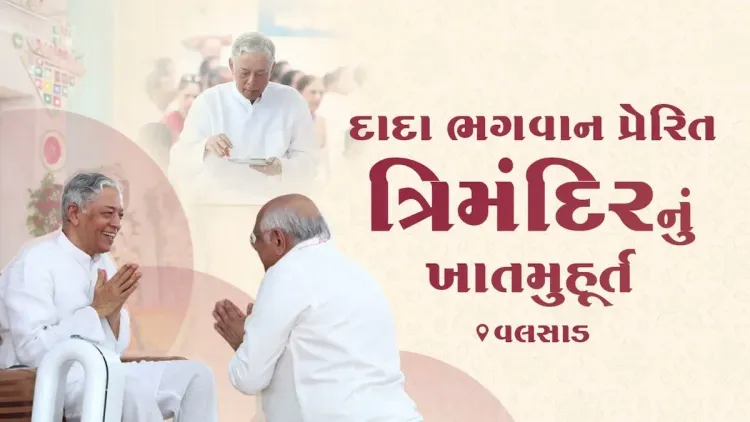
CM Bhupendra Patel attends Trimandir foundation ceremony in Valsad
Synopsis
Gujarat Chief Minister Bhupendra Patel joined spiritual leader Deepakbhai for the foundation-laying of a Trimandir at Nandavala village, Valsad district, expressing hope that the temple inspired by Dada Bhagwan's teachings will become a centre of spiritual consciousness and universal peace.
Key Takeaways
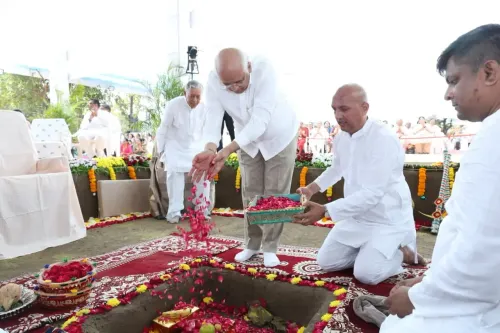
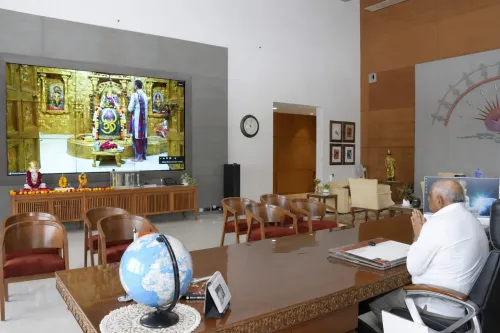
Gujarat CM Bhupendra Patel attended the khatmuhurt of a new Trimandir at Nandavala village, Valsad district on November 3, 2026 .
The ceremony was led by Pujya Shri Deepakbhai , the continuing spiritual head of the Akram Vignan tradition founded by Dada Bhagwan .
CM Patel expressed the wish that the Trimandir become 'a centre of spiritual consciousness, equanimity, and supreme peace.' The Trimandir concept is deliberately non-sectarian, enshrining deities across Hindu traditions as a symbol of universal harmony.
Dada Bhagwan (1908–1988) founded the Akram Vignan path centred on direct self-realisation without ritual penance.
A new spiritual landmark is taking shape in the southernmost corner of Gujarat. Gujarat Chief Minister Bhupendra Patel attended the khatmuhurt (foundation-laying ceremony) of a Trimandir to be built at Nandavala village in Valsad district on Tuesday, November 3, 2026, joining spiritual leader Pujya Shri Deepakbhai and a congregation of mahatmas and mumukshus — seekers on the path of self-realisation.
Writing in Gujarati, CM Patel described receiving the blessings of Deepakbhai and expressed his heartfelt wish that the Trimandir — inspired by the teachings of Param Pujya Dada Bhagwan — would become 'a centre of spiritual consciousness, equanimity, and supreme peace.' He extended warm wishes to all the mahatmas and volunteers involved in this punyakary (sacred endeavour), closing with the Akram Vignan salutation: Jai Satchidanand.
The Akram Vignan tradition behind the Trimandir
The Trimandir concept is rooted in the Akram Vignan spiritual path founded by Ambalal Muljibhai Patel, known universally as Dada Bhagwan (1908–1988). His movement centres on direct self-realisation — the recognition that 'I am pure soul' — without years of ritual penance. The tradition is notably non-sectarian, and its temples, called Trimandirs, enshrine deities across Hindu traditions as a symbol of universal spiritual harmony.
Deepakbhai, who continues Dada Bhagwan's lineage, has overseen the expansion of Trimandir complexes across India and abroad. The Nandavala project in Valsad adds to that network, planted in a district that already carries deep religious and cultural significance along Gujarat's southern coastal belt bordering Maharashtra.
Gujarat's chief ministers and the foundation-ceremony tradition
CM Patel's attendance is consistent with a long-standing practice among Gujarat's political leadership of participating in religious and community foundation events across faith traditions — a form of outreach that bridges governance and civil society. Valsad, home to significant tribal communities and diverse religious sites, fits naturally into this pattern.
The state has in recent years invested in spiritual tourism corridors, and events like this khatmuhurt carry both community and soft-infrastructure significance. Whether the Nandavala Trimandir project draws formal state support in its construction phase will be watched closely by both devotees and local administrators.
For now, a foundation stone is set — and with it, the aspiration that a town in Gujarat's deep south becomes a quiet node of inter-faith calm.
Point of View
With its universalist ethos and large diaspora presence, gives such events a reach well beyond one district. For the BJP in Gujarat, visible association with spiritually respected but politically neutral institutions serves as soft-power outreach with minimal controversy. The Nandavala Trimandir, when complete, will likely anchor a modest spiritual-tourism circuit in Valsad — an outcome that aligns with the state's broader infrastructure-plus-heritage playbook.
NationPress
3 Nov 2026
Frequently Asked Questions
What is a Trimandir?
A Trimandir is a non-sectarian temple complex associated with the Akram Vignan spiritual movement founded by Dada Bhagwan. It enshrines deities from multiple Hindu traditions under one roof as a symbol of universal harmony and spiritual equanimity.
Who is Deepakbhai in the Akram Vignan tradition?
Deepakbhai is the spiritual leader continuing the Akram Vignan teachings of Dada Bhagwan (Ambalal Muljibhai Patel, 1908–1988). He oversees the movement's activities and the construction of Trimandir complexes in India and abroad.
Where is Nandavala village located?
Nandavala is a village in Valsad district, the southernmost coastal district of Gujarat bordering Maharashtra. The new Trimandir is being constructed at this site.
Why did Gujarat CM Bhupendra Patel attend the Trimandir ceremony?
CM Patel participated in the foundation-laying ceremony to express support for the spiritual and community initiative, receiving blessings from Deepakbhai and voicing the hope that the temple will become a centre of peace and spiritual consciousness.
What is Akram Vignan?
Akram Vignan is a spiritual path founded by Dada Bhagwan focused on direct self-realisation — the inner recognition of the pure soul — without prolonged ritual or penance. The movement has a significant following in Gujarat and among the global Gujarati diaspora.