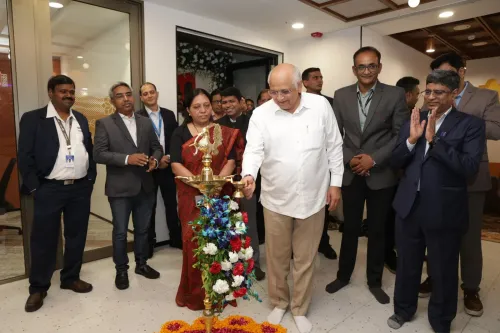
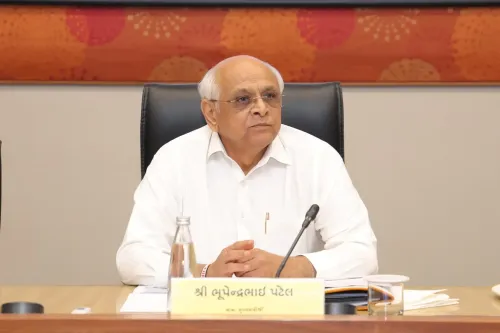
CM Bhupendra Patel Hails GIFT City as Global Financial Hub

Synopsis
Gujarat Chief Minister Bhupendra Patel on 19 July 2026 highlighted reports of over 100 multinationals exploring treasury and banking operations at GIFT City through JPMorgan, reaffirming the state's commitment to building India's premier international financial services hub.
Key Takeaways
Gujarat CM Bhupendra Patel on 19 July 2026 cited reports that over 100 multinational companies are exploring treasury and banking operations at GIFT City via JPMorgan .
GIFT City , India's first operational IFSC, was conceived by PM Narendra Modi during his tenure as Gujarat Chief Minister and became operational in 2015 .
The IFSCA , established by Parliament in 2020 , serves as the unified regulator for banking, capital markets, and insurance at GIFT City.
The Gujarat government reiterated commitment to world-class infrastructure, progressive policies, and ease of doing business at the IFSC.
The development is positioned within the Viksit Bharat 2047 framework, India's blueprint for achieving developed-nation status.
Upcoming IFSCA quarterly data and the Union Budget 2026-27 are key milestones to watch for further GIFT City expansion signals.
Gujarat Chief Minister Bhupendra Patel on Sunday, 19 July 2026, highlighted growing global interest in GIFT City, citing reports that over 100 multinational companies are exploring treasury and banking operations there through JPMorgan, and reaffirmed the Gujarat government's commitment to building world-class financial infrastructure.
Context
In his post on X, CM Patel described the development as evidence that 'global confidence in GIFT City continues to soar,' referencing a report that JPMorgan is facilitating the entry of more than 100 multinational corporations into treasury and banking operations at the Gujarat International Finance Tec-City. He credited the momentum to the 'visionary leadership' of Prime Minister Narendra Modi, who originally conceived the project during his tenure as Gujarat Chief Minister.
GIFT City, located near Gandhinagar, Gujarat, is India's first operational International Financial Services Centre (IFSC), designed to offer offshore banking, insurance, and capital market services under a unified regulatory framework.
Policy Backdrop
The project was formally approved by the Gujarat government in 2007 and became operational as India's first IFSC in 2015 with the launch of its first banking unit. The Finance Act 2015 and subsequent IFSC regulations introduced tax neutrality and relaxed FEMA norms to attract global financial institutions.
A significant policy milestone came in 2020, when Parliament established the International Financial Services Centres Authority (IFSCA) as a unified regulator overseeing banking, capital markets, and insurance at the city. Successive Union Budgets have incrementally liberalised capital account rules and permitted rupee derivatives at IFSCs, deepening GIFT City's integration with global financial markets.
The broader ambition has been to position GIFT City as a credible onshore alternative to established international financial centres such as Singapore and Dubai, particularly for treasury operations, aircraft leasing, and fund management business.
Stakeholders and Impact
For multinational corporations, a presence in GIFT City offers access to India's financial ecosystem under a globally comparable regulatory environment, with significant tax incentives. Global banks such as JPMorgan serve as anchor institutions, helping smaller multinationals navigate the regulatory and operational setup.
Fintech firms have also increasingly looked to GIFT City as a launchpad for cross-border payment and financial product innovation, supported by the IFSCA's sandbox and licensing frameworks. The Gujarat government's stated commitment to 'progressive policies and ease of doing business' signals continued state-level support alongside central regulatory facilitation.
The development aligns with the Viksit Bharat 2047 vision, India's long-term growth blueprint targeting developed-nation status by the centenary of independence, in which a mature international financial centre is seen as a structural pillar.
What's Next
Analysts and policymakers will watch upcoming IFSCA quarterly data releases on new licences granted and assets under management at GIFT City as a concrete measure of whether this reported surge in multinational interest translates into operational entities. The Union Budget 2026-27 is also being closely tracked for possible inclusion of additional financial products and further capital account liberalisation at IFSCs.
If the pipeline of over 100 multinationals attributed to JPMorgan's facilitation materialises into active units, it would mark a step-change in GIFT City's scale and could accelerate India's ambition to emerge as a genuine rival to Singapore and Dubai in the global financial services landscape.
Point of View
Reinforcing the state's role as a partner — not merely a host — to the central government's financial centre ambitions. By invoking PM Modi's original vision, Patel situates the current surge within a two-decade policy arc, lending it institutional continuity rather than presenting it as a one-off development. The JPMorgan reference, whether or not the underlying report is independently verified, serves to anchor the narrative in a globally recognisable institution, lending credibility to India's pitch against Singapore and Dubai. This pattern of state-level amplification of IFSC milestones is likely to intensify as the Union Budget 2026-27 approaches and political stakeholders seek to demonstrate returns on long-standing infrastructure and regulatory investments.
NationPress
19 Jul 2026
Frequently Asked Questions
What is GIFT City and why is it important?
GIFT City, or Gujarat International Finance Tec-City, is India's first operational International Financial Services Centre (IFSC), located near Gandhinagar, Gujarat. It is designed to offer offshore banking, insurance, and capital market services under a unified regulator — the IFSCA — and is India's primary effort to compete with global financial hubs like Singapore and Dubai.
Why are multinational companies interested in GIFT City treasury operations?
GIFT City offers significant tax incentives, relaxed FEMA norms, and a globally comparable regulatory environment through the IFSCA, making it attractive for multinationals seeking to manage treasury and banking operations within India's financial ecosystem without the regulatory friction of the domestic market.
What is JPMorgan's role in GIFT City?
JPMorgan is cited as facilitating the entry of over 100 multinational companies into treasury and banking operations at GIFT City, acting as an anchor institution that helps global corporations navigate the regulatory and operational setup at India's IFSC.
Who regulates GIFT City financial activities?
The International Financial Services Centres Authority (IFSCA), established by Parliament in 2020, is the unified regulator for all banking, capital markets, and insurance activities at GIFT City, replacing the earlier multi-regulator framework.
How does GIFT City connect to the Viksit Bharat vision?
GIFT City is seen as a structural pillar of the Viksit Bharat 2047 vision, India's blueprint for achieving developed-nation status by the centenary of independence. A mature international financial centre is considered essential for deepening India's integration with global capital markets and attracting high-value financial services investment.