CM Bhupendra Patel Pledges Gujarat's Role in Viksit Bharat
Synopsis
Gujarat Chief Minister Bhupendra Patel thanked Union Minister Amit Shah for his wishes on 15 July 2026, reaffirming Team Gujarat's commitment to rural economic growth, cooperative sector strengthening, and law and order as the state's contribution to the Viksit Bharat national development vision.
Key Takeaways
CM Bhupendra Patel publicly thanked Union Minister Amit Shah for his wishes on 15 July 2026 .
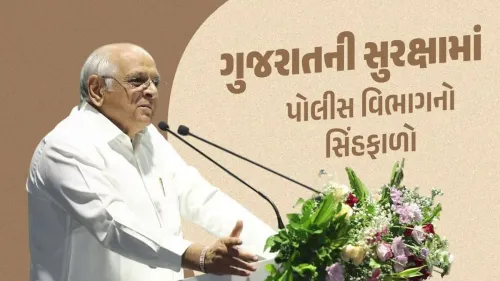
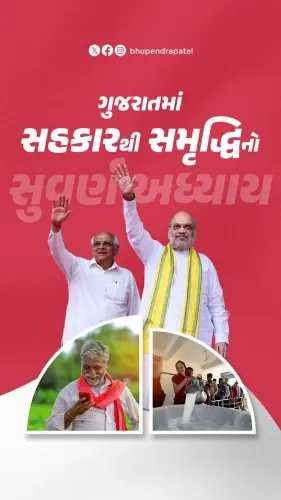
Patel pledged that Team Gujarat is committed to reviving the rural economy , strengthening cooperatives , and maintaining law and order .
The post explicitly names PM Narendra Modi and Amit Shah as guides for Gujarat's development agenda.
Gujarat committed to making its 'highest contribution' to the Viksit Bharat vision targeting a developed India by 2047 .
The Ministry of Cooperation , established in 2021 , oversees national cooperative policy — a sector in which Gujarat has a historic lead through institutions like Amul .
The post reinforces close state-centre coordination between the Gujarat government and the BJP-led Union government .
Gujarat Chief Minister Bhupendra Patel on Wednesday, 15 July 2026, publicly thanked Union Home and Cooperation Minister Amit Shah for his wishes and reaffirmed that Team Gujarat remains committed to rural economic growth, cooperative sector strengthening, and robust law and order as pillars of the state's all-round development.
Posting in Gujarati on X, CM Patel wrote: 'માનનીય વડાપ્રધાન શ્રી નરેન્દ્રભાઈ મોદી અને આપશ્રીના બહુમૂલ્ય માર્ગદર્શન હેઠળ...' ['Under the invaluable guidance of honourable Prime Minister Shri Narendra Modi and yourself...'], pledging that Gujarat would 'continue to move forward to make its highest contribution in building a Viksit Bharat.'
Context
Amit Shah holds two of the most consequential portfolios in the Union Cabinet — Home Affairs and Cooperation — making his engagement with state governments on both security and rural economic matters routine and significant. CM Patel's response acknowledged Shah's 'affectionate wishes' (સ્નેહપૂર્ણ શુભકામનાઓ) and framed Gujarat's agenda squarely within the national development vision. While the specific occasion prompting Shah's wishes was not specified in the post, Patel's reply signals close state-centre coordination on cooperative and governance priorities.
Policy Backdrop
The Ministry of Cooperation was established in 2021 to provide dedicated central focus on strengthening India's cooperative sector — a move widely seen as drawing on Gujarat's own cooperative heritage. The state is home to the Amul dairy cooperative, founded in 1946 and later scaled nationally through Operation Flood beginning in 1970, making it one of the most cited models for rural economic inclusion in the country. Prime Minister Narendra Modi, himself a former Gujarat Chief Minister, has consistently positioned the cooperative model as central to the Viksit Bharat vision — a national framework targeting a fully developed India by 2047.
CM Patel's post specifically names three priorities: reviving momentum in the rural economy, strengthening the cooperative sector, and maintaining firm law and order. This triad mirrors the broader template seen across BJP-governed states, where internal security measures are paired with economic inclusion programmes to present a unified development narrative.
Stakeholders and Impact
Rural farmers and cooperative societies across Gujarat stand as the primary beneficiaries of the agenda outlined by CM Patel. The state's network of dairy, credit, and agricultural cooperatives involves millions of members, and any policy push from both the state and the Ministry of Cooperation directly affects their livelihoods and access to rural credit. Strengthened coordination between Gandhinagar and New Delhi on cooperative policy could accelerate the expansion of multi-state cooperative societies and rural credit mechanisms.
The emphasis on law and order alongside economic growth also signals to investors and businesses that Gujarat intends to maintain its reputation as a stable, investment-friendly state — a positioning that has underpinned its industrial growth over the past two decades.
What's Next
Observers will watch for concrete policy announcements from both the Gujarat government and the Ministry of Cooperation that translate this stated commitment into scheme rollouts or legislative action. Potential areas include expansion of cooperative credit networks, new linkages between Gujarat's cooperative institutions and national bodies, and updated law-and-order frameworks tied to rural development goals. Gujarat's performance on these fronts will be closely tracked as a bellwether for the broader Viksit Bharat programme ahead of its 2047 target.
Point of View
Reinforcing the party's narrative that cooperative federalism under BJP rule delivers coherent, top-down development. With the Viksit Bharat deadline of 2047 increasingly anchoring BJP election messaging, such posts serve a dual purpose: they keep Gujarat in the national spotlight as a development template and pre-empt any perception of drift between Gandhinagar and New Delhi. Analysts will note that the pairing of cooperative economics with law and order — rather than, say, industrial investment — reflects a conscious pivot toward rural consolidation ahead of any upcoming electoral cycle.
NationPress
15 Jul 2026
Frequently Asked Questions
What did Gujarat CM Bhupendra Patel say about Viksit Bharat?
CM Bhupendra Patel pledged on 15 July 2026 that Gujarat would 'continue to move forward to make its highest contribution in building a Viksit Bharat,' reaffirming the state's alignment with the national development vision targeting a fully developed India by 2047.
Why did Bhupendra Patel thank Amit Shah?
CM Patel thanked Union Home and Cooperation Minister Amit Shah for his 'affectionate wishes.' The specific occasion prompting Shah's wishes was not mentioned in the post.
What is the Viksit Bharat vision?
Viksit Bharat is the central government's overarching framework to make India a fully developed nation by 2047, the centenary of independence. It covers economic growth, rural development, infrastructure, and social inclusion.
What is Gujarat's role in India's cooperative sector?
Gujarat has historically been a leader in India's cooperative movement. The Amul dairy cooperative, founded in 1946, was scaled nationally through Operation Flood from 1970 and remains one of the world's largest dairy cooperatives, making Gujarat a reference model for rural economic inclusion.
What are CM Bhupendra Patel's three stated priorities for Gujarat?
In his 15 July 2026 post, CM Patel identified three priorities: giving new momentum to the rural economy, further strengthening the cooperative sector, and achieving all-round state development through firm law and order.