CM Samrat Choudhary greets Bihar on Vijayadashami 2026
Synopsis
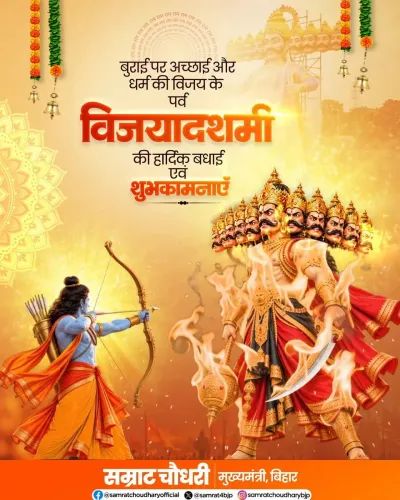
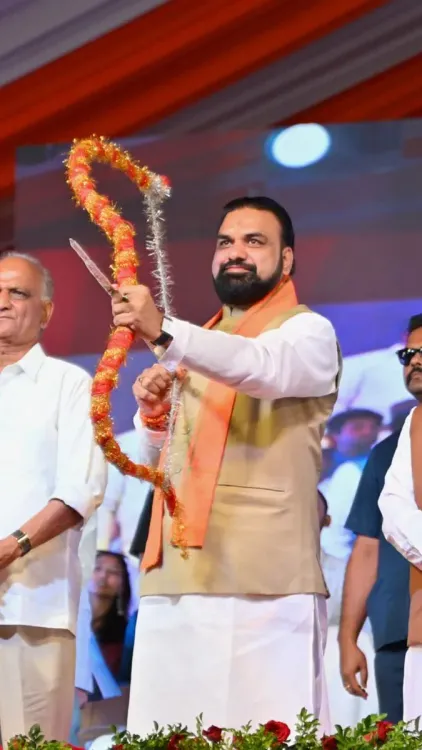
Bihar Chief Minister Samrat Choudhary marked Vijayadashami 2026 with a post invoking Lord Ram, framing the festival as a symbol of dharma, justice and public welfare, and praying for Bihar's prosperity and harmony.
Key Takeaways
Bihar Chief Minister Samrat Choudhary posted a Vijayadashami 2026 message on 21 October 2026 .
He described the festival as a symbol of the end of ego, respect for maryada , and the eternal victory of dharma — going beyond the conventional 'good over evil' framing.
The message called on citizens to walk the path of public welfare ( lokakalyan ), justice ( nyay ) and dedication to duty ( kartavyanishtha ).
He prayed to Lord Ram that every home in Bihar be illuminated with prosperity, and that the state reach new peaks of development, affluence and harmony.
The message follows a consistent BJP-governed-state pattern of using major Hindu festivals to link cultural values with governance priorities.
On the morning of Vijayadashami 2026, Bihar Chief Minister Samrat Choudhary invoked the spirit of Lord Ram and called the festival far more than a celebration of good over evil — framing it as a timeless symbol of the end of ego, the honour of maryada (righteous conduct), and the eternal victory of dharma.
Posting on X on Wednesday, 21 October 2026, the Chief Minister opened with the devotional salutation 'Siyavar Ramchandra ki jai!' — 'Victory to Lord Ramchandra, consort of Sita!' — before laying out a layered reading of the festival. 'This great festival,' he wrote, 'gives us the message to continuously march on the path of public welfare, justice and dedication to duty.'
A prayer for every household in Bihar
The message carried a direct appeal to Lord Ram on behalf of Bihar's citizens: that his boundless grace illuminate every home in the state with prosperity, and that the province touch new peaks of development, affluence and harmony. The phrasing was deliberate — lokakalyan (public welfare), nyay (justice) and kartavyanishtha (dedication to duty) are terms that straddle the religious and the governmental, weaving a festival message into a statement of governance intent.
Vijayadashami as a political-cultural touchstone for BJP-governed states
Vijayadashami — also known as Dussehra — marks the triumph of Lord Ram over the demon king Ravana and is observed across India through Ramlila performances and the symbolic burning of effigies. For BJP-led state governments, the occasion has become a consistent platform to blend Ramayan symbolism with appeals for welfare, justice and development — projecting cultural continuity alongside governance priorities without announcing new policy schemes.
In Bihar, this pattern is well established. The state's government regularly uses major Hindu festivals to reinforce its cultural identity while simultaneously communicating development aspirations to a diverse electorate. Chief Minister Choudhary's message fits squarely within that tradition — grounding the day's religious weight in the concrete language of vikas (development) and samriddhi (prosperity) for the state's people.
The festival also carries particular resonance in Bihar, home to the sacred Sitamarhi district — traditionally identified as the birthplace of Sita — giving Ramayana-linked occasions a geography that is both devotional and political.
On a day when millions across the state gather to watch the symbolic fall of Ravana's effigy, the Chief Minister's message asks citizens to turn that cathartic moment inward — and carry its lessons of humility, duty and justice into daily life. That, in the end, is the old story's newest retelling.
Point of View
Justice and duty without announcing a single new scheme. For a party that has made Lord Ram central to its political identity since the Ram temple movement, Dussehra messaging is never merely devotional; it is a statement of ideological continuity. In Bihar specifically, where caste arithmetic and development optics both matter enormously, anchoring prosperity hopes to Ram's grace is also a quiet signal to the state's large Hindu voter base. The language of maryada and dharma doubles as a soft contrast with what the BJP frames as the moral disorder of rival politics.
NationPress
21 Oct 2026
Frequently Asked Questions
What did Bihar CM Samrat Choudhary say on Vijayadashami 2026?
Chief Minister Samrat Choudhary posted a message on 21 October 2026 calling Vijayadashami a symbol of the end of ego, respect for righteous conduct and the eternal victory of dharma, and prayed for Bihar's prosperity and development.
What is Vijayadashami and why is it celebrated?
Vijayadashami, also known as Dussehra, is a major Hindu festival marking Lord Ram's victory over the demon king Ravana, celebrated across India with Ramlila performances and the burning of effigies symbolising the triumph of good over evil.
Who is Samrat Choudhary?
Samrat Choudhary is a senior BJP leader who serves as the Chief Minister of Bihar, one of India's most populous eastern states.
What did Samrat Choudhary wish for Bihar on Dussehra?
He prayed that Lord Ram's grace illuminate every home in Bihar with happiness and prosperity, and that the state touch new peaks of development, affluence and harmony.
How does the BJP typically use Vijayadashami messaging?
BJP-led state governments routinely release Vijayadashami messages that blend Ramayana symbolism — dharma, maryada, duty — with appeals for welfare and development, connecting the festival's moral themes to governance priorities.