CM Samrat Choudhary Honours Nobel Laureate Chandrasekhar on Birth Anniversary
Synopsis
Bihar Chief Minister Samrat Choudhary paid tribute to Nobel laureate Dr. Subrahmanyan Chandrasekhar on his 116th birth anniversary, honouring the astrophysicist's discovery of the Chandrasekhar limit and his lasting inspiration for future generations in science.
Key Takeaways
Bihar CM Samrat Choudhary posted a tribute on 19 October 2026 marking the birth anniversary of Dr.
Subrahmanyan Chandrasekhar .
Chandrasekhar was born on 19 October 1910 and won the Nobel Prize in Physics in 1983 .
He is celebrated for the Chandrasekhar limit — approximately 1.4 solar masses — a fundamental threshold in stellar evolution theory.
NASA named the Chandra X-ray Observatory , launched in 1999 , in his honour.
CM Choudhary said Chandrasekhar's contributions will 'forever inspire generations to come' in the field of knowledge and science.
A giant of twentieth-century astrophysics turns 116 today — and Bihar Chief Minister Samrat Choudhary marked the occasion with a respectful tribute to Dr. Subrahmanyan Chandrasekhar, the Indian-American scientist whose Nobel Prize-winning work reshaped humanity's understanding of how stars live and die.
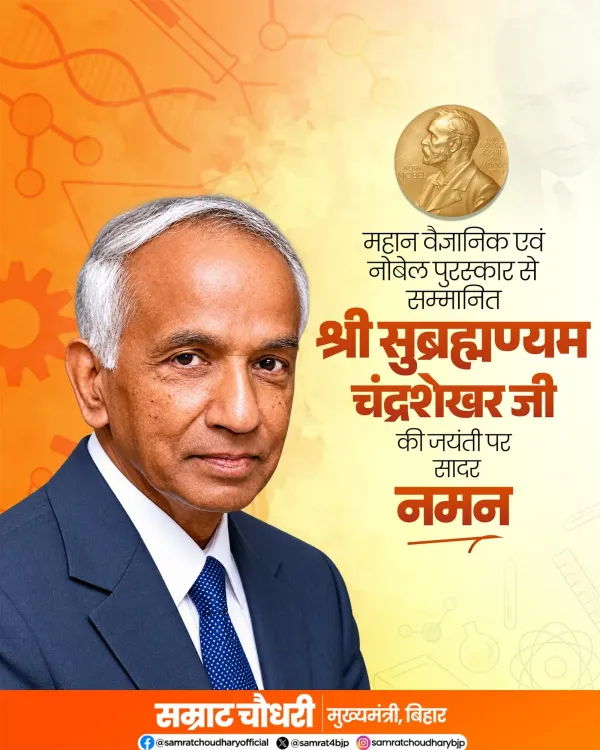
Posting on Monday, 19 October 2026, CM Choudhary wrote in Hindi: 'Mahan vaigyanik evam Nobel Puraskar se sammanit Dr. Subrahmanyan Chandrasekhar ji ki jayanti par sadar naman' — 'Respectful salutations on the birth anniversary of the great scientist and Nobel laureate Dr. Subrahmanyan Chandrasekhar.' He added that Chandrasekhar's unparalleled contributions to science 'will forever inspire generations to come to advance in the field of knowledge and science.'
The man who calculated a star's fate
Subrahmanyan Chandrasekhar was born on 19 October 1910 in Lahore (then British India). He is best known for the Chandrasekhar limit — a precise mathematical threshold, roughly 1.4 times the mass of the Sun, below which a dying star collapses into a white dwarf, and above which it continues collapsing toward a neutron star or black hole. He worked out the mathematics on a steamship voyage from India to England in 1930, as a 19-year-old. The establishment took decades to catch up.
In 1983, the Nobel Committee in Physics finally recognised that early brilliance, awarding Chandrasekhar the prize alongside William A. Fowler for 'theoretical studies of the physical processes of importance to the structure and evolution of the stars.' NASA later named its flagship X-ray space telescope — the Chandra X-ray Observatory, launched in 1999 — in his honour. He died in 1995, but his limit remains a cornerstone of modern astrophysics.
Why political tributes to scientists carry weight
Indian political figures across the spectrum regularly mark birth anniversaries of scientists and thinkers through public messages — a practice that blends cultural reverence with a quiet nudge toward scientific careers for young audiences. For a state like Bihar, which sends large numbers of students into national competitive examinations in science and engineering each year, invoking Chandrasekhar's name carries particular resonance. The message is simple and durable: a boy from undivided India changed how the world understands stars.
Chandrasekhar's story — institutional resistance, patient scholarship, ultimate vindication — is precisely the kind of narrative that science educators draw on to steady students through long, uncertain paths.
Point of View
While ceremonial, also quietly frames a governing party's identity as one aligned with progress and learning, an increasingly important register in India's knowledge-economy conversation.
NationPress
19 Oct 2026
Frequently Asked Questions
Who was Subrahmanyan Chandrasekhar?
Dr. Subrahmanyan Chandrasekhar was an Indian-American astrophysicist born on 19 October 1910. He won the Nobel Prize in Physics in 1983 for his theoretical work on stellar structure and evolution, most notably the Chandrasekhar limit.
What is the Chandrasekhar limit?
The Chandrasekhar limit is a maximum mass threshold of approximately 1.4 times the mass of the Sun. Stars below this limit collapse into white dwarfs when they die; those above it undergo further gravitational collapse into neutron stars or black holes.
Why is the Chandra X-ray Observatory named after Chandrasekhar?
NASA named its Chandra X-ray Observatory, launched in 1999, after Dr. Subrahmanyan Chandrasekhar to honour his foundational contributions to astrophysics and the study of stellar evolution.
Why did Bihar CM Samrat Choudhary post about Chandrasekhar?
Bihar Chief Minister Samrat Choudhary posted a tribute on 19 October 2026, the scientist's birth anniversary, to honour Chandrasekhar's scientific legacy and to inspire younger generations to pursue science and research.
When did Subrahmanyan Chandrasekhar win the Nobel Prize?
Subrahmanyan Chandrasekhar won the Nobel Prize in Physics in 1983, sharing the award with William A. Fowler for theoretical studies on the physical processes governing the structure and evolution of stars.