Shiv Sena (UBT) declares regime change inevitable, cites Tiranga row and 2024 polls
Synopsis
Shiv Sena (UBT)'s Saamana editorial pulls no punches: it alleges Modi clung to power after 2024 by manipulating Election Commissioners, frames the Tiranga movement as the tipping point for a regime change, and turns the BJP's own Emergency-era history against it — a calculated escalation designed to recast opposition protest as constitutional duty.
Key Takeaways
Shiv Sena (UBT) declared in its mouthpiece Saamana on 19 October 2026 that 'regime change' is an inevitable democratic process.
The editorial alleged that PM Modi retained power after the 2024 Lok Sabha elections by 'manipulating mafia-like Election Commissioners such as Gyanesh Kumar .' The party cited opposition to the Tiranga (Tricolour) movement as a key trigger accelerating the push for a regime change.
Historical parallels drawn include the Jan Sangh's merger into the Janata Party during the Emergency and V.P.
Singh's Janata Dal formation against Rajiv Gandhi — both endorsed by BJP predecessors.
The editorial rejected the 'anarchy' label for opposition protests, calling the desire to change government a hallmark of democracy.
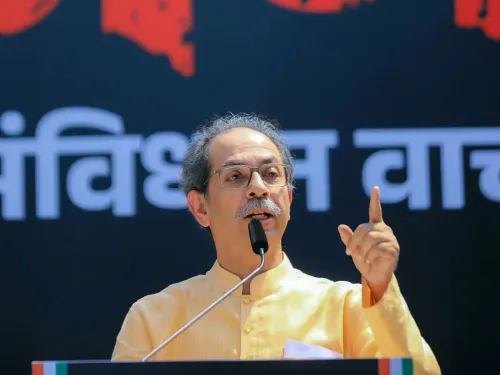
Shiv Sena (Uddhav Balasaheb Thackeray) on Monday, 19 October 2026, declared that a political 'regime change' is an inevitable and constitutionally sanctioned democratic process, arguing through its mouthpiece Saamana that the groundwork for such a transition was already laid in the 2024 Lok Sabha elections. The editorial marked one of the party's sharpest attacks yet on the ruling dispensation at the Centre.
The Saamana Editorial's Core Argument
The party's editorial board argued that the 'regime change' it advocates is not anarchic but deeply rooted in democratic tradition. It claimed that the 2024 general elections had in effect delivered a mandate for change, but alleged that Prime Minister Narendra Modi and others managed to retain power by what the editorial described as 'manipulating mafia-like Election Commissioners such as Gyanesh Kumar.' The ruling establishment has not responded to these specific allegations.
The editorial stated: 'Their cup of sins is full. Consequently, they were seized by the perverse idea to oppose the Tiranga (Tricolour) movement. This incident accelerated the momentum for a regime change.'
The Tiranga Movement as a Flashpoint
The piece singled out what it described as official resistance to the Tiranga (Tricolour) movement as a political turning point. It argued that any government opposing the hoisting of the national flag in India had forfeited its moral right to govern, and that citizens had collectively decided on a transition. 'Taking false oaths in the name of the Constitution will no longer be of any use,' the editorial warned, framing the protest movement as both patriotic and constitutionally legitimate.
Historical Parallels Invoked
In a sweeping defence of opposition-led regime change efforts, the editorial drew on several historical precedents. It referenced the Emergency era, noting that the Jan Sangh — a precursor to the Bharatiya Janata Party (BJP) — merged into the Janata Party specifically to oust the then-government. It also cited V.P. Singh's rebellion against Rajiv Gandhi and the formation of the Janata Dal, noting that BJP members at the time actively encouraged that effort.
'The campaign launched by the BJP against the courteous Prime Minister Dr Manmohan Singh was solely for regime change,' the editorial added, arguing that the ruling party has historically embraced the very tactic it now condemns as anarchy.
On the international front, the editorial noted that US President Donald Trump repeatedly declared his intent to 'effect a regime change in Iran,' for which, it claimed, 'the US dropped hundreds of bombs on Iran' — yet 'President Trump could not accomplish a regime change in Iran.' The comparison was used to underscore that desiring a change in government, even forcefully, is a well-established political act across democracies.
Rejection of the 'Anarchy' Label
Rejecting the ruling party's characterisation of opposition protests as anarchy or a 'game for power', the editorial argued that struggling for a change in government is a core feature of vibrant democracy. 'If the opposition is now saying that a government that came to power through unfair means should be changed, what is wrong with that? Modi, Fadnavis, and others perceive peaceful, democratic agitations as anarchy, yet all the agitations conducted by the BJP so far were of this very nature,' it stated.
What Comes Next
The editorial signals that Shiv Sena (UBT) intends to sustain its campaign framing regime change as a constitutional imperative ahead of upcoming electoral cycles. The party's aggressive tone — invoking the national flag, Electoral Commission conduct, and international comparisons — suggests a deliberate effort to broaden the coalition of discontent beyond its traditional Maharashtrian base. How the BJP and its allies respond to the Electoral Commissioner allegation, in particular, is likely to shape the next phase of this political confrontation.
Point of View
Alleging Electoral Commission manipulation, and weaponising the BJP's own Emergency-era history, Shiv Sena (UBT) is attempting to reframe street protests as constitutionally sacred acts — a narrative frame that is harder to dismiss than a simple power grab argument. The allegation against Election Commissioner Gyanesh Kumar by name is a significant escalation that warrants scrutiny; if substantiated, it strikes at the credibility of the 2024 mandate itself. Yet the editorial's rhetorical sweep — from Iran to the Emergency — risks diluting its sharpest points. The real political test is whether this framing gains traction beyond the party's core base, particularly in Maharashtra, where anti-incumbency arithmetic is already volatile.
NationPress
19 Oct 2026
Frequently Asked Questions
What did Shiv Sena (UBT)'s Saamana editorial say about regime change?
The editorial published on 19 October 2026 declared that a 'regime change' is an inevitable constitutional process rooted in democratic tradition. It argued that the 2024 Lok Sabha elections had already delivered a verdict for change, which it alleged was subverted by the ruling dispensation.
What allegation did Saamana make against Election Commissioner Gyanesh Kumar?
The Saamana editorial claimed that PM Modi and others retained power after the 2024 general elections by 'manipulating mafia-like Election Commissioners such as Gyanesh Kumar.' This is a specific and serious allegation; the Election Commission of India has not publicly responded to it as per available reports.
How does Shiv Sena (UBT) link the Tiranga movement to regime change?
The party argued that official resistance to the Tiranga (Tricolour) movement was a moral and political turning point, stating that the incident 'accelerated the momentum for a regime change.' It framed any government opposing the hoisting of the national flag as having lost its right to govern.
What historical parallels did the Saamana editorial draw?
The editorial cited the Jan Sangh's merger into the Janata Party during the Emergency, V.P. Singh's formation of the Janata Dal against Rajiv Gandhi — both supported by BJP predecessors — and the BJP's campaign against PM Dr Manmohan Singh, arguing the ruling party has historically pursued regime change itself.
Why does Shiv Sena (UBT) reject the 'anarchy' label for opposition protests?
The party argued that desiring and struggling for a change in government is a core feature of vibrant democracy, not anarchy. It pointed out that all BJP agitations in opposition were of the same nature, making the 'anarchy' charge, in its view, hypocritical.