CM Dhami accuses Congress of inciting youth, doubting EVMs after losses
Synopsis
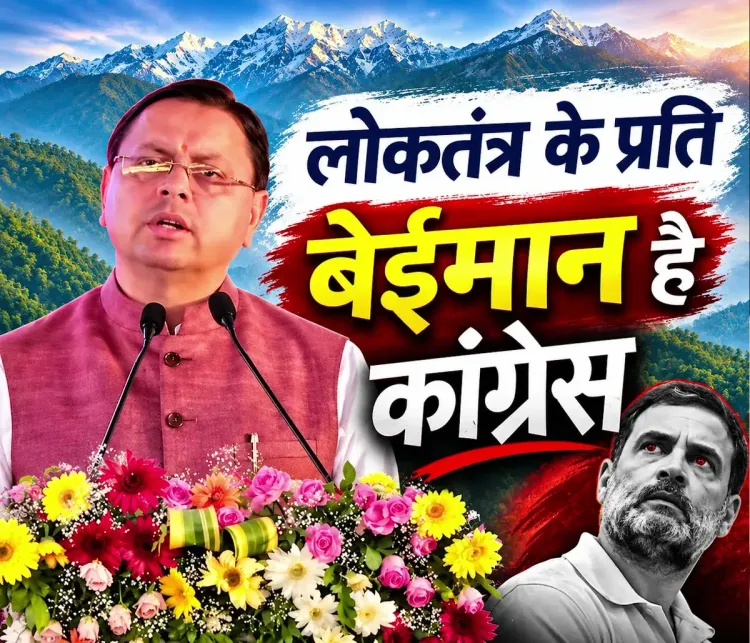
Uttarakhand CM Pushkar Singh Dhami attacked Congress on 6 November 2026, accusing it of inciting youth, spreading rumours, and questioning EVM credibility and Election Commission impartiality whenever election results go against the party.
Key Takeaways
CM Pushkar Singh Dhami posted on 6 November 2026 accusing Congress of making youth-incitement and violence part of its political strategy.
Dhami alleged Congress challenges EVM reliability and Election Commission impartiality whenever it loses elections.
Congress has raised EVM concerns after multiple elections since 2019 , including several state assembly results between 2017 and 2023 .
The Election Commission of India , established in 1950 , has consistently defended EVM integrity through technical audits.
No formal response from Congress leadership or the Election Commission had been issued at the time of publication.
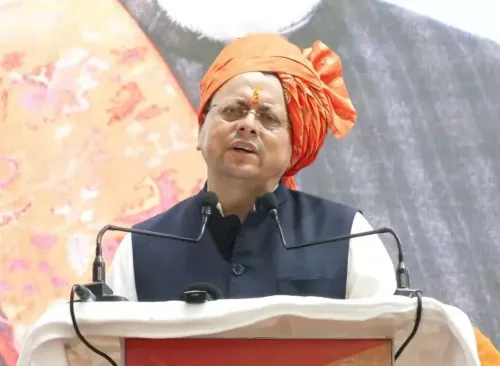
Every time a verdict goes against it, Uttarakhand Chief Minister Pushkar Singh Dhami argues, the Indian National Congress reaches for the same two levers — question the machines, question the umpire. On Friday, 6 November 2026, the BJP leader took that charge to X in a sharply worded post, accusing Congress of making youth-incitement, rumour-mongering, and violence a deliberate part of its political playbook.
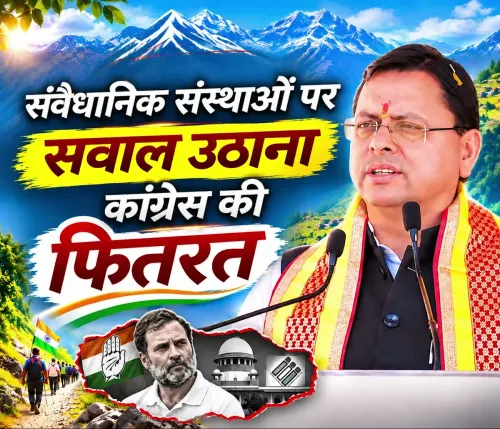
Posting in Hindi, CM Dhami wrote: 'Rajneetik swarth sadhne ke liye yuvaon ko bhadkana, afvaahein failana aur hinsa ko protsahit karna Congress ki rajneeti ka hissa ban chuka hai.' — 'Inciting youth for political self-interest, spreading rumours, and encouraging violence have become part of Congress's politics.' He added that when election results are not in Congress's favour, the party either raises questions about EVMs (Electronic Voting Machines) or challenges the impartiality of the Election Commission of India.A pattern older than a single election cycle
The allegation is not new — and that, politically, is precisely the point. Following the 2019 Lok Sabha results, Congress leaders publicly demanded a return to paper ballots and questioned EVM reliability. The same chorus resurfaced after several state assembly verdicts between 2017 and 2023 in which the party fell short. BJP leaders have made countering those claims a recurring refrain, framing them as an attack on constitutional institutions rather than legitimate electoral oversight.
The Election Commission of India, a constitutional body operational since 1950, has consistently defended the integrity of its EVM systems, citing technical audits and cross-party representation in the oversight process. The Commission has not publicly responded to this latest round of allegations.
Youth as the fault line
CM Dhami's specific mention of young voters is pointed. With first-time and young voters representing a growing share of India's electorate, both the ruling BJP and the opposition Congress have invested heavily in youth outreach. Dhami's framing casts Congress not as a champion of young Indians but as a force that instrumentalises them when electoral arithmetic disappoints — a charge Congress has not yet formally addressed.
The post arrives as the political temperature around electoral credibility continues to run high, with state assembly cycles keeping both parties in near-permanent campaign mode. Whether Congress leadership responds — and how the Election Commission weighs in publicly — will determine how far this exchange travels beyond social media.
India's democracy has absorbed decades of post-poll controversy; what changes each cycle is who is saying it and how loudly the institutional guardrails hold.
Point of View
The party seeks to delegitimise opposition grievances before they gain public traction. The specific framing around youth incitement is strategically significant — it pre-emptively brands any post-election unrest as manufactured, not organic. For Congress, persistent EVM rhetoric has become a double-edged sword: it energises a base that distrusts the system, but hands rivals a ready-made 'institution-wrecker' label. With assembly elections perpetually on the horizon, this exchange signals that the battle over electoral credibility will remain a central front in Indian politics well beyond any single result.
NationPress
6 Nov 2026
Frequently Asked Questions
What did CM Dhami say about Congress and EVMs?
CM Pushkar Singh Dhami accused Congress of questioning EVM reliability and Election Commission impartiality every time election results are not in its favour, calling it a pattern of political bad faith.
Has Congress actually questioned EVMs after election losses?
Yes. After the 2019 Lok Sabha results and several state assembly elections between 2017 and 2023 , Congress leaders publicly demanded paper ballots and raised doubts about EVM integrity.
What is the Election Commission of India's position on EVM security?
The Election Commission of India , a constitutional body since 1950 , has consistently defended EVM security, citing technical audits and multi-party oversight mechanisms.
Why did CM Dhami specifically mention youth in his post?
Dhami alleged that Congress incites young voters for political self-interest, framing any post-election unrest involving youth as deliberately manufactured rather than a spontaneous response to public grievances.
Has Congress responded to Dhami's accusation?
No formal response from Congress leadership had been issued as of the time of publication on 6 November 2026 .