CM Dhami Hails MSMEs as Spine of Economy on MSME Day
Synopsis
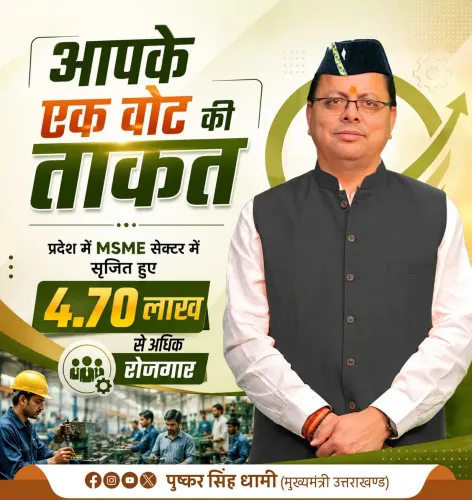
On International MSME Day, Uttarakhand Chief Minister Pushkar Singh Dhami called the MSME sector the backbone of India's economy and highlighted mountain-district enterprises as engines of youth self-employment and a check on persistent out-migration from the state's hill regions.
Key Takeaways
International MSME Day is observed on 27 June each year to highlight the sector's role in sustainable development and employment worldwide.
CM Pushkar Singh Dhami described MSMEs as the 'backbone' of the economy, crediting the sector with driving employment generation, innovation and self-reliance.
He specifically called out enterprises in Uttarakhand's mountainous regions built on local resources as connecting youth to self-employment.
Hill-district MSMEs were framed as playing a key role in curbing out-migration and building a prosperous rural economy.
India's MSME framework is anchored by the MSME Development Act of 2006 and received a major boost under Atmanirbhar Bharat in 2020 .
Uttarakhand's next industrial policy revision and state budget MSME allocations will be the key indicators of follow-through on these priorities.
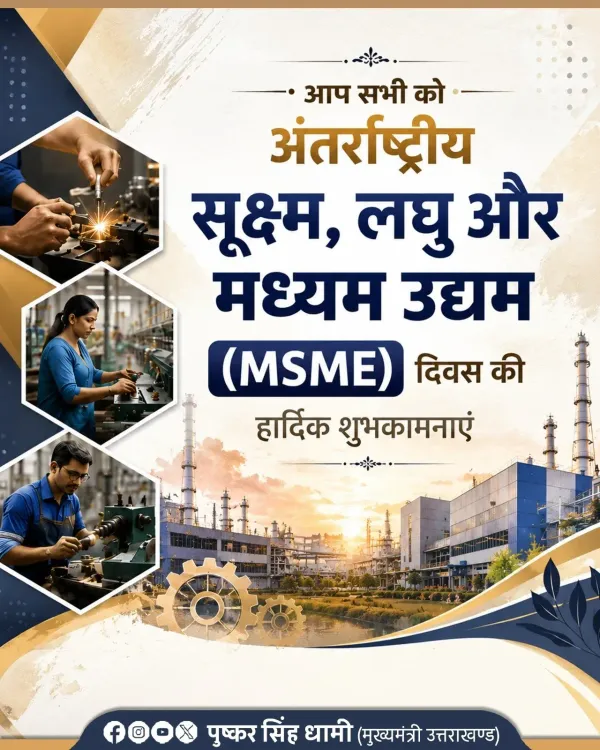
Uttarakhand Chief Minister Pushkar Singh Dhami on Saturday, 27 June 2026, extended greetings to entrepreneurs, innovators and working citizens on International MSME Day, calling the sector the 'backbone of the economy' and underscoring its role in driving employment, innovation and self-reliance — with a pointed focus on hill-district enterprises in Uttarakhand.
Context
International MSME Day is observed every year on 27 June to recognise the contribution of Micro, Small and Medium Enterprises to sustainable development and job creation worldwide. In his post, CM Dhami described the MSME sector as 'hamari arthvyavastha ki reed' (the backbone of our economy), adding that it is imparting fresh momentum to employment generation, innovation and self-reliance. He specifically highlighted enterprises in Uttarakhand's mountainous regions that are built on local resources, noting their dual role in connecting youth to self-employment and in building a prosperous rural economy.
Policy Backdrop
India's MSME framework rests on the Micro, Small and Medium Enterprises Development Act of 2006, which provided the first statutory classification and promotion structure for the sector. The Ministry of Micro, Small and Medium Enterprises was subsequently established in 2007 to give the sector dedicated administrative oversight. The sector received a significant policy push under the Atmanirbhar Bharat programme launched in 2020, which bundled credit guarantees, collateral-free loans and regulatory relief specifically for MSMEs hit by economic disruption.
At the national level, successive governments have positioned MSME growth as central to targets under Make in India, linking small-enterprise expansion to broader manufacturing and export ambitions. Himalayan states, including Uttarakhand, have layered state-level MSME incentives on top of central schemes, explicitly framing them as instruments to arrest out-migration from fragile hill economies.
Stakeholders and Impact
Out-migration from Uttarakhand's hill districts has been a persistent socio-economic challenge for decades, hollowing out villages and straining rural infrastructure. Local-resource-based enterprises — in sectors such as herbal products, handloom, horticulture processing and eco-tourism — are increasingly cited by state planners as a structural counter to this trend by creating viable livelihoods where young people already live. CM Dhami's message reinforces this framing, casting MSMEs not merely as economic units but as anchors of community stability in mountain regions.
For entrepreneurs and small-business owners across the state, the Chief Minister's public acknowledgement on a globally observed day signals continued political attention to MSME-friendly policy. Youth seeking self-employment options in remote districts stand to benefit most directly if the rhetorical commitment translates into credit access, market linkages and infrastructure support.
What's Next
Uttarakhand's next industrial policy revision and any fresh MSME credit outlay in the state budget will be closely watched as indicators of whether the government's stated priorities are backed by fiscal allocation. Analysts will also track whether hill-district MSME clusters receive targeted support — such as logistics subsidies or raw-material procurement networks — that address the specific cost disadvantages faced by mountain enterprises. The broader test is whether self-employment in the hills can be scaled enough to meaningfully slow the outward flow of working-age residents.
Point of View
The Chief Minister aligns state governance with the BJP's broader economic narrative while addressing a constituency-level anxiety. The real test will be whether this rhetorical alignment is followed by concrete budget lines and policy instruments targeted at mountain entrepreneurs. Until then, the statement reads as aspirational positioning ahead of what is likely to be a politically sensitive industrial policy cycle.
NationPress
25 Sept 2026
Frequently Asked Questions
When is International MSME Day celebrated?
International MSME Day is observed every year on 27 June to recognise the contribution of Micro, Small and Medium Enterprises to sustainable development and global job creation.
What did CM Dhami say on MSME Day 2026?
CM Pushkar Singh Dhami extended greetings to entrepreneurs and innovators, called the MSME sector the backbone of the economy, and highlighted how hill-district enterprises in Uttarakhand are linking youth to self-employment and helping curb out-migration.
How do MSMEs help reduce out-migration from Uttarakhand's hills?
Local-resource-based MSMEs in sectors like herbal products, handloom and horticulture processing create livelihoods within mountain communities, reducing the economic pressure on young people to migrate to plains cities for work.
What is Atmanirbhar Bharat's connection to MSMEs?
Atmanirbhar Bharat , launched in 2020 , included dedicated credit guarantees, collateral-free loans and regulatory relief for MSMEs, making it one of the largest policy interventions for the sector in recent years.
What is the legal framework governing MSMEs in India?
The Micro, Small and Medium Enterprises Development Act of 2006 provides the statutory framework for the classification, promotion and development of MSMEs in India, supported by the Ministry of MSME created in 2007 .