CM Dhami Backs Uttarakhand State Millet Policy for Farmers
Synopsis
Uttarakhand CM Pushkar Singh Dhami on 7 July 2026 highlighted the state's Millet Policy, aimed at boosting production, processing, and marketing of traditional crops like mandua and jhangora to raise farmer incomes and strengthen nutrition security and organic farming heritage.
Key Takeaways
Uttarakhand CM Pushkar Singh Dhami reaffirmed his government's commitment to farmer welfare and millet promotion on 7 July 2026 .
The State Millet Policy targets production, processing, and marketing of traditional crops including mandua (finger millet) and jhangora (barnyard millet).
The policy aims to raise farmer incomes, strengthen nutrition security, and promote organic farming in Uttarakhand's hill districts.
India's push for millets gained global momentum when the UN declared 2023 the International Year of Millets on India's proposal.
Uttarakhand's hill terrain makes it naturally suited to rainfed millet cultivation, giving the state a strategic advantage in the national millet revival.
Successful implementation could position Uttarakhand as a key supplier of certified organic millets to domestic and international markets.
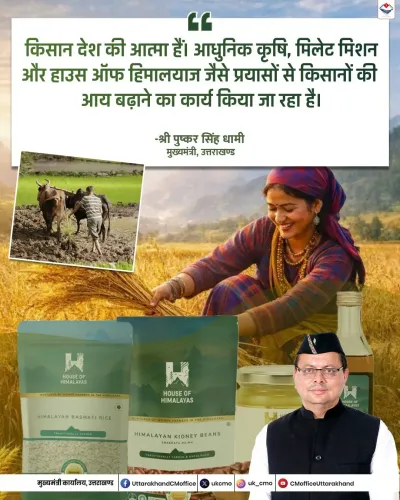
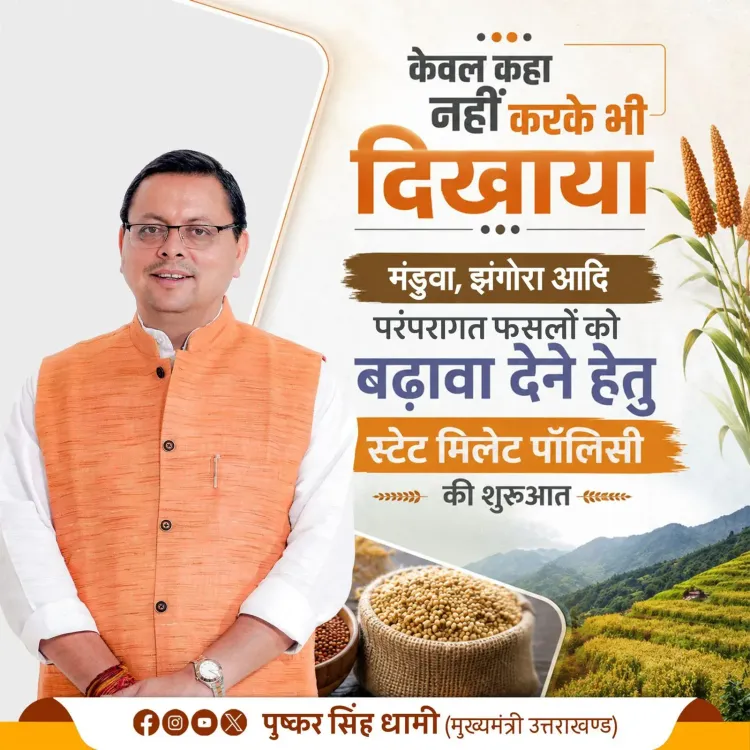
Uttarakhand Chief Minister Pushkar Singh Dhami on Tuesday, 7 July 2026 reaffirmed his government's commitment to economically empowering farmers and promoting Shri Anna (millets), highlighting the state's State Millet Policy as the vehicle for advancing production, processing, and marketing of traditional crops including mandua (finger millet) and jhangora (barnyard millet).
In his post, CM Dhami stated: 'Our government is working with commitment to economically empower farmers and promote Shri Anna (coarse grains). For this purpose, the State Millet Policy has been implemented in the state, through which production, processing and marketing of Uttarakhand's traditional crops including mandua and jhangora are being encouraged.'
Context
The post underscores a sustained policy thrust by the Dhami government to position Uttarakhand as a model state for millet revival. The Chief Minister noted that the initiative is simultaneously opening a path to increased farmer income and economic empowerment, while also giving new recognition to nutrition security, organic farming, and the state's rich traditional agricultural heritage.
Uttarakhand's hill districts have cultivated mandua and jhangora for centuries under rainfed conditions, making these crops naturally suited to the state's terrain. Their low input requirements and climate resilience make them central to any serious hill-agriculture strategy.
Policy Backdrop
The State Millet Policy sits within a broader national arc. The Government of India declared 2018 the National Year of Millets, and India's proposal to the United Nations led to 2023 being observed as the International Year of Millets globally. That international spotlight accelerated state-level policy action across India.
Since 2018, the Centre has positioned millets as a pillar of nutrition security and climate-resilient agriculture, integrating them with the POSHAN Abhiyaan. States with rainfed and tribal agriculture have followed with dedicated millet missions aimed at creating processing infrastructure and market linkages. Uttarakhand's policy aligns with this national pattern while emphasising the state's distinct organic and traditional farming credentials.
Stakeholders and Impact
The primary beneficiaries are hill farmers and traditional crop cultivators across Uttarakhand's mountainous districts, who have historically faced limited market access for indigenous varieties. By formalising support for processing and marketing, the policy aims to convert subsistence cultivation into a commercially viable livelihood.
Beyond farm incomes, the policy carries implications for nutrition security — millets are rich in micronutrients — and for the organic-farming ecosystem, since mandua and jhangora are typically grown without synthetic inputs. Consumers, health-food processors, and export-oriented agri-businesses stand to gain from a more organised millet supply chain in the state.
What's Next
Attention will now focus on the operational details of the State Millet Policy: the rollout of processing clusters, buyer linkages, and any subsidy or procurement support for farmers. Possible convergence with the central government's millet mission and Uttarakhand's existing organic-farming programmes will be closely watched by agriculture-sector observers.
If implementation keeps pace with the stated ambition, Uttarakhand could emerge as a significant supplier of certified organic millets to domestic health-food markets and, potentially, to international buyers — a development that would meaningfully shift income trajectories for hill farming communities.
Point of View
Converting a decades-old subsistence crop into a political and economic asset. By framing mandua and jhangora as both a heritage crop and a nutrition-security tool, the Dhami government is attempting to appeal simultaneously to hill farmers, urban health-conscious consumers, and the Centre's POSHAN Abhiyaan priorities. The move also signals competitive positioning — Uttarakhand wants to own the 'organic millet' brand nationally before other states consolidate that space. The real test will be whether processing infrastructure and market linkages follow the policy rhetoric, as past state millet initiatives across India have often stalled at implementation.
NationPress
7 Jul 2026
Frequently Asked Questions
What is the Uttarakhand State Millet Policy?
The Uttarakhand State Millet Policy is a state government initiative to promote the production, processing, and marketing of traditional millet crops — primarily mandua (finger millet) and jhangora (barnyard millet) — to raise farmer incomes and strengthen nutrition security in the hill state.
What are mandua and jhangora?
Mandua (finger millet) and jhangora (barnyard millet) are traditional rainfed crops grown for centuries in Uttarakhand's hill districts. They are highly nutritious, require minimal inputs, and are well-suited to the state's mountainous terrain and climate.
Why is India promoting millets?
India declared 2018 the National Year of Millets and successfully proposed to the United Nations that 2023 be observed as the International Year of Millets. The Centre has integrated millets into nutrition security programmes like POSHAN Abhiyaan, citing their micronutrient richness and climate resilience.
How will the millet policy benefit Uttarakhand farmers?
By supporting processing infrastructure and market linkages, the policy aims to convert subsistence millet cultivation into a commercially viable activity, increasing incomes for hill farmers who have historically had limited access to organised markets for indigenous crop varieties.