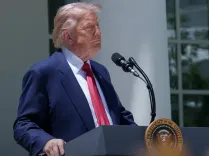
CM Dhami Marks 12 Years of Modi Govt Welfare Push
Synopsis
Uttarakhand CM Pushkar Singh Dhami on 8 June 2026 marked 12 years of PM Modi's government, highlighting Jan Dhan, Ujjwala, Ayushman Bharat, and Swachh Bharat as instruments of Antyodaya-driven welfare, and reaffirming the double-engine model in Uttarakhand.
Key Takeaways
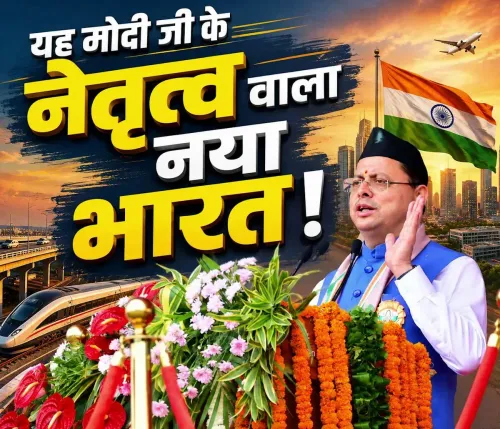
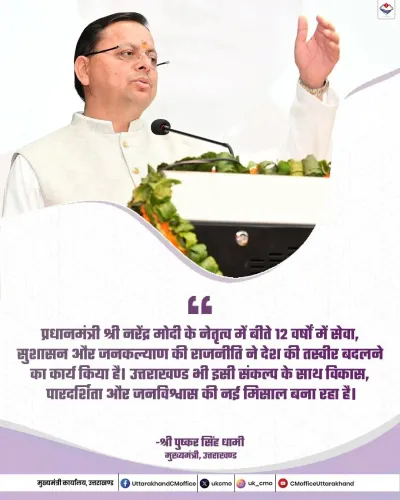
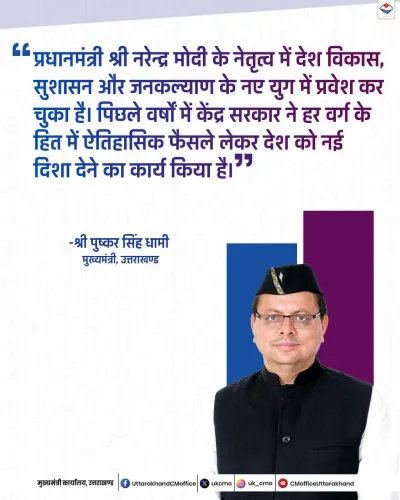
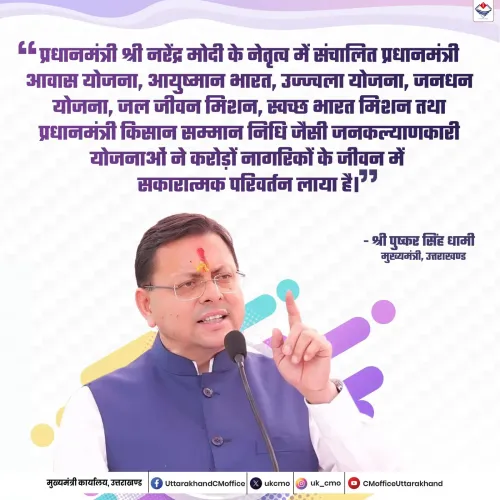
Uttarakhand CM Pushkar Singh Dhami posted on 8 June 2026 to mark 12 years of the Modi -led central government.
The post cited six flagship schemes: Jan Dhan Yojana , Ujjwala Yojana , Ayushman Bharat , Har Ghar Jal , Swachh Bharat Mission , and PM Awas Yojana .
Dhami invoked the Antyodaya principle, emphasising dignity, security, and confidence for the last person in the queue.
He described the Uttarakhand government as a 'double-engine' partner actively delivering central welfare schemes at the state level.
The post connects ongoing welfare efforts to the broader Viksit Bharat 2047 national development goal.
Uttarakhand Chief Minister Pushkar Singh Dhami on Monday, 8 June 2026, took to X to mark 12 years of the Narendra Modi-led central government, crediting it with transforming the lives of crores of poor and marginalised families through targeted welfare schemes anchored in the Antyodaya principle.
Context
Dhami's post, tagged #12YearsOfGaribKalyan (12 years of poor welfare), states that under Prime Minister Modi's leadership, 'a new stream of development has flowed in the country, keeping service, good governance, and the welfare of the poor at the centre.' The post marks the completion of 12 years of the BJP-led government at the Centre, which first assumed office in May 2014. Dhami explicitly extends the narrative to Uttarakhand, asserting that the 'double-engine government' in the state is continuously working to deliver the benefits of welfare schemes to the last person in the queue.
Policy Backdrop
The schemes cited in the post span a decade of flagship central initiatives. Pradhan Mantri Jan Dhan Yojana, launched on 28 August 2014, aimed to bring unbanked households into the formal financial system. Pradhan Mantri Ujjwala Yojana, introduced in May 2016, provided free LPG connections to women in below-poverty-line families, addressing both energy access and indoor air pollution.
Ayushman Bharat, announced in 2018, extended health insurance cover of up to Rs 5 lakh per year to eligible low-income families, while Swachh Bharat Mission, launched on 2 October 2014, targeted the elimination of open defecation across rural and urban India. PM Awas Yojana and Har Ghar Jal round out the list, addressing housing and piped drinking water respectively. Together, these programmes represent the central government's strategy of last-mile delivery through direct benefit transfers.
Stakeholders and Impact
The primary beneficiaries of these schemes are poor households and BPL (below-poverty-line) families across India, with Dhami specifically flagging their reach within Uttarakhand. The post invokes the Antyodaya ideal — a concept rooted in serving the weakest and most marginalised sections of society first — as the philosophical thread connecting all these programmes.
For Uttarakhand, a state with significant rural and remote hill populations, last-mile delivery of schemes such as Har Ghar Jal and PM Awas Yojana carries particular salience. Dhami's framing positions the state government as an active implementation partner rather than a passive recipient of central policy.
What's Next
The post signals that the Uttarakhand government intends to continue aligning state-level implementation with the broader Viksit Bharat (Developed India) goal, which the Centre has set as a target for 2047. Observers will watch for state budget allocations and saturation reports on scheme coverage in upcoming legislative sessions. As the BJP marks this political milestone nationally, state leaders like Dhami are expected to reinforce the double-engine governance narrative ahead of any future electoral cycles.
Point of View
Tying their own governance record to the Modi brand. The invocation of Antyodaya — a concept with roots in Deen Dayal Upadhyaya's integral humanism — signals ideological continuity rather than a new policy departure. By explicitly naming the double-engine model, Dhami positions Uttarakhand as a model implementer, a framing useful both for internal party optics and for voter outreach in a hill state with large rural and remote constituencies. The Viksit Bharat 2047 reference plants this routine political messaging within a long-arc national narrative, extending its shelf life well beyond the immediate anniversary.
NationPress
22 Sept 2026
Frequently Asked Questions
What is the #12YearsOfGaribKalyan hashtag about?
The hashtag marks 12 years of the BJP-led central government under PM Narendra Modi, which came to power in May 2014. It highlights welfare schemes aimed at poor and marginalised families under the Antyodaya principle.
What is the Antyodaya principle CM Dhami referred to?
Antyodaya means 'rise of the last person' and is a guiding philosophy in BJP governance rooted in the thought of Deen Dayal Upadhyaya. It prioritises the poorest and most marginalised citizens as the primary beneficiaries of state welfare.
What is the double-engine government model Dhami mentioned?
The double-engine government model refers to the BJP being in power both at the Centre and in a state simultaneously, allowing faster and aligned implementation of central schemes at the state level. Dhami used it to describe Uttarakhand's implementation of central welfare programmes.
What welfare schemes did CM Dhami highlight in his post?
Dhami highlighted six central schemes: Pradhan Mantri Jan Dhan Yojana (financial inclusion), Ujjwala Yojana (LPG connections), Ayushman Bharat (health insurance up to Rs 5 lakh), Har Ghar Jal (piped water), Swachh Bharat Mission (sanitation), and PM Awas Yojana (housing).
What is Viksit Bharat and how does it relate to welfare schemes?
Viksit Bharat, or Developed India, is the central government's vision for India to become a fully developed nation by 2047, the centenary of independence. Welfare schemes are presented as foundational steps toward this goal by ensuring inclusive growth from the grassroots up.