CM Dhami Credits Modi's 12 Years for India's Governance Shift
Synopsis
Chief Minister Pushkar Singh Dhami of Uttarakhand has credited Prime Minister Narendra Modi's 12-year leadership with reshaping India through service, good governance and public welfare — reinforcing the BJP's core governance narrative from the state's official CMO handle.
Key Takeaways
The Chief Minister's Office of Uttarakhand posted a statement by CM Pushkar Singh Dhami on 13 July 2026 .
Dhami credited PM Narendra Modi 's 12 years of leadership with changing India's governance landscape.
The three pillars cited are seva (service), sushasan (good governance), and jankalyan (public welfare).
Uttarakhand has been under BJP rule since 2017 and is a key implementer of centrally sponsored welfare schemes.
The statement mirrors similar messaging issued by BJP chief ministers across states, reflecting a coordinated national narrative.
The Chief Minister's Office of Uttarakhand on Monday, 13 July 2026, shared a statement by Chief Minister Pushkar Singh Dhami crediting Prime Minister Narendra Modi's leadership over the past 12 years with transforming India's political and administrative landscape through a focus on service, good governance, and public welfare.
Context
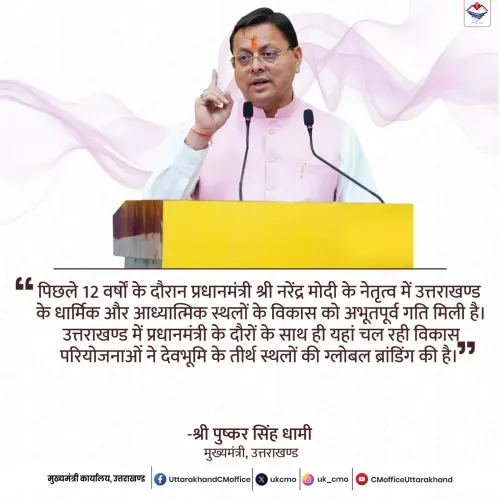
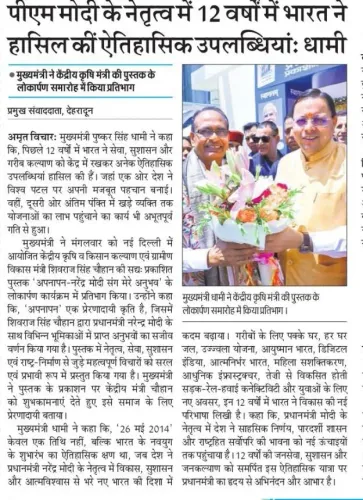
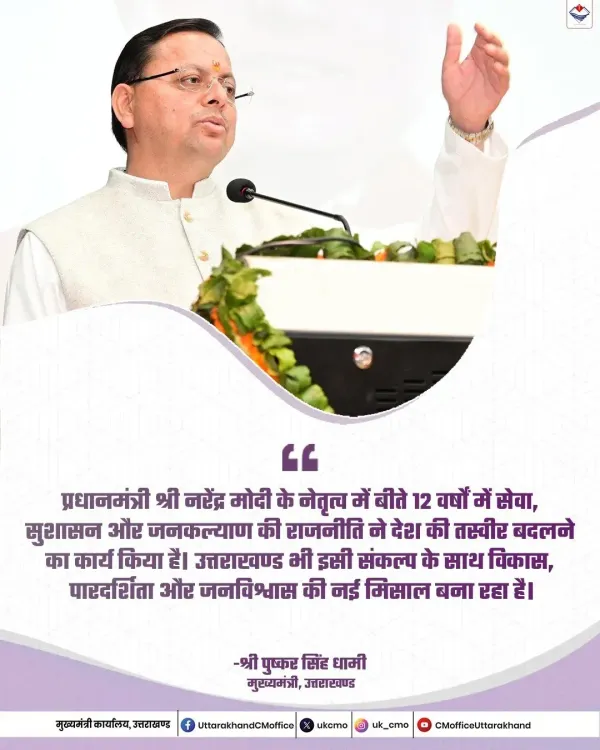
Dhami's statement, posted from the official CMO Uttarakhand handle, reads: 'Pradhan Mantri Shri Narendra Modi ke netritva mein beete 12 varshon mein seva, sushasan aur jankalyan ki rajneeti ne desh ki tasveer badalne ka karya kiya hai' — translated: 'Under the leadership of Prime Minister Shri Narendra Modi, the politics of service, good governance and public welfare over the past 12 years has worked to change the picture of the country.' The statement is attributed directly to Chief Minister Pushkar Singh Dhami.
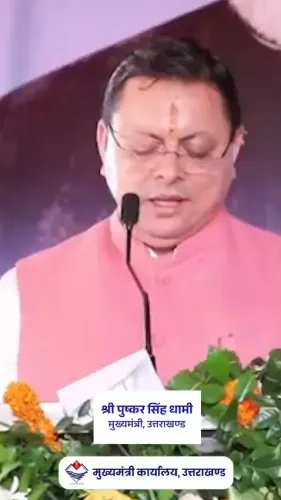
The post is accompanied by an image and tagged #Uttarakhand, signalling the state government's alignment with the national BJP narrative as Narendra Modi completes his 12th year in office since first assuming charge in May 2014.
Policy Backdrop
Narendra Modi came to power in May 2014 on a platform of 'maximum governance, minimum government,' a framework that has since become a reference point for BJP-governed states when assessing administrative performance. The three pillars Dhami invokes — seva (service), sushasan (good governance), and jankalyan (public welfare) — are the same terms used consistently in official communications from both the Centre and BJP-ruled state governments.
Uttarakhand has been under BJP governance since 2017 and has positioned itself as a proactive implementer of centrally sponsored schemes covering infrastructure, tourism, and social welfare. Dhami, who took charge as Chief Minister in 2021, has repeatedly framed state-level delivery within the broader national governance vision articulated from New Delhi.
Stakeholders and Impact
The statement is directed at a broad public audience and reinforces messaging around welfare delivery that affects residents across Uttarakhand's districts, particularly in hill regions where central scheme implementation has been a key political talking point. State governments functioning as delivery arms of centrally sponsored programmes have a direct stake in such narratives, as scheme performance is often cited during electoral cycles.
For the general public, the framing underscores the BJP's continued emphasis on governance outcomes — roads, housing, health, and social security — as the measure of political accountability. Similar statements have been issued by BJP chief ministers in other states, reflecting a coordinated messaging posture aligned with the national leadership.
What's Next
Statements of this nature typically precede or accompany updates on the state-level rollout of centrally sponsored welfare schemes, or appear in the lead-up to legislative sessions and political events. Observers will watch for concrete scheme announcements or progress reports from the Uttarakhand government that give operational weight to Dhami's assertion. Coordinated messaging from other BJP-governed states on similar themes would indicate a broader, nationally orchestrated communication push.
Point of View
A pattern that intensifies as election cycles approach. The invocation of 12 years is deliberate: it converts a calendar milestone into a political asset, framing continuity as achievement. For the BJP, such coordinated messaging from state capitals serves to reinforce the national brand while also giving state leaders a halo of association with Modi's approval ratings. The statement signals no new policy but is a reliable indicator that a round of scheme-progress communications or political events may follow in Uttarakhand.
NationPress
12 Oct 2026
Frequently Asked Questions
What did CM Pushkar Singh Dhami say about PM Modi?
CM Dhami said that under PM Modi's leadership over the past 12 years, the politics of service, good governance and public welfare has worked to transform India's governance landscape.
Why did the Uttarakhand CMO post this statement in July 2026?
The post marks 12 years of Modi-led governance since May 2014 and reflects the BJP's standard practice of issuing coordinated messaging from state governments to reinforce the national leadership's record.
What are the three pillars of governance Dhami mentioned?
Dhami cited seva (service), sushasan (good governance), and jankalyan (public welfare) as the defining pillars of the Modi government's 12-year tenure.
How long has the BJP governed Uttarakhand?
The BJP has governed Uttarakhand since 2017, with Pushkar Singh Dhami serving as Chief Minister since 2021.
Does this statement announce any new policy or scheme?
No new policy or scheme was announced. The statement is a political affirmation of the Modi government's governance record and is consistent with messaging issued by BJP-ruled states on similar occasions.