CM Dhami Credits Modi's 12 Years for Uttarakhand's Rise
Synopsis
Uttarakhand Chief Minister Pushkar Singh Dhami marked 12 years of PM Narendra Modi's leadership on 19 June 2026, crediting national policies — from Atmanirbhar Bharat to Char Dham connectivity — for elevating India's global stature and accelerating Uttarakhand's development.
Key Takeaways
CM Pushkar Singh Dhami posted on 19 June 2026 marking 12 years of PM Narendra Modi 's government under the hashtag #12YearsOfIndiaFirst .
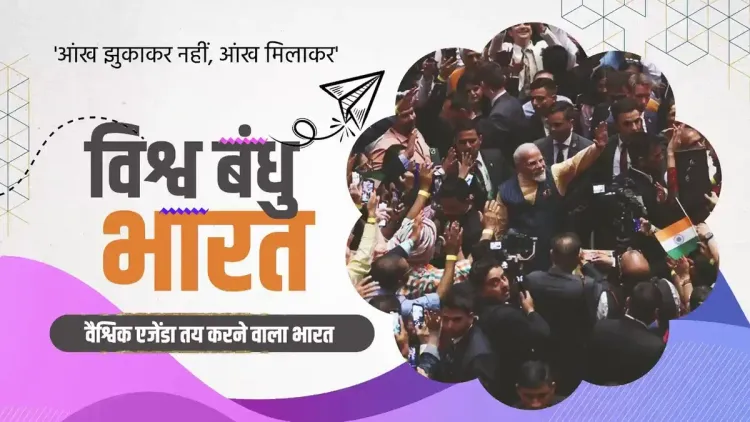
Dhami argued that India now commands global trust during crises, balancing national interest with international welfare.
He cited Atmanirbhar Bharat , strong foreign policy, rising global investment, and national security as pillars of India's rise.
For Uttarakhand , he highlighted modern connectivity, Char Dham Yatra infrastructure, growing investment, and new employment as direct benefits.
The post uses the 'Viksit Bharat — Viksit Uttarakhand' formulation, tying state development goals firmly to the Prime Minister's national vision.
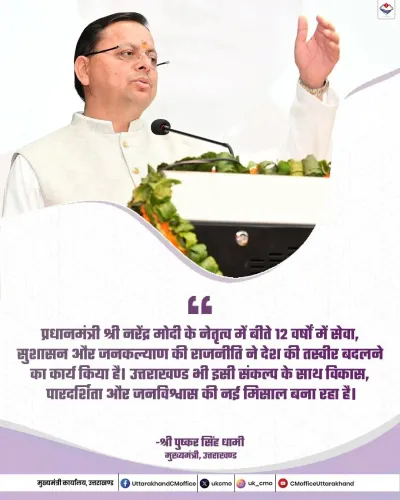
Uttarakhand Chief Minister Pushkar Singh Dhami on Friday, 19 June 2026, took to X to mark 12 years of Prime Minister Narendra Modi's leadership, arguing that India has established a new global identity and that the benefits of that transformation are now visible in Uttarakhand.
Context
Posting under the hashtag #12YearsOfIndiaFirst, CM Dhami wrote that under PM Modi's leadership, 'India has established a new identity on the global stage over the past 12 years.' He added that 'whenever the world faces a crisis, conflict, or significant global challenge, large and small nations alike look toward India with hope and trust.'
Dhami attributed this standing to what he described as India's ability to 'establish an effective balance between national interests and global welfare' — a framing consistent with the BJP's long-running 'India First' foreign-policy messaging.
Policy Backdrop
Narendra Modi assumed office as Prime Minister in May 2014, initiating an assertive foreign policy posture alongside large-scale domestic programmes. The Atmanirbhar Bharat (Self-Reliant India) initiative, announced in May 2020, sought to strengthen domestic supply chains, boost manufacturing, and attract foreign investment.
In his post, CM Dhami cited 'a strong foreign policy, Atmanirbhar Bharat, growing global investment, and robust national security' as the pillars that have 'placed India among the world's leading powers.' These themes mirror the BJP's broader national narrative as the party marks a decade-plus in government at the Centre.
For Uttarakhand specifically, the Char Dham National Highway Development Project — approved in 2016 — has been a flagship connectivity effort, widening mountain roads to improve access to the four major Hindu pilgrimage sites of Badrinath, Kedarnath, Gangotri, and Yamunotri. Central investment in tunnels and all-weather roads has been presented by state leaders as a direct dividend of national policy priorities.
Stakeholders and Impact
CM Dhami stated that 'the fruits of these far-sighted decisions have also been received by Devbhoomi Uttarakhand,' pointing to 'modern connectivity, strengthening of the Char Dham Yatra, rapidly developing infrastructure, growing investment, and new employment opportunities.' These are the constituencies most directly affected: pilgrims using the Char Dham corridor, investors eyeing the state's industrial and tourism potential, and residents seeking stable employment.
The post frames local development gains as inseparable from central government decisions — a political alignment that state BJP leaders have consistently maintained since 2014. This narrative is particularly potent in Uttarakhand, where the pilgrimage economy is a major driver of livelihoods and where infrastructure deficits in remote Himalayan terrain have historically constrained growth.
What's Next
Attention will turn to forthcoming Union Budget allocations and any new central investment announcements for Uttarakhand in upcoming NITI Aayog meetings, which will test whether the momentum CM Dhami describes translates into fresh project commitments. Further phases of Char Dham road and tunnel projects remain in various stages of execution, and their progress will be a concrete measure of the policy dividends he claims. The 'Viksit Bharat — Viksit Uttarakhand' (Developed India — Developed Uttarakhand) formulation Dhami used signals that the state government intends to keep its development pitch tightly coupled to the Prime Minister's national vision heading into future electoral cycles.
Point of View
Making a vote for the state synonymous with endorsing national policy. The timing — precisely at the 12-year mark — suggests a coordinated messaging effort across BJP-governed states rather than a spontaneous tribute. Analysts will watch whether concrete project deliverables, particularly on Char Dham road phases and industrial investment, follow to substantiate the claims made.
NationPress
19 Sept 2026
Frequently Asked Questions
Why did Uttarakhand CM Dhami post about PM Modi's 12 years?
CM Pushkar Singh Dhami posted on 19 June 2026 to mark 12 years of PM Narendra Modi's government, crediting national policies for India's global standing and for development gains in Uttarakhand such as Char Dham connectivity and new investment.
What is the Char Dham project Dhami mentioned?
The Char Dham National Highway Development Project, approved in 2016, aims to widen and upgrade roads connecting the four major Hindu pilgrimage sites in Uttarakhand — Badrinath, Kedarnath, Gangotri, and Yamunotri — to enable all-weather access.
What is Atmanirbhar Bharat and how does it relate to Uttarakhand?
Atmanirbhar Bharat, launched in May 2020, is a national initiative to boost domestic manufacturing, reduce import dependence, and attract investment. CM Dhami cited it as one of the policies contributing to growing investment and employment opportunities in Uttarakhand.
What does 'Viksit Bharat Viksit Uttarakhand' mean?
'Viksit Bharat — Viksit Uttarakhand' translates to 'Developed India — Developed Uttarakhand.' CM Dhami used the phrase to signal that Uttarakhand's development goals are directly tied to and enabled by the national vision being pursued by PM Modi's government.
How has India's global role changed under Modi according to Dhami?
According to CM Dhami's post, India under PM Modi's 12-year leadership has built a reputation as a trusted voice in global crises, with countries large and small looking to India for direction, owing to its balance between national interest and global welfare.