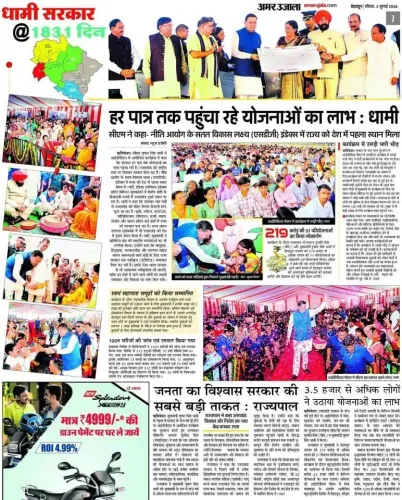
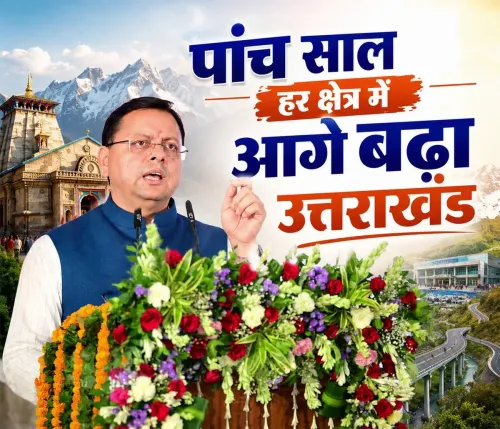
CM Dhami Marks 5 Years of BJP Rule in Uttarakhand
Synopsis
Uttarakhand Chief Minister Pushkar Singh Dhami marked five years of his BJP government on 4 July 2026, citing the Uniform Civil Code, a stringent anti-copying law, land reforms, an anti-conversion law, and a minority education act as defining legislative achievements under PM Modi's guidance.
Key Takeaways
CM Pushkar Singh Dhami publicly marked five years of his BJP government in Uttarakhand on 4 July 2026 .
He credited Prime Minister Narendra Modi 's leadership as central to the state government's direction and decisions.
The Uniform Civil Code (UCC) was cited as a landmark achievement, with Uttarakhand among the first states to formally advance its implementation.
Other key laws cited include the country's 'most stringent anti-copying law,' a strict land law , an anti-conversion law , and a minority education act .
The government's stated approach was not merely announcing schemes but establishing a new 'work culture of development' through bold, public-interest decisions.
Court challenges to several of these laws and the operational rollout of the UCC remain key areas to watch going forward.
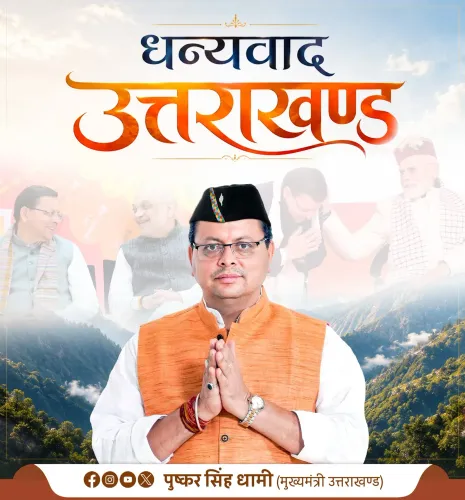
Uttarakhand Chief Minister Pushkar Singh Dhami on Saturday, 4 July 2026, took to X to mark five years of his government's tenure, crediting Prime Minister Narendra Modi's leadership for what he described as an era of service, good governance, and development in the state.
In the post, written in Hindi, CM Dhami stated: 'बीते पाँच वर्ष सेवा, सुशासन और समर्पण के भाव से उत्तराखंड के सर्वांगीण विकास को समर्पित रहे हैं' — 'The past five years have been dedicated to the all-round development of Uttarakhand with a spirit of service, good governance, and commitment.' He added that his government did not merely announce schemes, but established a new work culture of development through 'visionary, bold, and public-interest decisions.'
Context
Pushkar Singh Dhami was first sworn in as Chief Minister of Uttarakhand in 2021 following the BJP's assembly election victory. His government has since positioned itself as one of the more legislatively active BJP-ruled states, enacting a series of laws on social, religious, and land-related matters. The five-year milestone is being marked as a moment of political stocktaking ahead of the next assembly cycle.
The post is framed as an expression of gratitude to PM Modi, whose guidance Dhami credited as the driving force behind the state government's decisions. This framing is consistent with the BJP's practice of aligning state governance narratives with the national leadership.
Policy Backdrop
CM Dhami specifically cited five legislative or policy actions as the hallmarks of his government's tenure. The Uniform Civil Code (UCC) — a set of uniform personal laws applicable to all citizens irrespective of religion, long envisioned under Article 44 of the Constitution — was described as a historic decision. Uttarakhand has been among the first states to move formally on UCC implementation, making it a flagship political achievement for the BJP at the state level.
Beyond the UCC, Dhami cited the country's 'most stringent anti-copying law' targeting examination malpractice, a strict land law, an anti-conversion law, and a minority education act. Several BJP-governed states have advanced similar legislation in recent years, presenting these measures as responses to local governance and demographic concerns while echoing national-level debates on uniformity and regulation.
Stakeholders and Impact
The laws cited by CM Dhami span a wide range of communities in Uttarakhand. Landowners and migrants are directly affected by the state's land laws, which are designed to regulate property purchases in the hill state. Students and examination boards are subject to the anti-copying legislation, while religious communities — particularly those involved in conversion-related activity — are affected by the anti-conversion law and the minority education act.
Civil society groups and opposition parties have previously raised questions about the scope of some of these laws, and legal challenges before courts remain a key arena to watch. The broader pattern of such legislation across BJP-ruled states has kept these issues at the centre of national political discourse.
What's Next
With the five-year mark now formally acknowledged, attention will turn to the implementation status of these laws — particularly the UCC, whose rules and operational details remain a subject of public and judicial scrutiny. Court challenges to the anti-conversion and land laws are also ongoing, and any new notifications or amendments are expected to generate fresh political debate.
For CM Dhami, this public accounting of his government's legislative record signals the beginning of a longer narrative-building exercise as Uttarakhand looks toward its next electoral cycle.
Point of View
Designed to consolidate his government's legislative identity ahead of the next electoral cycle. By anchoring the narrative to PM Modi's guidance, he reinforces the BJP's standard practice of presenting state governance as an extension of national leadership — a framing that strengthens both the state and central party's political capital simultaneously. The specific enumeration of the UCC, anti-conversion law, and land law signals that these contentious but high-salience issues will remain central to the BJP's Uttarakhand campaign playbook. The broader pattern — multiple BJP states advancing similar legislation — suggests a coordinated ideological consolidation rather than isolated state-level improvisation.
NationPress
3 Oct 2026
Frequently Asked Questions
What has Uttarakhand CM Pushkar Singh Dhami achieved in five years?
CM Dhami cited the Uniform Civil Code, the country's most stringent anti-copying law, a strict land law, an anti-conversion law, and a minority education act as the defining achievements of his government's five-year tenure.
Has Uttarakhand implemented the Uniform Civil Code?
Uttarakhand has been among the first states in India to formally advance the Uniform Civil Code, and CM Dhami described it as one of his government's historic decisions, though operational details and rules remain subject to ongoing judicial and administrative processes.
What is Uttarakhand's anti-copying law?
CM Dhami described it as the country's most stringent law against examination malpractice; it targets cheating in public examinations and is presented as a measure to ensure fair access to government jobs and education.
Why did CM Dhami thank PM Modi in his post?
Dhami credited Prime Minister Narendra Modi's leadership and guidance as the driving force behind his government's major decisions, a framing consistent with the BJP's practice of aligning state governance with national leadership.
What is Uttarakhand's land law about?
The Uttarakhand land law is designed to regulate property purchases in the hill state, particularly to address concerns about land ownership patterns; it is one of several such measures enacted by BJP-governed hill and border states in recent years.