CM Dhami credits Modi for Uttarakhand's religious site growth
Synopsis
Chief Minister Pushkar Singh Dhami has credited Prime Minister Narendra Modi's 12-year tenure with delivering unprecedented development at Uttarakhand's religious and spiritual sites, citing central schemes such as PRASAD and the Char Dham All-Weather Road Project as key drivers.
Key Takeaways
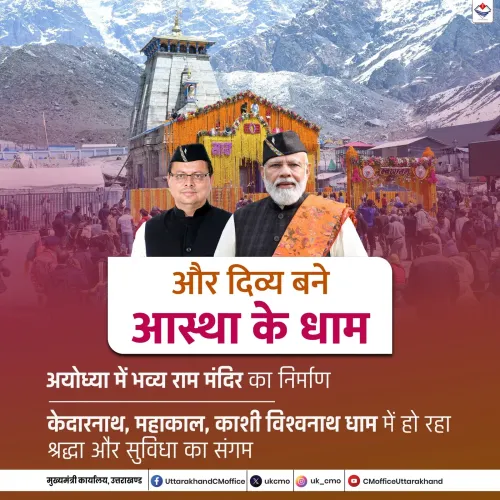
CM Pushkar Singh Dhami stated that religious and spiritual site development in Uttarakhand has received 'unprecedented momentum' under PM Modi over the past 12 years .
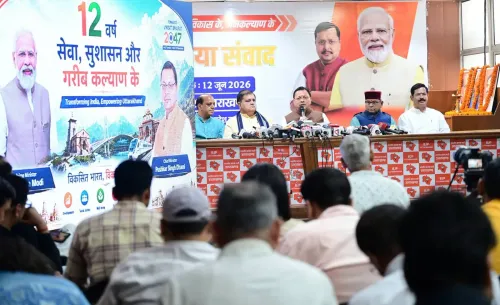
The statement was posted under the campaign hashtag #12YearsofGaribKalyan , marking the Modi government's 12th year in office.
The PRASAD scheme , launched in 2014-15 , has directed central funding toward pilgrim facilities at major shrines including those in Uttarakhand.
The Char Dham All-Weather Road Project , approved in 2016 , aims to provide year-round connectivity to Badrinath , Kedarnath , Gangotri , and Yamunotri .
Post- 2013 flood reconstruction of the Kedarnath Temple complex has been a flagship central-state coordination effort since 2014 .
Tourism-dependent local communities across the Char Dham corridor stand to benefit from improved infrastructure and extended pilgrimage seasons.
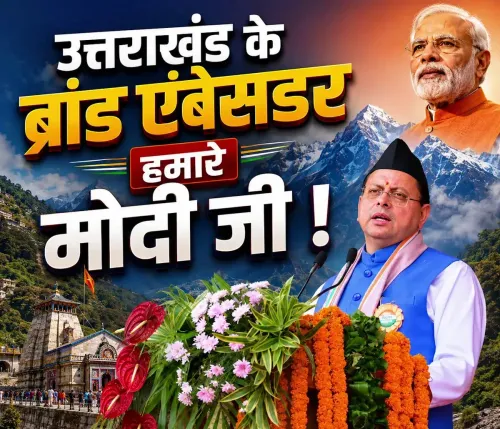
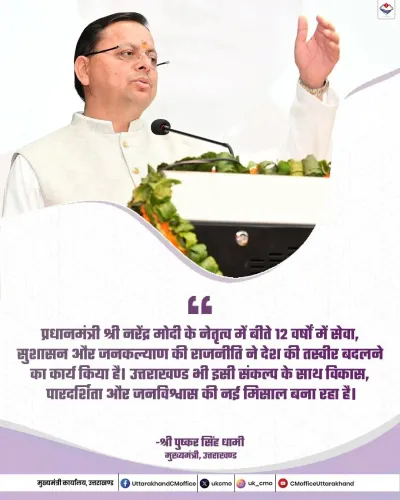
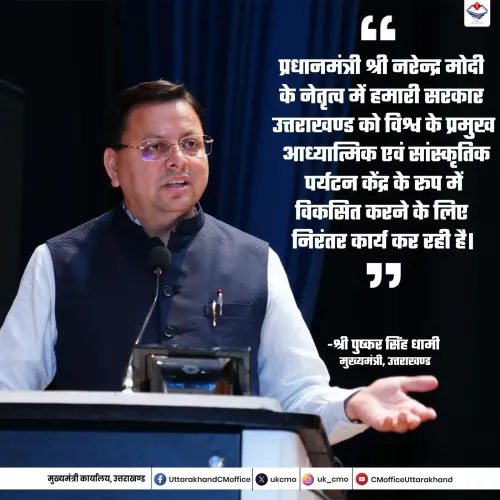
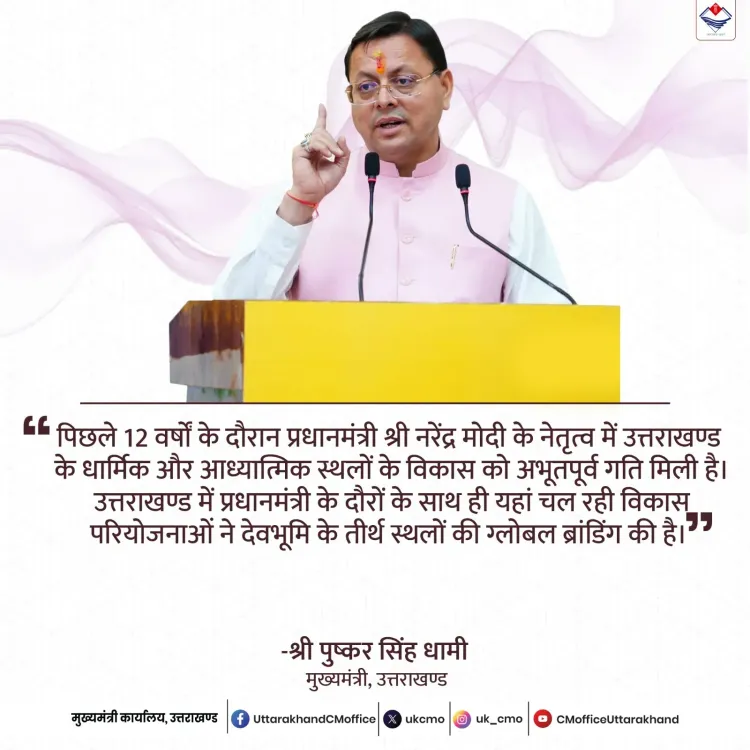
The Chief Minister's Office of Uttarakhand on Friday, 12 June 2026 shared a statement from Chief Minister Pushkar Singh Dhami crediting Prime Minister Narendra Modi with giving unprecedented momentum to the development of religious and spiritual sites in the state over the past 12 years.
Context
The statement, posted under the hashtag #12YearsofGaribKalyan, quotes CM Dhami as saying: 'Over the past 12 years, under the leadership of Prime Minister Narendra Modi, the development of religious and spiritual sites in Uttarakhand has received unprecedented momentum.' The remark is part of a broader ruling-party campaign marking 12 years of the Modi government at the Centre, which took office in May 2014.
Uttarakhand is home to the Char Dham — the four sacred Hindu pilgrimage centres of Badrinath, Kedarnath, Gangotri, and Yamunotri — which draw millions of pilgrims annually and form the backbone of the state's religious tourism economy.
Policy Backdrop
The Union government launched the PRASAD scheme (Pilgrimage Rejuvenation and Spiritual Augmentation Drive) in 2014-15, providing dedicated central funding for pilgrim amenities and infrastructure at identified religious sites, including several in Uttarakhand. The scheme has since channelled resources into facilities such as waiting areas, sanitation, lighting, and approach roads at major shrines.
Following the catastrophic June 2013 Kedarnath floods, the central government initiated phased reconstruction of the Kedarnath Temple complex and its approach routes from 2014 onwards, with the Ministry of Tourism and other agencies coordinating the effort. Separately, the Cabinet approved the Char Dham All-Weather Road Project in 2016 to ensure year-round connectivity to all four dhams — a project that has remained a centrepiece of the state's infrastructure narrative.
This pattern of integrating religious-site development with highway and tourism schemes has been replicated across other major pilgrimage centres in India, treating such infrastructure as both cultural preservation and economic stimulus for local communities.
Stakeholders and Impact
The primary beneficiaries of these investments are the estimated millions of pilgrims who visit Uttarakhand's shrines each season, as well as the tourism-dependent communities — hoteliers, guides, porters, and traders — whose livelihoods are directly tied to footfall at these sites. Improved all-weather connectivity and upgraded facilities have the potential to extend the pilgrimage season and increase visitor numbers.
Local residents and small businesses in towns such as Kedarnath, Badrinath, and Uttarkashi have historically seen economic cycles shaped by the condition of roads and pilgrim infrastructure, making central-government investment a matter of direct material consequence beyond its cultural significance.
What's Next
Observers will watch for physical progress updates on the remaining stretches of the Char Dham All-Weather Road Project, where land acquisition and environmental clearances have been ongoing concerns. Any new pilgrim-facility allocations in the next Uttarakhand state budget will also signal how the state government intends to build on the central momentum highlighted by CM Dhami. The campaign framing suggests the ruling dispensation intends to continue positioning religious infrastructure as a signature governance achievement heading into future electoral cycles.
Point of View
With CM Dhami using the #12YearsofGaribKalyan frame to associate Uttarakhand's religious tourism narrative directly with PM Modi's personal leadership. This aligns with a broader BJP governance strategy of positioning pilgrimage infrastructure — from Kedarnath to Ayodhya to Varanasi — as a cultural-nationalist deliverable with measurable economic returns. For Uttarakhand, where the Char Dham circuit is the dominant economic driver, such messaging carries particular resonance with both local constituents and the national Hindu pilgrim base. The forward risk lies in delivery gaps: incomplete road stretches or unresolved environmental disputes could complicate the 'unprecedented progress' claim in future accountability cycles.
NationPress
26 Oct 2026
Frequently Asked Questions
What has the Modi government done for Uttarakhand's religious sites?
The central government has supported Uttarakhand's religious sites through the PRASAD scheme launched in 2014-15, the Char Dham All-Weather Road Project approved in 2016, and phased reconstruction of the Kedarnath Temple complex following the 2013 floods.
What is the PRASAD scheme?
PRASAD — Pilgrimage Rejuvenation and Spiritual Augmentation Drive — is a central government scheme launched in 2014-15 to fund and upgrade infrastructure and amenities at identified pilgrimage sites across India, including several in Uttarakhand.
What is the Char Dham All-Weather Road Project?
The Char Dham All-Weather Road Project is a central government initiative approved in 2016 to build all-weather highway connectivity to Uttarakhand's four sacred dhams: Badrinath, Kedarnath, Gangotri, and Yamunotri.
What did CM Pushkar Singh Dhami say about PM Modi and Uttarakhand?
CM Dhami stated that over the past 12 years, under PM Modi's leadership, the development of religious and spiritual sites in Uttarakhand has received unprecedented momentum — a remark shared by the Chief Minister's Office on 12 June 2026.
Why is Kedarnath significant in Uttarakhand's development story?
Kedarnath, a 12th-century Shiva shrine, was severely damaged in the June 2013 floods. Its reconstruction — funded and coordinated with central government support from 2014 onwards — became a flagship project symbolising the revival of Uttarakhand's pilgrimage economy.