CM Dhami Marks 12 Years of Modi Govt's Development-Heritage Model
Synopsis
Uttarakhand CM Pushkar Singh Dhami on June 18 credited PM Modi's 12-year tenure with a unique model combining modern infrastructure and cultural heritage preservation, citing Kedarnath reconstruction, the Char Dham road, and the Rishikesh-Karnprayag rail line as key examples from Uttarakhand.
Key Takeaways
CM Pushkar Singh Dhami posted on June 18, 2026 marking 12 years of the BJP-led central government under PM Narendra Modi .
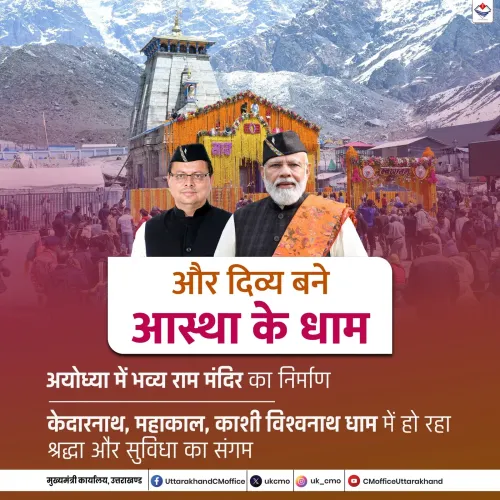
Dhami cited the Kedarnath Dham reconstruction and the Badrinath Dham Master Plan as flagship heritage-development projects in Uttarakhand.
The Char Dham All Weather Road , formally approved in 2016 , aims to provide year-round connectivity to all four pilgrimage sites.
The Rishikesh-Karnprayag Rail Line is under execution and would bring rail access to the Himalayan interior for the first time.
The Manaskhand Mandir Mala Mission is an Uttarakhand initiative aligned with central schemes like PRASAD and Swadesh Darshan launched in 2014-15 .
Dhami framed the current era as Amrit Kaal , where economic progress and cultural preservation advance as complementary national goals.
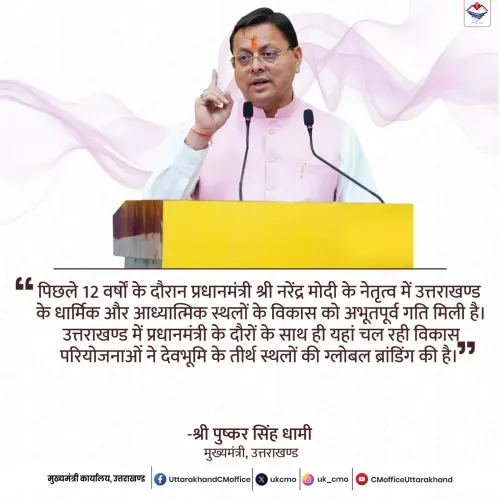
Uttarakhand Chief Minister Pushkar Singh Dhami on Thursday, June 18, 2026, credited Prime Minister Narendra Modi's leadership over the past 12 years with delivering a unique model that advances modern infrastructure alongside the preservation of India's cultural and spiritual heritage. Dhami cited several flagship projects in Uttarakhand as concrete proof of this dual approach, from pilgrimage site redevelopment to Himalayan rail connectivity.
Context
Dhami's post, shared under the hashtag #12YearsOfVikasBhiVirasatBhi ('12 Years of Both Development and Heritage'), marks the completion of 12 years of the BJP-led central government in office since May 2014. He described the period as one in which India has been given 'a new direction and a new identity' — 'nai disha aur nai pehchaan'. The post frames modern economic progress and civilisational heritage not as competing priorities but as complementary pillars of governance.
Dhami specifically highlighted Atmanirbhar Bharat, the digital revolution, rapid economic growth, and welfare schemes as drivers of development, while pointing to temple restoration and pilgrimage infrastructure as evidence of heritage stewardship. He described the present era as 'Amrit Kaal' — the aspirational 25-year window toward India's centenary of independence in 2047 — where, in his words, 'the pace of progress and the consciousness of culture advance together.'
Policy Backdrop
The projects Dhami enumerated in Uttarakhand have roots in central schemes launched after 2014. The Kedarnath Dham reconstruction — accelerated following the catastrophic 2013 floods — received sustained central funding and master planning. The Char Dham All Weather Road project, formally approved in 2016, aims to provide year-round highway connectivity to Badrinath, Kedarnath, Gangotri, and Yamunotri.
The Rishikesh-Karnprayag Rail Line is a strategic connectivity project under execution since the mid-2010s, designed to bring rail access into the Himalayan interior for the first time. The Manaskhand Mandir Mala Mission is an Uttarakhand state initiative aligned with central pilgrimage development programmes such as the PRASAD scheme (launched 2014-15) and the Swadesh Darshan tourism circuit scheme. The Badrinath Dham Master Plan similarly draws on this integrated framework of faith and infrastructure.
This framing mirrors messaging deployed around major projects in Ayodhya, Varanasi, and other sacred sites across India, reflecting a consistent BJP-led central government narrative of treating religious tourism and heritage as legitimate development sectors.
Stakeholders and Impact
Pilgrims and religious tourists stand as the most direct beneficiaries of the projects Dhami cited. The Char Dham circuit draws millions of visitors annually, and improved road and eventual rail access is expected to ease long-standing bottlenecks, reduce journey times, and improve safety on mountain routes. Local hill communities and the Uttarakhand tourism economy also stand to gain from higher footfall and better connectivity.
For the BJP, the 'Vikas Bhi, Virasat Bhi' ('Development as well as Heritage') framing carries political salience ahead of any future state or national electoral cycle, consolidating support among pilgrims, cultural conservatives, and infrastructure beneficiaries simultaneously. Dhami, as the state's chief minister, positions Uttarakhand as a model showcase for this dual-priority governance approach.
What's Next
Key milestones to watch include the completion timeline of the Rishikesh-Karnprayag Rail Line, which would mark a transformational shift in Himalayan connectivity, and updated pilgrimage footfall data once the full Char Dham All Weather Road is operationalised. Progress on the Badrinath Dham Master Plan and the Manaskhand Mandir Mala Mission will test whether the heritage-development model delivers measurable outcomes on the ground. As India advances through Amrit Kaal, Uttarakhand's pilgrimage corridor is set to remain a high-visibility proving ground for this governance philosophy.
Point of View
Virasat Bhi' narrative while simultaneously showcasing Uttarakhand as its most tangible proof-of-concept. By anchoring abstract governance philosophy to specific, visible projects — a rebuilt Kedarnath, a mountain highway, a new rail line — Dhami converts a party anniversary message into a state-level performance claim. This mirrors a broader BJP pattern of linking central scheme delivery to religious and cultural identity, a combination that has proven electorally potent in Himalayan and Hindi-belt states. The invocation of 'Amrit Kaal' also signals alignment with the long-arc 2047 national vision, tying Uttarakhand's infrastructure trajectory to a larger civilisational narrative.
NationPress
18 Sept 2026
Frequently Asked Questions
What is the Vikas Bhi Virasat Bhi campaign about?
'Vikas Bhi, Virasat Bhi' translates to 'Development as well as Heritage' and is a BJP framing that presents modern infrastructure and cultural-religious preservation as complementary goals pursued together under PM Modi's government since 2014.
What is the Rishikesh-Karnprayag Rail Line?
The Rishikesh-Karnprayag Rail Line is a strategic railway project in Uttarakhand that, once complete, will extend rail connectivity into the Himalayan interior for the first time, improving access to pilgrimage and tourist destinations.
What is the Manaskhand Mandir Mala Mission?
The Manaskhand Mandir Mala Mission is an Uttarakhand state government initiative focused on the development and beautification of temples in the Kumaon region, aligned with central pilgrimage development schemes like PRASAD and Swadesh Darshan.
What happened to Kedarnath after the 2013 floods?
The 2013 Uttarakhand floods severely damaged Kedarnath Dham. After 2014, reconstruction was accelerated with central government funding and master planning, resulting in a significantly rebuilt and expanded pilgrimage complex.
What is the Char Dham All Weather Road project?
The Char Dham All Weather Road is a central government highway project, formally approved in 2016, designed to provide year-round road connectivity to the four Uttarakhand pilgrimage sites — Badrinath, Kedarnath, Gangotri, and Yamunotri.