Trump 'may be' breaking law on Russian diesel deal, says GOP Senator Tillis
Synopsis
A rare Republican split erupted on live television as Senator Thom Tillis accused President Trump of 'may be' breaking federal law over a Russian diesel deal — while seven senators, crossing party lines, demanded an immediate reversal. With a statutory deadline on secondary tariffs arriving on 18 October, the legal and diplomatic fallout could extend well beyond Washington to major Russian energy buyers, including India.
Key Takeaways
Republican Senator Thom Tillis said Trump 'may be' breaking the law with his Russian diesel deal on 12 October 2026 .
Senate Republican Whip John Barrasso countered, calling the deal 'leverage' against Vladimir Putin .
A bipartisan group of seven senators , led by Jeanne Shaheen , demanded Trump 'immediately reverse course'.
Treasury Secretary Scott Bessent argued the Graham Act does not cover refined products like diesel, defending the deal's legality.
Under the Lindsey O.
Graham Sanctioning Russia and Iran Act of 2026 , Trump faces a deadline of 18 October 2026 to impose duties of up to 100% on top buyers of Russian crude and gas.
India , a major buyer of Russian energy, is directly in scope of the October 18 deadline, though the diesel carve-out and presidential waiver provision may offer relief.
Republican Senator Thom Tillis said on Sunday, 12 October 2025 that President Donald Trump 'may be' breaking federal law with his Russian diesel agreement, even as Senate Republican Whip John Barrasso defended the deal as 'leverage' — a sharp intra-party split emerging just one week before Trump faces a statutory deadline on penalising major buyers of Russian oil.
The Republican Divide on Display
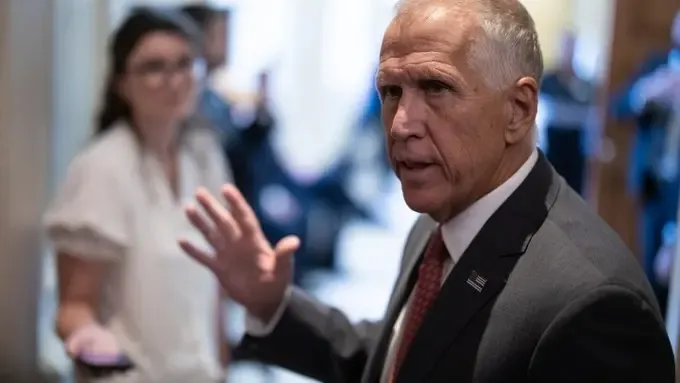
The disagreement played out simultaneously on two Sunday television programmes — NBC's Meet the Press and CBS' Face the Nation — underscoring how publicly the rift has broken. On NBC, anchor Kristen Welker asked Tillis directly whether Trump was violating the 2022 law banning Russian oil imports. 'I believe that he may be,' Tillis replied. 'I do believe there's a legitimate case for saying the president's not following the law,' the North Carolina Republican added.
Tillis further argued that an 86-vote Senate majority for the sanctions bill named after the late Senator Lindsey Graham reflected a near-universal legislative position. 'That's a universal position of the US Senate. And the president's actions and his comments over the last 24 hours are the exact opposite of the intent of that bill,' he said, adding that the diesel agreement was 'tarnishing Lindsey Graham's efforts to try and get the sanctions bill through.'
Seven Senators Call for Immediate Reversal
Later the same day, Tillis joined six other senators in a joint statement — led by Senate Foreign Relations Committee ranking member Jeanne Shaheen — declaring that Trump's decision 'runs directly counter to that law' and demanding that 'The Administration must immediately reverse course.' The signatories included Republicans Susan Collins, Lisa Murkowski, and John Curtis, and Democrats Richard Blumenthal and Ron Wyden, reflecting rare bipartisan pushback.
Barrasso: The Deal Is 'Leverage', Not a Violation
On CBS, host Margaret Brennan challenged Senate Republican Whip Barrasso — who had voted for the Graham law — asking whether Trump's move made 'a mockery' of the legislation. Barrasso rejected the framing. 'We passed that law to give the president the flexibility and the firepower to use another tool against Vladimir Putin,' he said. 'This is just another point of leverage for the president to use against Putin in an effort to get a long-term solution,' he added.
Meanwhile, Treasury Secretary Scott Bessent told Fox News that any lawmaker claiming the Graham law bars the diesel purchases is 'wrong', pointing to a statutory carve-out: Section 113 of the Lindsey O. Graham Sanctioning Russia and Iran Act of 2026, signed on 18 September 2026, counts only purchases of crude oil and natural gas — not refined products such as diesel — when determining which countries face tariffs. The law also allows the President to waive any duty by certifying to Congress that it is in the US national interest.
The October 18 Deadline and India's Exposure
The political and legal debate carries direct consequences beyond Washington. Under Section 113 of the Graham Act, the President must, within 30 days of the law's signing — by 18 October 2026 — impose duties of 'up to 100 percent' on goods from countries that ranked among the five largest importers of Russian crude oil or natural gas and continue purchasing. Neither senator named India on air, but New Delhi is widely understood to be among the largest buyers of Russian energy, placing it squarely within the law's scope. Whether the diesel carve-out and presidential waiver authority shields India from tariff exposure remains the central legal and diplomatic question ahead of the deadline.
What Happens Next
With the 18 October deadline days away, the White House must either impose the secondary tariffs, invoke the national-interest waiver, or argue — as Bessent does — that the diesel deal falls outside the law's definitions. The outcome will test both the legal architecture of the Graham Act and the durability of Trump's energy diplomacy with Russia, with significant downstream consequences for countries like India that have deepened Russian energy ties since 2022.
Point of View
And the White House's 'refined-products carve-out' defence is a legal argument, not a settled fact. Bessent's Fox News assertion that Congress is 'wrong' substitutes confidence for legal analysis — the courts or a bipartisan congressional challenge could test that claim quickly. For India, the ambiguity is strategically useful for now, but the October 18 deadline forces a resolution: a presidential waiver would set a precedent that Washington is willing to shield partners even when domestic law pushes the other way, which is a signal with its own geopolitical weight.
NationPress
12 Oct 2026
Frequently Asked Questions
What is the Russian diesel deal that is at the centre of this controversy?
President Trump agreed to a deal involving Russian diesel purchases, which critics argue violates a 2022 law banning Russian oil imports and contradicts the Lindsey O. Graham Sanctioning Russia and Iran Act of 2026. The White House and Treasury Secretary Scott Bessent maintain the law's tariff mechanism applies only to crude oil and natural gas, not refined products such as diesel.
What does the Lindsey O. Graham Sanctioning Russia and Iran Act of 2026 require?
Signed on 18 September 2026, the law requires the President to impose duties of up to 100% within 30 days on goods from countries that are among the five largest importers of Russian crude oil or natural gas and continue buying. The President may waive these duties by certifying to Congress that a waiver serves the US national interest.
Why does the October 18 deadline matter for India?
India is widely regarded as one of the largest buyers of Russian energy, placing it within the law's scope. The October 18 deadline is when Trump must decide whether to impose secondary tariffs, invoke a national-interest waiver, or rely on the argument that diesel imports fall outside the law's definitions — each option carrying different implications for Indian trade and energy policy.
Who are the senators who have called on Trump to reverse the diesel deal?
Seven senators signed a joint statement demanding an immediate reversal: Senate Foreign Relations Committee ranking member Jeanne Shaheen (Democrat), Republicans Susan Collins, Lisa Murkowski, John Curtis, and Thom Tillis, and Democrats Richard Blumenthal and Ron Wyden.
How is the Republican Party divided on this issue?
Senator Thom Tillis publicly stated Trump 'may be' breaking the law and signed a bipartisan reversal demand, while Senate Republican Whip John Barrasso defended the deal as 'leverage' against Putin. Treasury Secretary Scott Bessent also backed Trump, arguing Congress members who claim the law bars the diesel purchases are 'wrong'.