CM Dhami Chairs Uttarakhand Cabinet Meet on Key Sectors
Synopsis
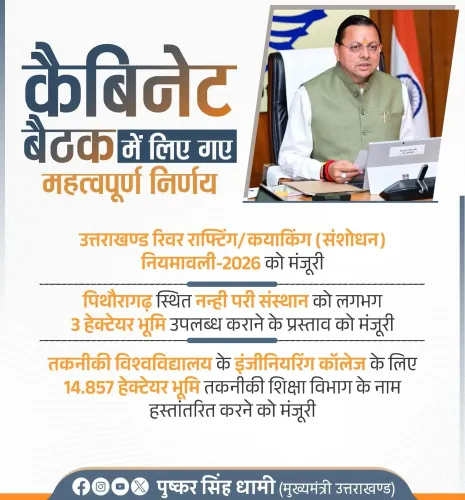
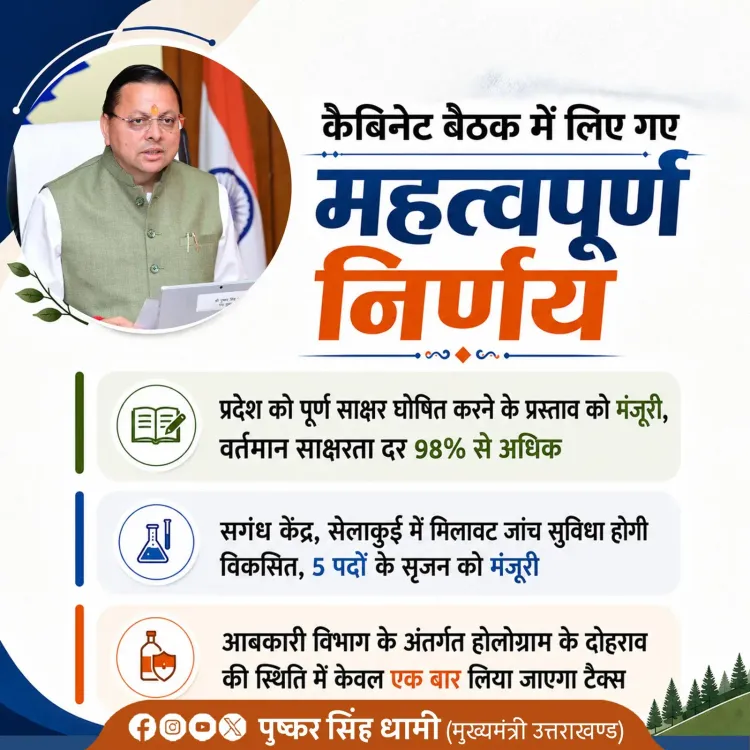
Uttarakhand Chief Minister Pushkar Singh Dhami chaired a multi-sector cabinet meeting at the state secretariat on 18 June 2026, taking key decisions on education, agriculture, tourism, employee welfare, animal husbandry, and good governance aimed at accelerating the state's holistic development.
Key Takeaways
The Uttarakhand Cabinet met at the state secretariat on 18 June 2026 under CM Pushkar Singh Dhami .
Decisions were taken across six sectors : education, agriculture, tourism, employee welfare, animal husbandry, and good governance.
CM Dhami said the decisions would 'give new momentum to the holistic development of the state.' The meeting aligns with the BJP government's pattern of using regular cabinet sessions to integrate central schemes with state priorities.
Teachers, farmers, tourism operators, government employees, and livestock owners are among the key stakeholders.
Detailed government orders and budget allocations are expected to follow in the coming days.
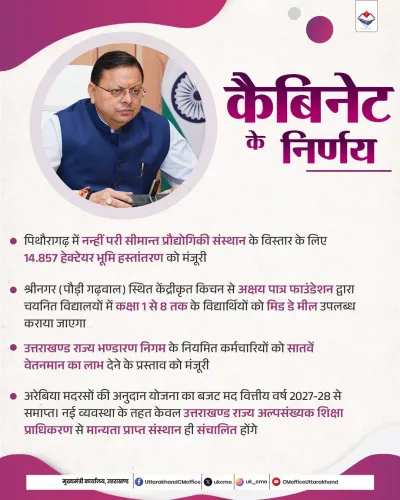
Uttarakhand Chief Minister Pushkar Singh Dhami on Thursday, 18 June 2026, chaired a cabinet meeting at the state secretariat where several significant decisions were taken spanning education, agriculture, tourism, employee welfare, animal husbandry, and good governance.
Context
Posting on X after the meeting, CM Dhami wrote — 'सचिवालय में हुई कैबिनेट बैठक में शिक्षा, कृषि, पर्यटन, कर्मचारी कल्याण, पशुपालन एवं सुशासन से जुड़े अनेक महत्वपूर्ण निर्णय लिए' — meaning: 'In the cabinet meeting held at the secretariat, several important decisions were taken related to education, agriculture, tourism, employee welfare, animal husbandry, and good governance.' He added that these decisions would 'give new momentum to the holistic development of the state while also strengthening public welfare and better service delivery.'
The meeting was held at the Uttarakhand Secretariat and brought together the state cabinet to deliberate on multi-sectoral policy priorities ahead of the monsoon season, which is critical for both agriculture and tourism in the hill state.
Policy Backdrop
Uttarakhand's BJP government has consistently used regular cabinet sessions to align central government schemes with state-specific development priorities. Since 2021, when CM Dhami assumed office, the cabinet has approved a series of measures aimed at administrative efficiency, economic diversification, and welfare outreach across the state's largely rural and mountainous geography.
On education, Uttarakhand has been implementing the National Education Policy (NEP) with state-level adaptations since 2020, restructuring both school and higher education frameworks. In agriculture, the government has championed organic farming and horticulture as alternatives to migration-dependent livelihoods. Tourism infrastructure upgrades and animal husbandry support have been recurring cabinet themes, given the state's economic reliance on pilgrimage circuits, adventure tourism, and livestock-based rural incomes.
Stakeholders and Impact
The decisions are expected to touch a wide cross-section of Uttarakhand's population. Teachers and students stand to benefit from any education-sector resolutions, while farmers and horticulturists in the hill districts await follow-through on agricultural support measures. Tourism operators and hospitality businesses — particularly those dependent on the summer and monsoon pilgrimage season — will watch for infrastructure and regulatory decisions.
Government employees are stakeholders in the employee welfare component, and livestock owners in rural and semi-urban areas will look for clarity on animal husbandry support. The good-governance pillar of the agenda signals continued focus on service-delivery reforms, a priority the Dhami administration has publicly emphasised since taking office.
What's Next
Detailed government orders and budget allocations stemming from the 18 June cabinet decisions are expected to be notified in the coming days. Observers will track whether the resolutions translate into revised scheme guidelines or fresh financial outlays in the state's monsoon budget cycle.
Implementation reviews — particularly in the education and animal husbandry departments — will be a key indicator of how swiftly the Uttarakhand government converts cabinet approvals into on-ground outcomes for the state's 1 crore-plus rural population.
Point of View
Agriculture, tourism, employee welfare, animal husbandry, and good governance — reflects the Dhami government's strategy of projecting administrative momentum across constituencies ahead of the monsoon session. For a hill state like Uttarakhand, where seasonal windows for agricultural and tourism activity are narrow, the timing of such approvals carries practical significance beyond optics. The emphasis on 'good governance' and 'service delivery' as explicit cabinet agenda items also tracks a wider BJP-ruled state pattern of institutionalising administrative reform as a political deliverable. How quickly government orders follow will determine whether this meeting registers as substantive policy action or routine cabinet activity.
NationPress
17 Sept 2026
Frequently Asked Questions
What decisions were taken in the Uttarakhand cabinet meeting on 18 June 2026?
The cabinet meeting chaired by CM Pushkar Singh Dhami at the state secretariat on 18 June 2026 took decisions related to education, agriculture, tourism, employee welfare, animal husbandry, and good governance. Specific details of individual decisions are expected to be notified through formal government orders.
Who chairs the Uttarakhand cabinet meetings?
Uttarakhand Chief Minister Pushkar Singh Dhami , who has been in office since 2021 , chairs the state cabinet meetings held at the secretariat in Dehradun .
How does the Uttarakhand government implement cabinet decisions?
After a cabinet meeting, the relevant state departments issue formal government orders detailing scheme guidelines, financial outlays, and implementation timelines, which are then published in the official gazette.
What is the significance of animal husbandry decisions in Uttarakhand?
Animal husbandry is a key livelihood source for rural households in Uttarakhand 's hill districts. Cabinet decisions in this sector typically address veterinary services, breed improvement, and support for dairy farmers who depend on livestock income.
What is Uttarakhand's policy on education reform?
Uttarakhand has been implementing the National Education Policy (NEP) with state-specific adaptations since 2020 , covering restructuring of school curricula and higher education frameworks to align with national standards.