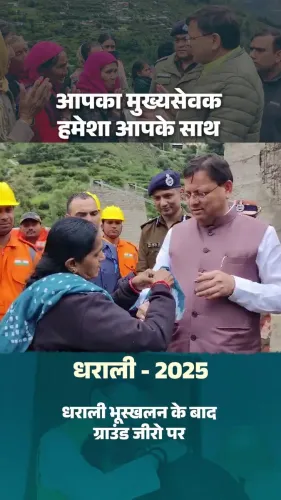
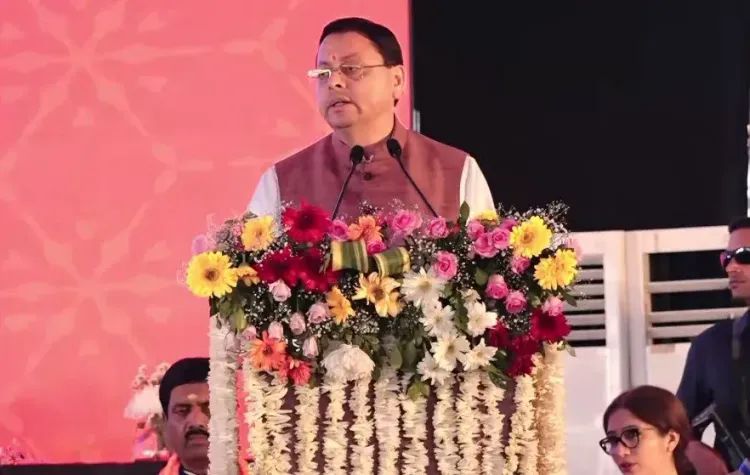
CM Dhami likens Amit Shah to Sardar Patel on key reforms
Synopsis
Uttarakhand CM Pushkar Singh Dhami invoked Sardar Vallabhbhai Patel's legacy to honour Union Home Minister Amit Shah on 6 November 2026, citing Article 370 abrogation, the Citizenship Amendment Act, and three new criminal codes as defining achievements.
Key Takeaways
CM Pushkar Singh Dhami publicly likened Union Home Minister Amit Shah to Sardar Vallabhbhai Patel , citing shared dedication to national unity and integrity.
Article 370 , granting special status to Jammu and Kashmir , was abrogated in August 2019 under Shah's stewardship as Home Minister.
The Citizenship Amendment Act (2019) opened a fast-track citizenship route for persecuted non-Muslim minorities from Pakistan, Bangladesh, and Afghanistan ; rules were notified in 2024 .
Three new criminal codes — Bharatiya Nyaya Sanhita , Bharatiya Nagarik Suraksha Sanhita , and Bharatiya Sakshya Adhiniyam — replaced colonial-era statutes from July 2024 .
The Patel comparison reflects the BJP's long-standing effort to claim the 'Iron Man's' nation-building legacy, symbolised also by the Statue of Unity inaugurated in 2018 .
All three reforms face ongoing legal scrutiny in Indian courts, underscoring their continuing political and constitutional significance.
Three landmark laws, one abrogated constitutional provision, and a citizenship overhaul — Uttarakhand Chief Minister Pushkar Singh Dhami invoked the legacy of Sardar Vallabhbhai Patel on 6 November 2026 to frame Union Home Minister Amit Shah as the architect of a new era of national integration.
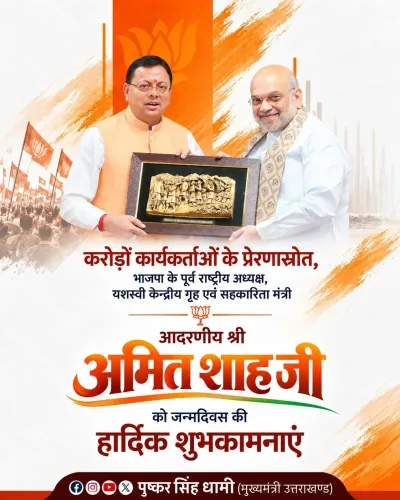
Dhami's statement, shared by the Chief Minister's Office of Uttarakhand, draws a pointed parallel: just as Patel unified hundreds of princely states into the Indian Union after 1947, Shah has — in the government's framing — dismantled asymmetric constitutional arrangements and replaced colonial-era legal infrastructure. The CM's exact words: 'Aadarneey Shri Amit Shah ji ka vyaktitva Loh Purush Sardar Vallabhbhai Patel ji ke samaan hi raashtra ki ekta aur akhandta ke prati samarpit raha hai' ('The personality of respected Amit Shah ji has been dedicated to national unity and integrity in the same way as the Iron Man Sardar Vallabhbhai Patel ji').
Three pillars Dhami places at Shah's door
The CM singles out three specific actions. First, the abrogation of Article 370 in August 2019, which stripped Jammu and Kashmir of its special constitutional status via a presidential order backed by a parliamentary resolution — ending a seven-decade asymmetry that had been a persistent fault-line in federal politics. Second, the Citizenship Amendment Act (CAA) of 2019, which opened a fast-track path to Indian citizenship for non-Muslim religious minorities — Hindus, Sikhs, Buddhists, Jains, Parsis, and Christians — who fled persecution in Pakistan, Bangladesh, and Afghanistan. The Act's implementation rules were finally notified in 2024, activating the pathway years after parliamentary passage.
Third, the trio of new criminal codes — the Bharatiya Nyaya Sanhita, the Bharatiya Nagarik Suraksha Sanhita, and the Bharatiya Sakshya Adhiniyam — passed in December 2023 and rolled out nationwide from July 2024, replacing the Indian Penal Code, the Code of Criminal Procedure, and the Indian Evidence Act respectively. Those statutes dated to the British colonial period; their replacement marks the most sweeping overhaul of India's criminal justice architecture in over a century.
The Patel comparison and its political weight
Invoking Sardar Patel is deliberate political shorthand. Patel's reputation rests on the swift, sometimes forceful integration of 562 princely states between 1947 and 1950 — a feat of statecraft that defined the territorial shape of modern India. The BJP has long claimed Patel's legacy as its own, most visibly through the Statue of Unity in Gujarat, the world's tallest statue, inaugurated in 2018. Placing Shah in that lineage is an assertion that legislative centralisation — ending Kashmir's special status, standardising citizenship criteria, unifying criminal procedure — is the contemporary equivalent of Patel's post-Partition nation-building.
These reforms have simultaneously attracted strong opposition: critics of Article 370's abrogation argued it violated the terms of Jammu and Kashmir's accession; the CAA faced nationwide protests over its religion-based eligibility criteria; and the new criminal codes have been challenged in multiple state high courts over provisions related to police custody timelines and bail conditions. That contested political terrain is precisely why such a tribute carries signal value within the BJP's governing coalition.
For Uttarakhand — a BJP-governed Himalayan state sharing a sensitive border with both China and Nepal — alignment with the Centre on national-integration messaging carries both symbolic and administrative weight. Dhami's public positioning of Shah as Patel's heir is as much a statement of federal loyalty as it is a tribute.
Point of View
Without a confirmed specific occasion, suggests the statement is part of a sustained BJP communication strategy to reinforce its national-integration narrative ahead of any electoral or policy cycle. The Uttarakhand government's amplification of this framing also signals New Delhi-Dehradun alignment on contentious federal issues, which carries practical significance for a border state dependent on central security and development funding. Whether courts ultimately uphold or restrain these reforms will determine whether the Patel parallel endures or becomes a liability.
NationPress
6 Nov 2026
Frequently Asked Questions
Why did Uttarakhand CM Dhami compare Amit Shah to Sardar Patel?
CM Dhami compared Amit Shah to Sardar Patel because, in his view, both leaders dedicated themselves to national unity — Patel by integrating princely states after 1947, and Shah by abrogating Article 370, enacting the CAA, and replacing colonial criminal laws.
What is Article 370 and when was it abrogated?
Article 370 was a constitutional provision granting special autonomous status to Jammu and Kashmir. It was abrogated in August 2019 through a presidential order and a parliamentary resolution steered by Home Minister Amit Shah.
What does the Citizenship Amendment Act do?
The Citizenship Amendment Act of 2019 provides a fast-track path to Indian citizenship for non-Muslim religious minorities — including Hindus, Sikhs, Buddhists, Jains, Parsis, and Christians — who fled religious persecution in Pakistan, Bangladesh, and Afghanistan. Its implementation rules were notified in 2024.
What are the three new criminal laws that replaced the IPC?
The three new criminal codes are the Bharatiya Nyaya Sanhita (replacing the IPC), the Bharatiya Nagarik Suraksha Sanhita (replacing the CrPC), and the Bharatiya Sakshya Adhiniyam (replacing the Indian Evidence Act). They were passed in December 2023 and came into force from July 2024.
Who is Pushkar Singh Dhami?
Pushkar Singh Dhami is the Chief Minister of Uttarakhand, representing the BJP government in the state since 2021. He is known for his close alignment with the central BJP leadership on issues of national integration and security.