CM Dhami to set up India's first Agniveer Cell in Uttarakhand
Synopsis
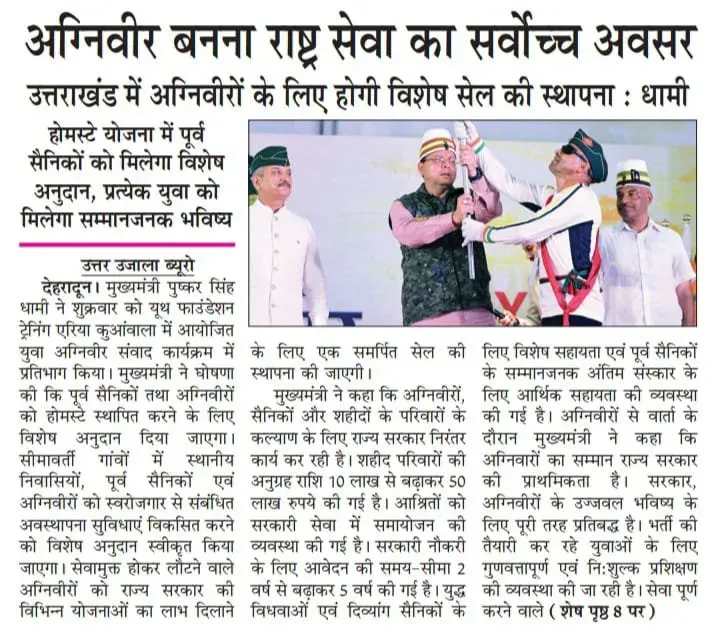
Chief Minister Pushkar Singh Dhami has announced that Uttarakhand will establish India's first dedicated Agniveer Cell, creating an institutional support mechanism for youth serving under the Central government's four-year Agnipath military recruitment scheme.
Key Takeaways
Uttarakhand will set up the country's first dedicated Agniveer Cell , as announced by CM Pushkar Singh Dhami on 18 July 2026 .
The cell is aimed at supporting Agniveers — recruits under the Agnipath scheme launched by the Government of India in June 2022 — who complete their four-year service tenure.
Uttarakhand has one of India's highest per-capita military recruitment rates, making Agniveer welfare a critical policy issue for the state.
The announcement follows a broader pattern of states introducing welfare and reservation measures for Agniveers since 2022 , but a dedicated cell would mark a more institutional approach.
Specific mandate, budget, and launch timeline for the cell have not yet been disclosed.
The initiative could serve as a model for other states with high defence recruitment to replicate similar support structures.
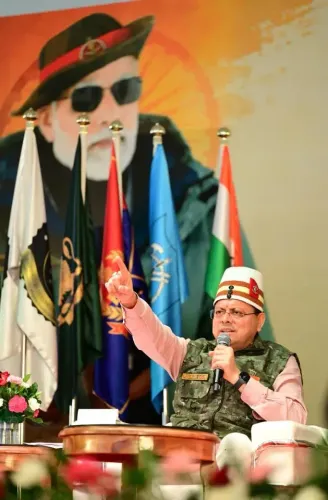
The Chief Minister's Office of Uttarakhand announced on Saturday, 18 July 2026 that Chief Minister Pushkar Singh Dhami will establish the country's first dedicated 'Agniveer Cell' in the state, marking a significant step in supporting youth who serve under the Central government's short-service military recruitment programme.
The post, shared by the official CMO Uttarakhand account on X, stated: 'Uttarakhand mein banega desh ka pehla Agniveer Seel' — ('India's first Agniveer Cell will be established in Uttarakhand'). The announcement positions Uttarakhand as the first state in the country to create a formal institutional mechanism specifically dedicated to Agniveers.
Context
The Agnipath scheme was launched by the Government of India in June 2022 to restructure recruitment into the Army, Navy, and Air Force. Under the scheme, recruits — called Agniveers — serve for a period of four years, after which approximately 25 per cent are retained for regular service while the rest are released into civilian life.
The scheme triggered widespread protests at the time of its launch, with concerns raised about long-term career prospects for the majority of Agniveers who would not be absorbed into permanent service. States with historically high military enlistment were among the most vocal in raising these concerns.
Policy Backdrop
Uttarakhand is one of India's states with the highest per-capita military recruitment, with a large population of serving personnel and veterans concentrated across districts including Pauri Garhwal, Almora, Pithoragarh, and Chamoli. The state has a deep cultural and economic connection to the armed forces, making Agniveer welfare a politically and socially significant issue.
Between 2022 and 2024, several Indian states announced job reservations and welfare packages for Agniveers in state government services. CM Dhami, who has been in office since 2021, has consistently positioned ex-servicemen welfare and youth employment as priorities of his administration. The proposed Agniveer Cell would represent a more structural, institutional approach — going beyond reservation notifications to create a dedicated support mechanism.
Stakeholders and Impact
The primary beneficiaries of the proposed cell would be Uttarakhand's Agniveers — young men and women from the state who enlist under the scheme and eventually transition back to civilian life. A dedicated cell could potentially assist with skill certification, employment linkages, and coordination with central and state welfare programmes.
Families of serving Agniveers and the broader community of ex-servicemen in the state are also key stakeholders, as the cell's existence could signal a more organised state-level response to the post-service challenges that have been widely discussed since the scheme's launch. If the cell's mandate extends to coordination with the Ministry of Defence, it could also serve as a model for other high-recruitment states.
What's Next
The announcement does not specify the operational guidelines, budget allocation, or a formal launch timeline for the Agniveer Cell. The key details to watch will include the cell's precise mandate — whether it focuses on employment facilitation, grievance redressal, skills training, or a combination — and how it will coordinate with central defence and labour ministries.
If the structure proves effective, it could prompt other states with significant Agniveer populations to replicate similar institutional frameworks, setting a broader national precedent for state-level integration of short-service military personnel into civilian economies.
Point of View
The cell could shift the national conversation from protest-driven criticism of Agnipath to state-led integration solutions. The true test, however, lies in the institutional details that are yet to be announced.
NationPress
18 Jul 2026
Frequently Asked Questions
What is the Agniveer Cell announced by Uttarakhand?
The Agniveer Cell is a dedicated institutional mechanism announced by CM Pushkar Singh Dhami to support youth from Uttarakhand who serve as Agniveers under the Central government's Agnipath scheme. It is being described as the first such cell in the country.
What is the Agnipath scheme and who are Agniveers?
The Agnipath scheme was launched by the Government of India in June 2022 to recruit youth into the Army, Navy, and Air Force for a fixed term of four years . These recruits are called Agniveers . About 25 per cent are retained for regular service after the term; the rest return to civilian life.
Why is Uttarakhand setting up an Agniveer Cell?
Uttarakhand has one of India's highest per-capita military recruitment rates, with a large population of serving personnel and veterans. The cell is intended to provide structured support for Agniveers transitioning out of service, addressing concerns about post-service employment and welfare.
Is Uttarakhand the first state to support Agniveers?
Several states announced job reservations and welfare packages for Agniveers between 2022 and 2024. However, a dedicated Agniveer Cell as an institutional structure is being claimed as a first by Uttarakhand, going beyond individual policy notifications.
What are the details of the Uttarakhand Agniveer Cell — budget, launch date, mandate?
As of the announcement on 18 July 2026 , specific details including the cell's operational mandate, budget allocation, and formal launch timeline have not been publicly disclosed by the Chief Minister's Office.