CM Dhami: Uttarakhand now has 7 heliports, 118 helipads
Synopsis
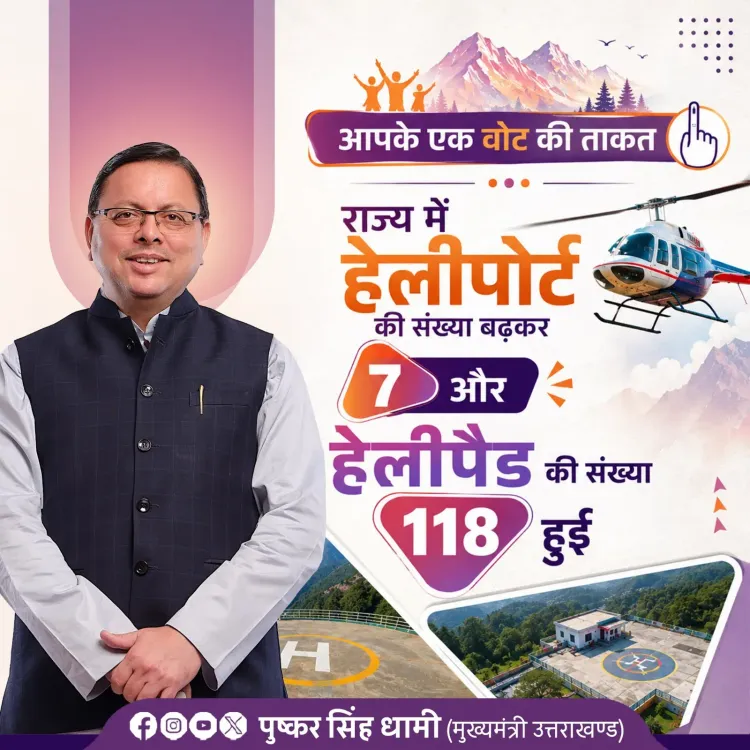
Uttarakhand CM Pushkar Singh Dhami announced the state's heliports have grown to 7 and helipads to 118, crediting sustained government efforts to strengthen air connectivity for tourism, daily mobility, and faster disaster relief operations across the Himalayan state.
Key Takeaways
Uttarakhand now has 7 heliports and 118 helipads , according to CM Pushkar Singh Dhami's announcement on 19 July 2026 .
The expansion is aimed at serving a dual purpose: boosting tourism and mobility , and improving disaster and emergency rescue operations.
Helipad construction in Uttarakhand accelerated significantly after the devastating 2013 Kedarnath floods , which exposed gaps in aerial rescue logistics.
The central government's UDAN scheme (launched 2016) has provided a national policy framework supporting helicopter connectivity in hilly states like Uttarakhand.
Key beneficiaries include pilgrims on the Char Dham circuit , remote hill communities, and state disaster relief agencies.
Operational integration of the expanded network with tourism and emergency response systems will be closely watched in the coming months.
Uttarakhand Chief Minister Pushkar Singh Dhami on Sunday, 19 July 2026, announced a significant expansion of the state's aerial infrastructure, stating that the number of heliports has risen to 7 and helipads to 118 — a development he attributed to sustained government efforts to strengthen air connectivity across the Himalayan state.
Context
Posting in Hindi on X, CM Dhami said: 'हमारी सरकार के सतत प्रयासों से उत्तराखंड में हवाई संपर्क व्यवस्था को अभूतपूर्व मजबूती मिली है' ['Our government's sustained efforts have given unprecedented strength to the air connectivity system in Uttarakhand']. He noted that the expansion serves a dual purpose — boosting tourism and mobility on one hand, and enabling faster, more effective disaster relief and emergency rescue operations on the other.
Uttarakhand is a mountainous state in northern India heavily dependent on pilgrimage circuits and adventure tourism, where road access to remote areas can be cut off for extended periods, particularly during the monsoon season.
Policy Backdrop
The push for aerial infrastructure in Uttarakhand gained urgent momentum after the catastrophic 2013 Kedarnath floods, which exposed critical gaps in rescue logistics and accelerated helipad construction across the state's high-altitude zones. Since then, helipad networks have become a core component of both the state's disaster management framework and its Char Dham pilgrimage logistics.
At the national level, the central government's UDAN (Ude Desh ka Aam Naagrik) scheme, launched in 2016, has supported regional air connectivity including helicopter routes in hilly and remote states, providing a policy and funding framework that complements state-level investments like those announced by CM Dhami.
Uttarakhand's heliport expansion reflects a broader national pattern of building dual-use civil-defence aviation assets in disaster-vulnerable Himalayan regions, a strategy also being pursued in neighbouring hill states.
Stakeholders and Impact
The primary beneficiaries of this infrastructure are tourists and pilgrims visiting destinations such as Kedarnath, Badrinath, Hemkund Sahib, and other high-altitude sites, for whom helicopter services reduce travel time and physical difficulty significantly. Helicopter services to the Char Dham circuit have seen rising demand in recent years.
Remote hill communities and state disaster relief agencies stand to gain from the improved emergency response capacity. In a state prone to cloudbursts, landslides, and flash floods, the ability to deploy rescue teams and supplies rapidly by air can be the difference between life and death in the critical hours after a disaster.
What's Next
Attention will now turn to the operational status and readiness of the expanded heliport and helipad network, particularly ahead of the peak pilgrimage and monsoon seasons when both demand and disaster risk are at their highest. Integration of this infrastructure with state tourism data and emergency response protocols will be a key measure of its real-world impact.
Any further budget allocations or project announcements for Uttarakhand's aviation sector are expected to be watched closely in the next state assembly session, as the government seeks to build on this expansion and position the state as a model for mountain aviation connectivity in India.
Point of View
The BJP-led state government reinforces its 'double engine' narrative of coordinated central-state action under schemes like UDAN. The dual-use framing — tourism and disaster relief — is also shrewd, broadening the political appeal beyond any single constituency. The announcement fits a wider pattern of mountain states leveraging aviation infrastructure as a visible, tangible marker of administrative competence in geographically challenging terrain.
NationPress
20 Jul 2026
Frequently Asked Questions
How many heliports and helipads does Uttarakhand have in 2026?
According to CM Pushkar Singh Dhami's announcement on 19 July 2026, Uttarakhand has 7 heliports and 118 helipads, reflecting a significant expansion of the state's aerial infrastructure.
Why is helipad infrastructure important for Uttarakhand?
Uttarakhand is a mountainous state prone to landslides, cloudbursts, and flash floods. Helipads enable rapid disaster rescue operations and also support the large number of pilgrims and tourists visiting high-altitude destinations like Kedarnath and Badrinath where road access can be cut off.
What is the UDAN scheme and how does it relate to Uttarakhand's heliports?
UDAN (Ude Desh ka Aam Naagrik) is a central government scheme launched in 2016 to improve regional air connectivity, including helicopter routes in hilly and remote areas. It provides a national policy and funding framework that supports state-level heliport development in states like Uttarakhand.
When did Uttarakhand start expanding its helipad network?
Helipad construction gained significant momentum after the catastrophic 2013 Kedarnath floods, which exposed critical gaps in aerial rescue capacity. Since then, expanding the helipad network has been a priority for both disaster management and Char Dham pilgrimage logistics.
Who benefits from Uttarakhand's expanded heliport and helipad network?
The primary beneficiaries are tourists and pilgrims visiting the Char Dham circuit and other high-altitude destinations, remote hill communities with limited road access, and state disaster relief agencies that rely on aerial deployment during emergencies.